The power of positive being

Screen Shot 2015-02-07 at 3.00.48 PM

I happen to believe that positive psychology can be a force for good – good for one’s self, and like the rings in a pond that ripple out, good for others. Whether it’s writing down at the end of each day three positive things that happened – many call this keeping a Gratitude Journal – or painting a picture in your mind of yourself at your best, which then generates actions on your part to make that picture real, positivity is a powerful force.

By positivity I don’t mean wishy-washy positive thinking, affirmations and telling yourself everything will be O.K. when you don’t really think it will. I mean focusing more on positive things that happen around you and to you as well as using more of your positive emotions: kindness, forgiveness, patience, curiosity, wonder.

As social scientist Dr. Barbara Fredrickson’s research reveals, the more positives we associate with in our lives the more robust we are: more creative, more open to possibilities, flexible, emotionally strong, physically healthy and socially connected. As Dr. Boyatzis’s, organizational psychologist at Case Western Reserve University, research reveals the more positively-focused we are, the more we stimulate neurons in the brain that open us up cognitively, perceptually and emotionally. In other words, it pays to be hopeful, to dream and to look on the bright side.

Yesterday my friend Miriam Tucker was in New York and we had an interesting discussion over lunch about this topic. She had recently written about it. You might like to read her article

While we tend to shy away from being hopeful and positive for fear it will brand us Pollyanna-ish or we’ll end up with egg on our face if we fail, why not conduct an experiment? 

It was found that people who kept a Gratitude Journal for 2 months reported feeling happier, with fewer physical problems and increased their physical activity. They also benefited from sleeping longer and feeling more refreshed. 

I keep a gratitude tally in my head most days, noting at some point three positive things that have happened. While I can’t tell you what it may set off in my brain, I can tell you it rewards me in the moment with a warm glow.

Above a page from my book, “The ABC’s Of Loving Yourself With Diabetes.”

An alternative way of eating for health, The Primal Blueprint


NewImage

This is my full interview with Mark Sisson, health and fitness expert and author of the newly updated book, The Primal Blueprint.

Q: Tell me what the “Primal Blueprint” is in a nutshell?

Mark Sisson: For over 200,000 years, homo sapiens were hunter-gatherers living in “the wild,” eating plants and animals. For the last 9,900 years, our ancestors lived on unprocessed, whole foods, with few modern comforts. It’s only in the last 100 years that we’ve started eating industrialized, processed food and living sedentary lives. So, we’ve got 200,000 years of eating animals and plants versus 10,000 years eating grains versus 100 years eating mutated grains, refined sugar and vegetable oils. 

The Primal Blueprint is a lifestyle whose tenets are informed by biological evolution, traditional wisdom, and modern science to form a healthy, sustainable, enjoyable way of being. It’s a way to eat, move, sleep, and simply exist with our ancient genes in this modern world – taking advantage of modern science and drawing upon lessons of our evolutionary background.

Q: You talk in your book about one being a “sugar-burning” or a “fat-burning” person. What does that mean?

Sisson: A sugar-burner requires a steady drip of dietary sugar – fructose and glucose – to maintain energy levels. So they can’t go long without eating. They burn basically carbohydrate and have difficulty accessing their stored body fat to use for energy, and in terms of weight loss, burn their fat. A fat-burner uses both their body fat and dietary glucose for energy and end up burning fat which leads to weight loss. Also, if a fat-burner skips a meal, it’s okay because he can run for days on his own fat (adipose) tissue.

Q: Even though our earliest ancestors may have eaten as you suggest in the Primal Blueprint, our more recent ancestors have been eating grains and beans for thousands of years. Have we not adapted to this way of eating? Asians were always thin eating their diet of rice and noodles, how do you explain that?

Sisson: Rice is the least offensive grain. It’s basically pure starch as opposed to something like wheat. It has no problematic lectins or plant proteins that interfere with digestion or disrupt satiety signals to the brain. In Asian countries they used to eat only foods like rice, meat, vegetables, all cooked in animal fat, and every day life was active. Now diabetes, heart disease, and obesity are on the rise because, like us, they’re eating more wheat, sugar, and vegetable oils and moving less. And no, our bodies haven’t evolved to catch up to our diet today.

Q: Most medical professionals regard burning ketones as a bad thing. The Atkins diet was criticized for that in the 1970’s. Yet the Primal diet depends on it. How do you answer them?

Sisson: They mistakenly equate ketosis with ketoacidosis. The former is a viable physiological way of burning fat for energy. It burns cleaner than glucose and spares necessary glucose for the brain to use. The latter is a pathological condition that occurs when insulin isn’t around to keep ketone production in check. Ketosis is a perfectly healthy physiological state to dip into from time to time. Burning ketones, which isn’t the same as being in ketosis, let alone ketoacidosis, is always occurring in a healthy fat-burner.

Q: I have type 1 diabetes. Making ketones has always been regarded as dangerous for people with type 1 diabetes. Is this diet viable for people with type 1 diabetes?

Sisson: Making ketones, which leads to ketoacidosis, only occurs when there is insufficient insulin present to regulate ketone production. Making ketones is different than burning ketones. As long as a person with type 1 diabetes is aware of this and manages this, there shouldn’t be a problem. I get a fair amount of feedback from people with type 1 diabetes who have had successimplementing the Primal Blueprint.  And it can help with managing the disease. I would tell any patient to let their doctor know before undertaking any massive lifestyle change.

Q: Why do you believe eating Primal is the way we were meant to eat?

Sisson: I tried eating “the right way” for over thirty years and it nearly killed me. I was the paragon of fitness, a competitive marathoner and triathlete who ate whole grains and beans and watched my red meat intake. It didn’t work. Since I have always been a student of human evolution, I got my degree in biology, I started thinking about health in terms of nutrition and fitness. I did a lot of research and self-experimentation and trained tons of people, enough to realize that the Primal way of eating works. And I’ve found it works for just about everyone who gives it an honest try.

Q: What are people most satisfied with about the Primal diet/lifestyle?

Sisson: That it’s not a struggle, that its seems to come naturally once you get it. People like a lifestyle that emphasizes delicious, fresh, wholesome food, simple and effective exercise, lots of leisure and relaxation, good sleep and quality time with loved ones.

Q: Is there any scientific research to support this diet? 

Sisson: Careful parsing of the nutritional literature is actually the basis of many of our recommendations, but there have been several paleolithic diet controlled studies. In one notable study by Lindberg out of Sweden, diabetic heart disease patients were put on one of two diets: Paleo (very similar to Primal) or Mediterranean. Paleo allowed no dairy, no grains, and had more meat, eggs, vegetables, and fruit than the Mediterranean diet, which was high in whole grains, legumes, vegetables, fish, margarine and low-fat dairy. Both groups improved, but the paleo group showed significantly greater improvements.

Q: What other eating approaches do you respect? And why?

Sisson: I like well-designed vegetarian diets. My wife was a vegetarian for years, still is, for the most part, except for seafood, and she’s one of the healthiest people I know. As long as you’re not eating loads of pasta, but eating actual vegetables and plenty of eggs and quality dairy, I think you can be very healthy as a vegetarian. I have dozens of longtime readers who are vegetarian yet make this lifestyle work for them. 

Q: Conventional wisdom says soy, beans, whole grains and complex carbohydrates like sweet potatoes have a protective or positive influence, yet they’re not part of a Primal diet

Sisson: There’s nothing magical about beans or grains. They have no dietary monopoly when it comes to vitamins or minerals. Leafy greens, cruciferous vegetables, berries, and all the other produce we can eat provide plenty of micronutrients. Plus, many of those minerals in beans and grains aren’t absorbed. Phytic acid, found in most beans and grains, binds to minerals and prevents their absorption. Habitual grain eaters like birds and rats produce phytase, the enzyme necessary to break down phytic acid – but we don’t. So while those foods look impressive on paper, we’re not absorbing most of their nutrients. Traditional cultures that consumed grains and beans did so only after extensive soaking and fermentation, which improves the digestibility and deactivated most of the phytic acid. It also takes a lot of work and I’m just not willing to put forth that much effort.

Complex carbohydrates like sweet potatoes are not allowed on some paleo plans but they’re allowed on the Primal plan. Roots, tubers, and other starchy, underground plant organs can be an important part of your diet, especially if you’re highly active and need the glucose.

Q: How do you answer your critics like Dean Ornish who has scientifically proven that eating whole grains, and severely restricting the consumption of animal products and dietary fat reverses heart disease?

Sisson: Dean Ornish has “scientifically proven” that avoiding processed junk food plus daily meditation, stress-reduction therapy, regular exercise, and a cessation of smoking tobacco results in a slight, not a major, regression of narrowing in the coronary artery. The Ornish plan isn’t just the diet. It’s an entire lifestyle change. Stress, lack of exercise, and smoking are all causally related to heart disease, so you can’t focus on just the food.

I would agree with Dr. Ornish that removing processed carbohydrates, vegetable oils, and sugar is healthy. My program does all that too. I just disagree that removing animal products and healthy fat is a necessary component, and he has never proven that to be the case.

Q: Do you believe people with type 2 diabetes would be better served by this diet considering that they are three times more likely to have a cardiovascular event, and this diet emphasizes eating saturated fat?

Sisson: Absolutely. The last reviews of the medical literature have found that replacing carbohydrates with saturated fat does not increase the incidence of cardiovascular disease. Plus, this diet doesn’t emphasize saturated fat, it de-emphasizes toxic foods like gluten-grains and processed vegetable oils that are high in omega-6 and sugar. 

Q: I have followed the Primal diet now for almost six weeks and find it takes extra time shopping to keep fresh produce in the house, and to prepare meals. Also, since I’m not a skilled cook, I find myself cooking the same things day after day. How successful have people been staying on the ‘Blueprint?’ 

Sisson: It’s highly sustainable. A massive online community has sprung up around Paleo/Primal eating. In addition to my own cookbook, paleo cookbooks are being released every couple of months, and there are several dozen high quality Primal recipe blogs. 

We post new recipes every Saturday and link to others every Sunday. To cut down on prep time, I would devote a Sunday afternoon to making a week’s meals. A big pot of stew, chili or curry, some parboiled vegetables, some sliced fruit, grilled meat that you can simply heat up or eat cold. If you plan and prep ahead, making your own food gets a whole lot easier.

As for produce, frozen vegetables are actually a more economical, longer-lasting, and often more nutritious option than wilted “fresh” produce. 

Q: Do you know any cases where the Primal Blueprint hasn’t worked?

Sisson: I’ve seen people fail because they went too low-carb while trying to run 120 miles a week and train for a triathlon. Or because they went overboard with the “Primal treats” made out of almond flour, honey, and coconut oil, but I would say they were doing it wrong. I’ve never known anyone to fail when they removed processed, industrial junk food, started sleeping more and exercising better.

Book Review: The Primal Blueprint gives both an historical background on why we should be eating like our earliest ancestors during paleolithic times and why we’re now eating like our neolithic ancestors, and that our bodies haven’t adapted to many of these foods. Furthermore, many of the foods we eat today, especially grains, have been genetically and environmentally modified causing insulin resistance and inflammation, the root causes of many of today’s lifestyle diseases. The Blueprint in the book gives you 10 steps for reprogramming your genes to transform yourself from a sugar-burner to a fat-burner, lose weight, heal your body and boost your energy. Also, the Primal approach is not just a meal plan, and Sisson covers a life system including fasting, bursts of exercise and strength training, sleep and stress reduction. 

What I like most: The book is written very simply and is a quick, easy and fun read. Men will probably also enjoy the cartoon-like characters Sisson uses to make some of his points. If you choose to try the diet, there is much support and more information on Mark’s blog, Mark’s Daily Apple. Mark’s written hundreds of articles about going Primal and provides recipes to help on the journey. I must also confide I like that on the Primal plan red wine and dark chocolate, in moderation, are allowed.

Weaknesses: Mark’s enthusiasm will tell you this is a simple diet and lifestyle, but for the average American it probably isn’t. There is some repetition in the book and at times not as much specificity, or scientific evidence, as I would have liked. 

Take 2 and call me in the morning: With all lifestyle changes, talk to your health care provider before beginning this program. 

Personal note: I tried the diet for six weeks. I felt fine and lost 2.5 pounds, but I found myself constipated. I then put some complex carbohydrates back into my diet like oatmeal and beans. Now I follow a diet in-between the Primal Blueprint and low-carb with some complex carbs and dairy. I side with those who say too much carbohydrate, not too much fat, is the cause of most of today’s ills including diabetes.
Diabetes Alert Day: Might you have diabetes?

You have the opportunity to, in a few minutes and with a few answers, change your life. You’re invited to take the American Diabetes Association’s (ADA) “Diabetes Risk Test” – right now.

Each year the ADA sends out the call to help people become aware of whether they may have, or are at risk for, type 2 diabetes. One in three American adults are at risk for diabetes. One in four doesn’t know he has it.

You’d think you’d know if you had diabetes. But at least one-quarter to one-third, of the 26 million Americans with diabetes – get this – don’t! Do you want to take the chance of having diabetes and not knowing when early detection can save your life and the quality of your life?

Here are common risk factors for type 2 diabetes: a family history, being overweight, being sedentary, high blood pressure and high cholesterol,, belonging to a minority risk group like African American, Hispanic and Native American Indian, for women having delivered a big baby. This used to include being over 50 years of age but with the increasing incidence of type 2 diabetes in children, I don’t think age is as much a factor.

Here are common symptoms: Thirst, peeing all the time, fatigue, hunger, losing weight, blurry vision, frequent infections, slow healing, tingling or numbness in feet, waking in the middle of the night to go to the bathroom. But most people with diabetes have already had it several years before they’re diagnosed, so you may have it and not yet have or recognize the symptoms.

Here’s the way you find out if you have diabetes. Take the ADA’s risk test. Invite family members to take the test. If you or any of your loved ones are at risk, make an appointment with your doctor to get a test for diabetes. 

If you have it, the sooner you know, the greater your chance to avoid and  or delay diabetes complications. If you don’t have it, but suspect someone you know may, be a friend and pass along this information. 

I just heard on the morning news that diabetes is a tsunami. Sounds like they’ve elevated its “epidemic” status one degree higher. Don’t kid yourself: if you’ve got it, you want to know so you can do something about it.

The healing power of friends


DSCN0525

Spring has sprung. I’m looking at the tree outside my window full with pink and white flowers while I’m sitting at this computer writing my next book. It’s going to be a small handbook of the key things to do to stay healthy with diabetes and lots of suggestions how to do ’em. So as I’m writing I thought I’d like to share one step with you for taking care of your diabetes. 

Collect Good Friends, Even If You’re Not A Collector 

If you’re planning on starting a collection, skip rare stamps, miniature toys, and vintage handbags, and head straight for the collection that pays dividends whether the market is up or down – good friends. Good friends don’t take up much space in your home and they’ll be there to cheer you when you’ve lost your cheer. Good friends say nice things about you even when you don’t, and they provide a shoulder to cry on when it’s all too much. 

Diabetes may from time to time make you feel alone; I know. But collect good friends and I guarantee you’ll find diabetes easier to live with. Plus, studies show that having friends, and strong social networks, can improve your blood pressure, memory and decrease physical ailments, cognitive decline, depression and Alzheimer’s. And don’t forget the biggest benefit of all – you’ll hardly ever have to dust them! 

• Let your friends know that you value them and schedule a get-together

• If you’ve been shouldering a lot of pain and stress, see if a friend would be willing to listen or help. Most people want to help others. 

• Do something new that you think you’ll enjoy where you’ll also meet new people – take a class, volunteer at your church. You’re very likely to make a new friend or acquaintance there. 

• Having friends who have diabetes is especially gratifying. Consider volunteering at your local American Diabetes Association or Juvenile Diabetes Research Foundation office. 

I don’t know where I’d be without my friends, and I hope I never find out.

Bridging the gap between patient and provider

Screen Shot 2015-02-07 at 3.05.36 PM

I’m part of a new service being offered by QuantiaMD called “Ask the Patient.” I’ll be answering health care provider’s (HCP) questions about what it’s like to live with diabetes, and how they can help their patients achieve better control and make healthy behavior changes. Given the strong emphasis on cut and cure in medical training and bare mention of behavior change, here’s an opportunity for providers to understand how to turn on a patient’s desire, skills, hope, and enthusiasm to take care of their diabetes. 

Here’s my page which consists of a 3 minute introduction of myself, explanation of the service and a call for questions. After questions are submitted I’ll my answers will be presented in a follow-up video.  

The service is available only to HCPs so patients will not know what you are asking. All you have to do is sign up.Members can access QuantiaMD for free through any smartphone, tablet or computer.  

If you are a health care provider, or know of someone you think this would benefit please pass this along. Having patient-experts as resources to help HCPs better understand what we deal with is to me a fantastic idea, and a brilliant way to help both patients and health care providers achieve better outcomes. 

Ask the Patient

A new doctor-patient relationship feature coordinating an active conversation between health care providers, and selected patient experts, exclusively on QuantiaMD. Through Ask the Patient, QuantiaMD is bringing the patient’s perspective on engagement, chronic disease, medical errors and many more topics to their community of clinicians. QuantiaMD is a medical learning network where HCPs connect with and learn from knowledgeable patients eager to share their experiential wisdom. On QuantiaMD, physicians learn about clinical advances from expert faculty and connect professionally to better manage their practices, support their patients, and take care of themselves. 

A1C Champions is looking for you

images

Are you successfully managing your diabetes? Are you interested in helping others do the same? Then you may be interested in being a peer-mentor as part of the A1C Champions group

There are 70 of us A1C Champions who live across the country and go across the country – or stay mainly in our local area – giving various presentations to help our fellow patients take better care of themselves, and their diabetes. That’s me above giving an A1C program. I’ve been doing it for 5 years and I find it enormously fulfilling work. 

VPR Communications, the group that trains us to do this work, is actively looking for more Champions. Here are the criteria: 

1) You must use insulin

2) Have an A1C less than 7%

3) Be at least 21 years old

4) Have a strong desire to help others

If interested, you can see more about the program on the A1C Champions web site. If you’re ready, or have any questions, please contact Becky Lodes at becky@vprpop.com or call 855-A1CHAMP (855-212-4267).

The power of the A1C Champion programs is that patients hear how to better manage their diabetes from a patient. Often they will have heard similar information from their health care providers, but when they hear it from you – and they know you live it – they hear it in a completely different way. 

The programs also allow you to share your story, your experiences, what it’s been like for you to live with diabetes and what makes you successful. 

You often become just the missing piece that moves someone to do something for their health that they’ve been putting off for years. 

I’ve given more than 50 programs, sometimes to ten people, sometimes to 200, and somehow I never tire of it. 

A 40-year journey with type 1 diabetes

riva at 20

That’s me, of course. Probably in my early twenties, just a few years after getting diabetes at the age of 18. This month is my 40th year with diabetes. I can’t say if I ever thought I’d reach this point: I don’t think I ever really considered it. I did think, however, how in the world will I read the little lines on my syringe when I’m old? Luckily at 58, I still have my eyesight. And better yet, I don’t think I’m old, yet!

I wrote about my journey to here on the Huffington Post. Maybe another reflection when I hit 50 years!

OneTouch VerioIQ meters being replaced

Unknown

I just received notice that LifeScan is replacing its OneTouch VerioIQ Metersin the U.S. and Canada. To be honest, I’m not sure if the meter is yet available to the public in the States but you can find more information on their web site. 

It appears according to the press release I received, “the OneTouch® Verio™IQ Meter, under very specific circumstances, produces an error that causes the meter to turn itself off when a user attempts to access the “ResultLog” to view stored test results. If this occurs, when the product is turned back on, the meter enters the “set up” mode and requires the user to confirm the date and time settings before being able to test again.” 

This doesn’t affect the meter’s accuracy or your data and you can still use your meter if you have one. That said, LifeScan is providing free replacement meters without the problem.

To receive a replacement meter, call LifeScan’s Customer Service number: 1 888-567-3003. You will need your meter’s serial number and you will be asked to return your original meter.

A few weeks ago I tried out this meter. It’s unique advantage is it’s a pattern detector: it alerts you if your numbers are out of range three consecutive times around the same time of day. 

It’s very useful if you’re looking to get a better handle on your numbers and when you tend to be too low or too high so you can think about what you may be doing that’s causing those out-of-range numbers.

Now, if only the VerioIQ would also give me a daily alert along the lines of, “Congratulations, you’re doing a wonderful job!” when my numbers are in range!

My Valentine’s Day card


IMG_0268-2

So, the husband’s in Holland where it’s cold and dark and I’m sitting in Brooklyn this morning. (That photo’s from our Christmas trip to Israel). Hmmm…some Valentine’s Day you say? Well for me it is. It is the expression of the heart that just keeps growing fonder.

Yesterday I received my Valentine’s email:

“I did an experiment,” he wrote. “At 7:10 PM I checked my blood sugar (no he doesn’t have diabetes, but he has a meter for occasional curiosity checks) and it was a perfect 85. I made dinner, vegetables and a veggie burger.  I sauteed it all in a wok with olive oil. I also ate 8 nuts. I finished dinner around 7:35 PM. [Is he anal? Not really. But he’s a good researcher ;-)]

At 8:10 PM I took my blood sugar. It was 139. At 9:35 PM, two hours post-meal, I took my blood sugar again. It was 108.

I think in a normal person [he means without diabetes ;-)] blood sugar also fluctuates. Then it comes back to a set point. But even if you just eat vegetables and a plant-based veggie burger, no other carb, no rice or pasta, it shoots up. So if this pushes up blood sugar in a non-diabetic, then what you are doing as a person with type 1 diabetes, keeping your blood sugar so well managed, is near perfection!

And by the way, I HATED pricking my fingers!”

Yes, girls, to me that is love, and the perfect Valentine’s Day card. The guy who four years ago went out in the midnight sun while we were on vacation in Helsinki, Finland to buy me a meter, is after 10 years of marriage still willing to prick his fingers for me.

Timesulin’s new “Smart Cap” for insulin pens coming this summer

Unknown

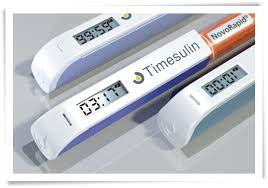
I mentioned meeting the Timesulin people when I was at the IDF World Congress in Dubai. I am truly happy with this little invention that I’ve been road-testing since. Now it’s left the production floor and is available in Europe. 

Yes, I know, everything seems to happen in Europe before here, but Timesulin are now talking with distributors and planning for the cap to be available in the U.S. this summer.

Just so you’re ready when it’s available, here’s a little preview. 

Ever wonder whether you took your injection? Now you’ll know. Place the cap on your insulin pen (there are caps that go with each insulin pen on the market) and it begins counting. Look at your pen cap minutes later, or hours later, and you’ll see when you took your injection. Once you take the cap off, after 8 seconds it resets to zero. The cap will last about a year before it needs replacing.

In using it, not only did I like the knowledge that I had taken my shot, but it kept me more regular in doing it every 24 hours since I can take my Lantus without thinking much did I take it at 8 AM yesterday or 9 AM?

I’m equally impressed by the Timesulin group. It’s family – a few brothers, one wife and a friend or two. All of them smart. All of them devoted and committed. And of course it all began because co-founder and CEO, John Sjolund, has had type 1 diabetes since the age of three and an over-active mind. 

As John says, “A person who doesn’t live with diabetes will wonder how it’s possible to forget when or whether you’ve given yourself an injection, but given the hectic lives we all lead, keeping track of the four-times-a-day ritual can be difficult for anyone living with a chronic condition. It’s like trying to remember if you turned the stove off.”

I couldn’t agree more. Simple? You bet. There’s no big booklet to read when you take it out of the box. No charger to plug in. Just take off your pen’s cap, pop this one on and you’re off and running. Effective? You bet. It keeps you regular without the Metamucil. 

Now if only they could do this for my vial and syringe ;-(