Diabetes. O.K, she’s done

Screen Shot 2015-02-08 at 12.45.28 PM

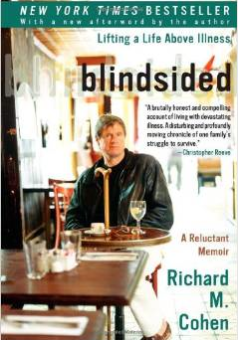
Have you read Blindsided by Richard Cohen? I’ve mentioned it before, and you really should. Already suffering with MS for 20+ years, Cohen got cancer, twice. Thus the title. There’s a presumption, I think most of us make, that if we already have something, like diabetes, that’s it, we’ve got “ours” and so cancer, parkinsons, MS, MD, Alzheimer’s should pass us over. But, life being life, by now we’ve learned there’s no such thing as fair, (although it seems I  have to be constantly reminded) and we are as vulnerable to getting anything as the next guy. 

Lately I feel like Mr. Cohen, blindsided. Not by anything major like cancer, but by lots of little ailments. Last year I had an ankle incident and had my foot in a boot cast for three months. It came out of nowhere. I stepped out of my friend’s car after a nice day in Connecticut visiting my parents and walking down the street I felt my ankle go out from under me. Bam, I spent the next three months in a cast.

A week ago, my wrist started hurting. Of course I ignored it the first few days, then when it didn’t subside I went to the doctor to hear a diagnosis of tendonitis. Why? Probably overuse at the computer. Ah, modern day ails. 

So now I’m in a wrist brace debating whether to go to the hand surgeon I got a referral for. And, I’m in intermittent pain, waiting to see if it subsides. My increasing hearing loss seems makes me nod my head even though I may not have heard you and my tinnitus, that began a few years ago, I wouldn’t wish on my worst enemy, not that I have any, of course. 

These aren’t big things, really, but in a life already defined by taking 3-6 shots a day, pricking my fingers 4-7 times a day, calculating everything I eat, eating when I don’t want to because I’m low, adhering to  a rigorous walking regimen, having several mild to energy-robbing lows each month, don’t I have enough to contend with? Didn’t someone write this down in the big Book of Life? 

Riva Greenberg: √ Diabetes. Done. 

Anybody listening?

2:10 A.M. to 2: 25 A.M., just another night with a low

I woke up last night at 2:10 AM and just felt off. My first thought of course was low blood sugar, even though my thoughts weren’t rising like scrambled eggs and my heart wasn’t beating out of my chest. I crept out of my bedroom into the kitchen, flicked the light and tested. Darn, a borderline 65 and it was only 2 A.M. I should have known when I was 123 before bed that I wouldn’t make it through the night. 

Typically, when I have some wine with dinner my blood sugar needs to be about 140 before I go to sleep since I’ll drop about 60 points overnight, and there I was 20 points shy. I wore a CGM once for 3 days to see if my blood glucose followed any trends. What was revealed to me was that indeed it did–I drop significantly overnight. When I asked my diabetes educator, “Why?” and, “What can we do about this?” the answer was “We don’t know why, it’s just how your body responds” and “Let’s move your Lantus from before bed to the morning. The drop may be less severe.” And it is. So now I follow a fairly doable system  knowing where my blood sugar needs to be before I go to sleep based on whether or not I’ve had two glasses of wine. I just have to be alert and make the effort even when it’s the last thing I’m in the mood to do at midnight.

Anyway, back to the kitchen. After discovering I was 65 I ate one glucose tablet, a few strawberries and a small bite of an Extend Bar. A few bites before bed help keep my blood sugar more level overnight. Then I tiptoed back into the bedroom. My husband who was now on the verge of wakefulness said, “Are you OK?” I said “Yes.” And I was, and I wasn’t. I don’t often have this thought but I did last night, How unfair and frustrating that this is how I have to live! How amazing that this is my life?! The thought that followed seconds later was a resigned acceptance, Well, if this is how I have to live then this is what I have to do. This is my life.

But there’s a second act to last night’s show. Now back in bed I lay there having a debate with myself whether my 1 glucose tablet, 2 strawberries and bite of Extend Bar was enough to get me through the next five hours. After a good ten minutes debate, because I really didn’t want to get up again, my sleepier side lost and I walked back into the darkened kitchen and retrieved and chomped down another glucose tablet. 

This morning I woke up at a stellar 86. Yet I’ve been mulling all morning about how hard I work at managing my diabetes and the only reward is maybe I’ll get less complications, maybe they’ll be postponed, maybe I will make it to 80 years old and won’t have more than my share of heartache. 

Of course now that the sun is making its way over to my living room window, my thoughts shift along with its brightness. Living side by side with my intermittent anguish is the hopeful expectation that within the next five to ten years there’ll be more advances in diabetes research, tools and procedures that will make managing diabetes almost effortless and ensure us much better control. 

How odd that all that we do to manage diabetes, particularly for type 1s, just becomes mundane in an egregious life, and that we exist in a constant ebb and flow from fear to faith and night to day. 

Back, back, back in the USA

IMG_2106 copy copy

It’s a slow re-entry here in San Francisco from Tokyo before heading home to New York. I would have liked to add a post while in Tokyo, but I was just too busy. Having lived in Tokyo for six years, from 1986-1992 and worked for Dentsu at the time, then the world’s largest advertising agency by billings, I was just having too good a time visiting friends and soaking up every lovely and kooky thing about Japan. 

Part of that soak included an overnight stay at an onsen (hot springs) in the countryside in a traditional Japanese inn with hot, relaxing baths both inside and under the stars. The kooky part included warm-seat high-tech-toilets in every major department store and restaurant with so many buttons for cleaning and air drying one’s self that I feared pressing any one of them– and often had to search voraciously just for the flush button.

Suffice to say my answer to Asia in general is: “Drink wine,” it will help lower your blood sugar after all the noodles and rice have raised it. And, as therapists advise, use your numbers as information, not an excuse to beat yourself up. My blood sugars throughout this trip have been far less “in the zone” than usual because my eating has veered from my routine low-carb diet and my exercise has been erratic. I tried for the most part to accept that and to see anew how different foods affect my blood sugar. Luckily, most of the time, I was successful in this attempt.

I did learn while in Japan that the rising epidemic of diabetes has not left them untouched, and why should it when McDonalds and Kentucky Fried Chicken are now staples. Also, one doesn’t speak of diabetes very openly. There are no TV commercials selling meters and strips and if you’re standing in the bookstore in the toonyobyo (diabetes) section you keep your voice down, because to have diabetes is seen as very unfortunate. The Japanese will admit to having “metabolic syndrome” much more easily than diabetes, for that is only a syndrome, while diabetes is an illness. And with many things Japanese, presentation is very important.

Yet, you can see my friends didn’t mind that I have diabetes, and in fact they used it as a great learning opportunity. They got to see up close what it really means to have and live with diabetes and how to take care of it. The constant shots and blood sugar testing were eye-opening, and of course gained much sympathy. And, my friends also went out of their way to provide the unofficial Japan launch of my book, The ABCs Of Loving Yourself With Diabetesat a Chinese restaurant. To my great surprise the book is posted on Amazon in Japan, as well as the U.S., as is also my new book arriving in book stores in July: The 50 Diabetes Myths That Can Ruin Your Life: And the 50 Diabetes Truths That Can Save It. 

In all, it’s been quite a ride. Home Saturday to nurse my coming depression ;(

Slices of diabetes-life in 4 short stories

Through my friend who lives here in Sydney I had two contacts to make while here. One was with the General Manager (GM) of Diabetes Australia, no slouch there, although he was working in his wife’s candle shop when we met and absent shoes. Well, we are in Sydney mate. Diabetes Australia is the equivalent of the American Diabetes Association. Turns out after a nice chat he suggested I send him my new book when published this July, The 50 Diabetes Myths That Can Ruin Your Life: And the 50 Diabetes Truths That Can Save It, and he’ll get it to his media person to possibly distribute in Oz (that’s  Aussie-speak for Australia.)

The other meeting was with two mums of children with type 1. One is the mother of a five year old boy who had to be yanked out of public school because the principal didn’t want to deal with his diabetes and supply a nurse. Now the family are paying private school fees and she told me the law is very grey here as to what services a child is entitled to in regards to a school nurse. Actually the GM of Diabetes Australia said he’d be happy to advocate for her as last year Diabetes Australia took a case to court and won getting a type 1 ambulance driver’s job back. 

The other woman I met is the mother of an eight year old girl diagnosed almost a year ago. Since, she has become very involved in JDRF (Juvenile Diabetes Research Foundation) here and inspired many others. It is interesting to sit a world away and share the same stories and feelings. And I knew beside sharing my knowledge and experience that just having these two women see someone who’s in as good shape as I am after living with type 1 37 years that they would gain something invaluable. The eight year old’s mum sent me this response after our breakfast by the beach:

Hi Riva, 
 
It was lovely to meet you and I take loads of comfort in meeting folk like you who play to win with diabetes. Sometimes I may sound too blasé about diabetes; it is a tough 24/7 disease but I refuse to let it take me and Emily (her daughter) down so I hang on to every positive role model that I can and I know that one day she too will be sitting with someone else over breakfast and be sharing her positive story on diabetes; so a huge thank you. 

Later that day I also met Emily’s dad who is an accountant by trade and has been working nose-to-the-grindstone on an algorithm whereby people who use a pump can better optimize how much to dose and how often to test their blood sugar. My husband came to this meeting as well and being a “systems” guy shared that when dealing with diabetes there are many complex systems to take into account in addition to meds, like food, exercise, stress and emotional resilience. 

Emily’s dad nodded his head, and perhaps gripped his graphs and charts a little tighter. I suspected that they were what was helping him feel he can have perfect control over something he can’t, diabetes, and feel he can protect his child. 

One day I’m pretty sure Emily will be the one to let her dad know that life is O.K and that she is O.K. even living with diabetes, and maybe even recognize that in some way she is “all the more” for what she goes through managing this disease.

Blood & Honey sheds new light on diabetes

I was impressed when I tripped over Jessica Bernstein in an article in DiabetesHealth magazine last month titled, “Blood & Honey: A Documentary.” 

Bernstein is a psychologist making a documentary film that deals with the psychological component of living with diabetes. As a type 1 diabetic herself, she says,  “I wanted to understand how living with the condition for so many years influenced people’s identity development.”

Like me, Bernstein has seen that diabetes researchers are focused almost exclusively on the negative aspects of diabetes. Few talk about how people can develop in positive ways as a result of dealing with diabetes. Bernstein began turning this realization and curiosity about how diabetes can have a positive, developmental affect into a film.

Her film, Blood & Honey is still partially in development and looking forextra funding. At present, the film features interviews with several people who live with chronic illness and explores what we can learn from them. There’s an African medicine man who shares that peple who live with chronic illness for many years in his culture are considered “elders,” the wise ones that communities draw upon in times of crisis. An interesting and far different slant than how seniors who live with diabetes here are regarded and hold it themselves. Here the primary sentiments attached seem to be:  blame, guilt and victimhood rather than wisdom and reverence.

Philosopher, Susan Wendell, who’s lived with chronic fatigue syndrome for 20 years also featured in the film believes people who spend years living with chronic illness learning how to deal with pain and suffering become valuable resources for others. “We don’t talk as much about the experience of illness as we talk about how to get over it, how to stop it, how to prevent it, how to relieve it, how you can be healthy if you really try,” says Wendell. “I think there’s an enormous body of knowledge among people who are suffering that is untapped and if we tapped into it we’d be less afraid and know better how to cope when something happens to us,” she finishes.

As producer Bernstein says,”Coming to see myself as someone with wisdom to share was a revelation.” When Bernstein tells someone she’s lived with diabetes for 36 years, as have I incidentally, they remark, “Oh, I’m so sorry.” Nobody she says has thought to pick her brain and learn what she’s learned about central issues of diabetes and life, like uncertainty, loss, change and mortality. 

Imagine just for a moment how it might change how you feel about yourself and living with diabetes if you regarded yourself as a wise one where every day your strength, courage, humility and dreams are tested, and you learn from such experiences. Would you see yourself differently, your capability and value?

Bernstein’s film has gotten off to an exciting start and is seeking funds. Learn more about the film by checking out her web site, and you can make a tax deductible donation through www.bloodandhoney.org.

A rare animal, the diabetes wannabee

I’d never heard the term before last year when I made a new friend named Joe. Joe’s a diabetes educator and therapist who works with families with diabetes. Joe was the first to acquaint me with the “diabetes wannabee” talking about a colleague of his whom he respects enormously who doesn’t have diabetes but is so totally supportive you’d think she did. I found it a strange notion–after all why would anyone want to have diabetes? Then surprisingly soon after, I began wondering if my husband was exhibiting “diabetes wannabee” tendencies.

A recent blood test he had taken revealed a fasting glucose of 102 and he was immediately alarmed. The doctor reassured him that 2 points above the cut off was nothing to be concerned about, but it did concern him and living with me he had the opportunity to measure his blood glucose whenever he wanted so I gave him his own meter and lancing device. 

He approached the task with what appeared to be unnatural gusto and glee deciding he would measure his glucose four times a day for three days. Like clockwork the first day at the appropriate hour he walked into the kitchen where we keep the meters, pulled out a test strip, inserted strip into meter, secured an appropriate finger and ample drop of blood and recorded his number. I would watch withholding a smile, yet after his third test I began to notice some uncomfortable feelings within myself: Was I jealous? Was he encroaching on my territory? Were we both now worthy of sympathy, not just me? I went so far as to wonder what would life be like if we both had diabetes? Midway through the second day, however, whatever novelty motivated his initial burst of enthusiasm wore off, the testing stopped, I got my fair share of, “I don’t know how you do it!” and my “diabetes wannabee” was a “diabetes don’twannabeeanymore.” Also, his numbers confirmed no diabetes.

I guess you could see having diabetes as membership in an exclusive club, like getting picked to play on a sports team without having had to wait embarrassedly while the team captain decided whether or not he’d pick you. Maybe that is the allure to the “diabetes wannabee,” but whatever it be now that my “diabetes wannabee” has run off the field I get to reclaim the star position on this turf and I’m truly happy for a host of reasons that I’m the only one on the field.

Remember when walking was something you did rather than measured?

The aerial route inside my park 

 NewImage

Most days I walk around, sometimes inside, my local park two blocks away which takes me just about an hour door to door. I’ve worn a pedometer enough times to know it’s about 7,200 steps. I also know approximately 2,000 steps make a mile, so this walk is slightly more than 3.5 miles. And if I cared to spend even more brain cells on it, this would tell me I walk about a sixteen-minute mile. 

Well, this summer my husband made a commitment to exercise and was out the door every day at 7 AM to do his walk/run and Chi Gong in the park. Of course, being a techno-guy, he was not content merely to strap on a pedometer, but strapped something on around his chest to measure his heart beat, something else on his sneaker to measure his footstep, something that surveyed his walk from the air (thus the photo) so he could come home and look at where he’d been on his computer–as if he didn’t know–and a watch that told him how far he’d gone both in miles and kilometers, at what speed and probably who he passed. Somewhere in his enthusiastic sharing, I stopped listening. Sorry, bad wife.

One day we walked together and wanting to share his toys he demonstrated how each worked, making them available to me out of his deep love and generosity. By time he showed me how I’d know from his watch (rather than my head) that my 3.5 mile/hour walk was about a 16 minute mile I said, “That’s nice, but who cares?” Bad, bad wife. 

I know everything I need to know having worn a pedometer a few times: like that I have 2,800 steps left to cover to fulfill the 10,000 steps a day recommendation for health and that the ordinary running around I do every day typically has me fulfill that target. I don’t need to see where I went when I get home, thank goodness my memory isn’t yet that faulty, and I don’t need to confirm that my heart was beating while I was walking, thank god for that. Or, how many beats my heart makes per footfall. If I can put one foot in front of the other at a good pace without falling over I figure I’m doing more than fine.

A soldier in the trenches, me

Got a lot a livin’ to do

NewImage 

As an A1c Champion, I am often asked to deliver educational/motivational programs to fellow people with diabetes.

Recently I gave a presentation in Buffalo, N.Y., where I was double-billed with a diabetes educator.  Her speech preceded mine, so I leaned back and listened. And what I heard was a solid forty-five minutes of A1cs, blood pressures, weight control, exercise, portion control, and carb-counting…in short, numbers, zones, and target ranges up the wazoo. Where is the humanity in this, I thought? Where is the patient in this? Where is the acknowledgement of the energy required to slog through each and every day? I saw my purpose–to talk about how we hold diabetes in our lives.

Taking the stage, I shared my own shock and fear upon diagnosis, my subsequent denial, and my early complications. The room quieted. I was, they saw, like them: a soldier in the trenches. I saw the landscape they saw; I tramp through the same dark forest; I look for cover when diabetes rains down upon me or drains me out.

“When you’re so busy testing every day,” I said, “reading labels, counting carbs, and calculating, do you stop to think why you’re doing all this work? Isn’t it to see the grandkids grow up, start that second career, create the best vegetable garden in town, contribute something to the world, or have another million days with your spouse?” Heads nodded and people leaned forward, turning from silent witnesses into curious, involved participants. Someone had understood and acknowledged this piece of living with diabetes where their heart resides, along with their anguish and struggle.

My predecessor, warm and personable though she was, didn’t have diabetes. That put her not just on the other side of the projector, but also on the other side of our experience, where unfortunately many healthcare providers sit. People are dying–literally–to hear their healthcare providers address the emotional issues of living with diabetes and while it’s not providers’ fault, if you don’t live with a chronic illness that greets you every morning unrelenting, on a fundamental level in the messy arena of some messy emotions, many physicians and even educators lack the training to empower us to deal with the psychosocial aspects. 

We, however, are in the business of chronic illness. We have life adjustments to make, and we have precious little help to make them. So here are my recommendations: Learn all you can. Appreciate what you hold dear. Pace your efforts and forgive your mistakes. Keep the vision of your ‘best life’ ever-present. And spend more time doing what you love. While we’re living with diabetes, let’s not short-change the “living” part.

Here is another thought: How about the idea that we are “more than,” rather than “less than”?  After all, we do this whole other job called “managing diabetes.” I think we should be living with our heads held high, showing others the invisible “superhero” cape we wear. Call me crazy, and I’m sure some of you will, but I see a gift in diabetes:  that of a longer, healthier life than I probably would have had without diabetes, if I manage it responsibly.

After the program, people crowded around to thank me, and they were smiling. How often do you imagine someone leaves a diabetes talk with a smile? That’s where I want this blog to take you–to a place where you connect to your heart and spirit, a place where you may see that diabetes can bring greater meaning and purpose into your life. And, yes, there’ll still be room for ranting on the tough days. 

Do you remember when it all began?

I was really caught short the other day. Spending most of my personal time around diabetics who know the score, I was faced with my neighbor’s mother who had just been put on insulin and was scared witless to give herself a shot. She asked if I would lead her through it so she didn’t make a mistake. She was using an insulin pen, which I do not use, so I had to read the instruction sheet right along with her. In doing so, I realized just how confusing and daunting this can be.

First there was the screwing in of the pen needle. Do you do that while it’s still in its protective plastic case or liberate it first? I still don’t know. Then there was the actual slipping off of the needle cover to expose the slinty steel thread. Then the priming: tap the exposed insulin cartrige a few times – how many is a few times and what exactly are we looking for? Carol was looking for something while I figured this was just about sending any air to the top of the cartridge. But how would she know that? And I saw she took pains to tap the cartridge in a particular way as if tapping otherwise wouldn’t be right. Then you’re instructed to dial a dose of two units to release any air in the cartridge. With this motion one should see a drop of insulin escape from the needle. Well, I did, but Carol didn’t because at that point she told me her vision’s not very good and she wasn’t wearing her reading glasses which would probably help. Oy, I thought, we’re dealing with units of insulin and your vision’s not very good? And being as nervous as you are about this, you’re not wearing glasses? Is this denial?

OK, air test performed and I ask Carol how many units her doctor said she needed to inject. She looked at me confused and said, “Doesn’t it say on the instruction sheet?” Yikes, power outtage of the mind, total disconnect, no apparent understanding that you dose for your needs based on food, exercise, blood sugar count. But I can’t blame Carol. She doesn’t know what she hasn’t been told, or what hasn’t been clearly communicated. Whereupon I see what a major breakdown we have in our medical system. You need to manage this disease, yet probably millions of people with diabetes are walking around with no information, misinformation and totally unprepared to take it on. Hmmm…doesn’t bode well for rising medical costs or the millions who’ll find themselves in hospital beds in years to come, as one diabetes educator expressed to me. So, we held off the injection till Monday when she could ask the doctor how much insulin she was to take.

Monday night I ran down to her apartment to guide her through her first injection. She answered the door in a T-shirt and no pants. I was about to say, “Do you want to put on some pants?” when I realized she was thigh-exposed for her first shot. How foolish of me not to infer this, but then I shoot through stockings, jeans, and usually just tuck up my shirt and go right through my abdomen. Anyway, within 5 minutes I had guided her through her first injection, her shaking hands steadied and she put that pen in that naked thigh like a trooper, hit the button, and because she told me she heard the click, extracted it quickly only for me to see that the dose button had only dialed down from her dose of 8 units to 6. So I instructed she put the needle in her thigh again, click the button fully, wait 5 seconds and then extract. She was loathe to do it, not because it meant sticking herself again, but she’d been clearly told not to use a needle twice. Wow, since I use my syringes a week or two before changing, I saw again the long journey from novice to old-hand. In again we went and out. This time the full dose dispensed. Mazeltov! Success, and she was smiling. Her high pitched shaky voice calmed to a quiet gleeful whisper and a new insulin-dependent diabetic was born.

Every day, every moment

Here’s the truth today, this moment, April 7th, 8:30 PM. As I’m eating dinner I’m thinking do I need to take a little more Humalog to cover the square of Lindt’s 85% chocolate I just gave in to or will my glass of wine balance me out?

Did the handful of cooked kidney beans I was noshing on before I had the time to get the fish in the broiler really, really raise me enough worth bothering to cover, after all I did walk six blocks to the library earlier in the day which was an impulsive, unexpected move on my part.  

Is there such a thing as an impulsive, unexpected move when you are insulin-dependent? What does six blocks buy me? .25 of a unit of Humalog? Need I factor that in if I don’t want to lose my kidney function? 

Every day, every moment, I have to think whether or not I need an insulin injection or so it feels; it’s not just injecting before meals as much as what have I just eaten and do I need to cover it? Am I going to walk down to the bank this afternoon? Damn, I don’t know where my blood sugar is right now, and at this moment I don’t want to have to care. I’m tired.

36 years tired, 24 hours tired, every 60 minutes tired. I sense there are many of you who know of what I speak. I will keep my chin up, but tonight, right now, I’m just too tired.