Your contribution & heading West

I said I would and I did. Today I wrote a check to the Diabetes Research Institute Foundation (DRI) for $500. DRI is the premiere Institute looking for a cure for diabetes, and half of my donation comes from the sale of my book, The ABCs Of Loving Yourself With Diabetes-– in other words, from you. Thank you. 

The other news is that I will be on a working vacation over the next five weeks, ’til January 18th. I will continue to post, although at this moment still have to figure out exactly how to do that from New Zealand and Japan! Just to say, posts may be a bit more irregular, you can’t always predict when a herd of sheep may be passing or a friendly native insists you join him at the pub or the local sento. 

Here’s to a very happy holiday and that we all swing into the new year in good health and good cheer. 

Knowledge is powerful medicine

Expected release, July 2009

 NewImage

It just amazes me. This very afternoon, not three hours and 46 minutes ago I turned in my manuscript for the book I’ve been writing this year–and it’s already posted on Amazon! Did you miss that? Already posted on Amazon–with a publication date of July, 2009. What can I say. Sometimes the world goes just a bit too fast for me.

I finished my book this afternoon writing a Postscript at the very end that I could only write after reading through the 300 pages I’ve scribed with a clear, objective and fresh editor’s eye. I’ll share part of it with you here:

“As I look back over writing this book: talking with top diabetes experts, conducting my research and having so many fellow patients share with me their personal story, I have learned two things. The first is that having correct information and practical knowledge is a prerequisite for living a healthy life with diabetes. The second is that you have to believe it’s worth the effort to take good care of yourself, and your diabetes, to have that life: one that’s not only healthy, but happy, productive, fluid and fulfilling. 

While it takes a bit of work, when you become the “expert” on your life, and your diabetes, you win the prize—the ability to live a more simple and ordinary life, just like anyone else.”

That is the prize, I have realized, to live a simple life and enjoy all its pleasures without always feeling like you’re carrying a monkey on your back. 

So, look for 50 Diabetes Myths That Can Ruin Your Life: And the 50 Diabetes Truths That Can Save It next summer. I do believe it will be a break away hit, maybe not a summer beach read, but surely one of the best books out there to separate fact from fiction and appeal to your curiosity. And besides, it’s chock full of stories from fellow patients, including me. 

Diabetes + My Response = My Life

Screen Shot 2015-02-08 at 1.55.06 PM

If you’ve rambled around this site a bit and read some of my posts you know my work aims to help you look for whatever good you can in having diabetes, since after all, you have it. And let the bad roll over you as best you can. And, to push the envelope so far that you create an exceptional life, not despite having diabetes, but because of it.

Granted, that’s easier said than done, and you have to be in the right place in your life and your head, and there will be days you’ll feel, “yea, I got it, whoo hoo, and days you’ll think, “I can’t bear another moment of this, another fxxckin’ high blood sugar, another low, another muffin calculation….! Well, you get the point. Still, I believe, looking for the good in life is a more worthwhile way to live.

So it struck me while reading Amy Tenderich’s blog, DiabetesMine, last week, that while Amy focuses as an experienced journalist on sharing what’s going on in diabetes research, technology and pharmaceuticals, and I know she has a whip-smart cynical sense of humor, that at the end of one of her posts she wrote, “Living well and being happy with diabetes is a delicate construct that is tested every day with fluctuating BGs, imposing tasks, and endless responsibility…  Better to appreciate the life I’m living than pine for the one I can’t have.” 

I can hardly put it better myself. Each one of us confronts the challenge of diabetes on a daily basis and how you respond to it, as how you respond to anything in life, is what creates the quality of your life. If you’re doing really well with this, or really poorly, I’d love to hear from you.

Holiday Gift: Free diabetes center in New York City

Screen Shot 2015-02-08 at 1.56.25 PMLeopard, tiger, you get the idea — one scary cat, waiting

The Friedman Diabetes Institute, part of Beth Israel Medical Center, opened last month in Manhattan. They’re located at 317 East 17th Street on the 8th Floor. All you need is a doctor’s referral to make an appointment and avail yourself of their free services. There are diabetes education classes and consults, as well as a nutritionist, exercise physiologist and diabetes nurse educator at your service. Did I say free?

December’s calendar shows weekly exercise classes being led by High Voltage, fitness guru whose ‘Energy Up’ program is helping school age kids in New York City get fitter. Trust me, there’s no other name for her spirit and passion. There are support groups for type 1s and type 2s, classes in medications, healthy holiday eating and footcare.

Did I say all this is free? What are you waiting for? If you live in the New York City  area run on those feet you want to protect and learn, learn, learn — check out your heart, your diet, your knowledge, make some new friends and get started on a healthy right foot in 2008.

Since the 1990’s more diabetes clinics have closed in New York City than are open. This is one of the few centers we have. Did I say it’s free?

Note: I found this quote on Scott’s Web log and as I think about getting the information you need to be healthy it seems so apt:

“Living with diabetes is like living with a tiger. If you feed it, groom it, never turn your back on it; you can live with a tiger. If you neglect it; it’ll pounce on you and rip you to shreds.” By Wil “Printcrafter”

Open the door on diabetes and smell the fresh air

Loading my syringe and surprising my friend

 NewImage

Surprise transforms into curiosity, admiration, knowlege and understanding

 NewImage

 While in Burlington Airport a few weeks ago I saw a man feeding himself through a tube he was holding in mid air connected to his chest…and you’re embarrassed to take a shot or test your blood sugar in public? Get over yourself!

Scroll back: Last month I delivered three diabetes presentations, the last one in Randolph, Vermont, a sleepy little hamlet 60 miles from Burlington where more than 70 people came for the hospital’s Diabetes Day. I was the key-note speaker.

I love addressing patients no matter where in the country–one minute I am a stranger and one hour later I am a “best friend” and “confidant” for  their diabetes-life issues. I relish the momentary bond and treasure the invested trust.

But this is only in part a story about “we” diabetics. Leaving Burlington, I was socked into the airport for a three and a half hour delay due to fog and planes backed up at LaGuardia airport. I read a little, paced a little and finally on my way to board, I passed a gentleman, about 40 years old, who with his flannel shirt fully unbuttoned and his chest fully exposed, was feeding himself through a six inch tube entering his chest and curving upward in mid air. The tube had a funnel like opening into which he was pouring a liquid.

I had two reactions. The first was, wow, look at that, I’ve never seen that before. The second was, wow, he has no embarrassment about doing this and exposing himself in this wayHe is not leaning over a toilet in a dimly lit bathroom stall, he is completely out in the open managing a necessary part of his condition.

This made me think about all the people who hide their diabetes care. Do you take an injection covertly or skulk off to the restroom to do it where you can barely see? Do you not test your blood sugar while out because you’re embarrassed if someone sees you? Do you harbor feelings of shame, guilt, or worry for other’s comfort based on your behaviors managing your diabetes?

No one was gathered around this man, no one stopped to gawk and there were no huddled groups whispering about what he was doing. I dare say most people didn’t even notice. It may be hard to admit, but the truth about most of us is we’re so absorbed with ourselves that we don’t notice much what others are doing unless our attention is called there. 

One reason to come out of the dark managing your diabetes is you’ll do the things you should be doing more often and more frequently, like taking your meds and testing more, which will give you better control. Also, the burden you shoulder may not feel quite so heavy when it hits the light. The second reason is to educate the general public so diabetes gets the funding it needs and you get the respect you deserve. How’s anyone going to understand that diabetes is not a “piece of cake,” yes pun fully intended, or just a matter of avoiding sweets unless they see what we deal with? 

If you didn’t contribute last month during “Diabetes Month” to making someone more aware of diabetes, take your management out of the closet and into the restaurant, library, airport and school so others can understand what diabetes truly is and what your life is like managing it. Please note, I don’t mean you should be an exhibitionist or not respect the environment you’re in. I don’t hesitate to do what I need to do in front of friends, but I’m more discreet for instance in a business setting where such behavior is not the norm.

The long and short of it is if anyone notices what you’re doing at all, I’ll just bet they’re more likely to be surprised, sympathetic and supportive, as my dining companion Paul was above, than judgmental and irritated, and with that we all win. 


Counting my blessings, large and small

images

Of course you’d expect it, but today is the day–although it’s a good practice to do it every day–to take a few moments and think about what we’re thankful for.

So here’s my list:

1. The love, support, friendship and encouragement of my husband (I’m also thankful he works in Holland, particularly since we live in a tiny one-bedroom apt.)

2. That my parents are still living — close enough, and far enough away

3. My friends who truly know me and like me anyway. Some even offer to bring me soup when I’m sick. Hmm, maybe I should reconsider the others…

4. This work that I do that I didn’t even have to go back to school for! In fact it seemed to come out of thin air. (My husband says that’s not true, I did the hard work, but then he’s loving and supportive.)

5. All the people I meet through doing this work: fellow patients and diabetes professionals. There is an immediate bonding, and while I might prefer not to be in this club, at least this club doesn’t have cliques like high school did. Ugh!

6. Peanut butter and yogurt. I discovered it decades ago and still don’t understand why Danon doesn’t have such a flavor.

7. The beauty of where I live: brownstones, trees, sky — 20 minutes from Manhattan, and ah, only 20 minutes home.

8. My health: I’m not missing any body parts, I have all my senses and outside of diabetes, I’m fit as a fiddle.

9. That nobody asked me to create a list of “10 Things I’m thankful for,” so I can stop here.

10. But then, just as I was posting this list a friend (#3) sent me these photos, and I love them. So, there is a #10 after all. I’m thankful for a good laugh and tender moments.


Counting down to the holidays

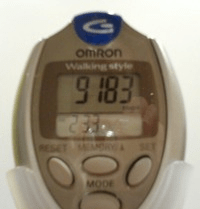
My Omron pedometer

 NewImage

As I sail from Thanksgiving into the merriment of Christmas, Hanukah, Kwanzaa and New Year’s Eve, counting how many sweet potatoes and marshmallows I just devoured and how many cookies and glasses of champagne await me, I have one eye on threatening extra calories. But I have my other eye on a different set of numbers.

Diabetes comes with so many numbers. Our pre-meal blood sugars should be between 90 and 130, our 1-2 hour post meal blood sugars should be between 120 and 140, our A1cs should be below 7, our HDL over 45, LDL under 100, oops no, for us it’s under 70, our triglycerides under 150… you get the idea. But here’s one measurement I find truly encouraging, rather than discouraging. Counting my steps.

I know how I eat and how I move affect and create all the numbers above, but here’s one value I feel I have immediate, visceral control over; how many times I lift my foot, stretch it forward and put it down again. And, I am rewarded (not just with my blood sugar going down, my insulin sensitivity going up, my calories going away,) but with the instant knowledge and immediate gratification of seeing the results of my labor. 

These 9,183 steps on my pedometer are yesterday’s count from a one hour and 15 minute walk. On this late fall day I was strolling through a nearby neighborhood peering into new restaurants and kicking the leafy foliage underfoot. Since these 9,000 plus steps occurred between 11:30 AM and 1 PM, I know my ambling around my apartment before and after certainly put me over the 10,000 steps a day recommendation for physical activity.

There’s something truly motivating in seeing such immediate results of your efforts. Every time I give a diabetes presentation and show my pedometer someone will ask me where they can get one. Maybe they like the “gadget-ness” of it, but seeing things in black and white makes a big difference — it gives you a feeling of control. And as we all know, diabetes feels pretty uncontrollable a lot of the time.

So while you’re counting how many holiday parties you’re going to, slices of pumpkin pie you just ate, mini hot dogs and mushroom tartlettes you’ll be sidling up to at the buffet tables yet to come, remember, you can always count your steps. Getting them up to 10,000 a day, I guarantee you will put a holiday smile on your tiramisu-stained face.

Blood & Honey sheds new light on diabetes

I was impressed when I tripped over Jessica Bernstein in an article in DiabetesHealth magazine last month titled, “Blood & Honey: A Documentary.” 

Bernstein is a psychologist making a documentary film that deals with the psychological component of living with diabetes. As a type 1 diabetic herself, she says,  “I wanted to understand how living with the condition for so many years influenced people’s identity development.”

Like me, Bernstein has seen that diabetes researchers are focused almost exclusively on the negative aspects of diabetes. Few talk about how people can develop in positive ways as a result of dealing with diabetes. Bernstein began turning this realization and curiosity about how diabetes can have a positive, developmental affect into a film.

Her film, Blood & Honey is still partially in development and looking forextra funding. At present, the film features interviews with several people who live with chronic illness and explores what we can learn from them. There’s an African medicine man who shares that peple who live with chronic illness for many years in his culture are considered “elders,” the wise ones that communities draw upon in times of crisis. An interesting and far different slant than how seniors who live with diabetes here are regarded and hold it themselves. Here the primary sentiments attached seem to be:  blame, guilt and victimhood rather than wisdom and reverence.

Philosopher, Susan Wendell, who’s lived with chronic fatigue syndrome for 20 years also featured in the film believes people who spend years living with chronic illness learning how to deal with pain and suffering become valuable resources for others. “We don’t talk as much about the experience of illness as we talk about how to get over it, how to stop it, how to prevent it, how to relieve it, how you can be healthy if you really try,” says Wendell. “I think there’s an enormous body of knowledge among people who are suffering that is untapped and if we tapped into it we’d be less afraid and know better how to cope when something happens to us,” she finishes.

As producer Bernstein says,”Coming to see myself as someone with wisdom to share was a revelation.” When Bernstein tells someone she’s lived with diabetes for 36 years, as have I incidentally, they remark, “Oh, I’m so sorry.” Nobody she says has thought to pick her brain and learn what she’s learned about central issues of diabetes and life, like uncertainty, loss, change and mortality. 

Imagine just for a moment how it might change how you feel about yourself and living with diabetes if you regarded yourself as a wise one where every day your strength, courage, humility and dreams are tested, and you learn from such experiences. Would you see yourself differently, your capability and value?

Bernstein’s film has gotten off to an exciting start and is seeking funds. Learn more about the film by checking out her web site, and you can make a tax deductible donation through www.bloodandhoney.org.

Some simple thoughts as Thanksgiving nears

P1010077 copySimple pleasures: put time aside  to enjoy them

What if we had to purchase happiness and self esteem the way we purchase most things? Would you value it more? Would you feel it more? Would you recognize it as a tangible commodity you owned? Would our lives be happier, easier, more joyful overall? It’s an interesting notion I think.

Somehow it seems negative emotions:  anger, fear, guilt, worry get more of our attention and feel more at home in our lives than positive emotions like happiness, hope, pride and success. Is it just fear of failure or something else at work. I don’t know, but if you had to pay for simple pleasures –  a sunny day and clear blue sky, a field of flowers, to have the loved ones in your life that you do, the satisfaction of a job well done, a fun dinner with friends, coming home after an arduous trip, having your kids put an arm around you – would you enjoy these things more? 

I try these days, as too many of my contemporaries are getting ill and passing away, to recognize how fortunate I am and cherish the day and all it brings. Time passes much faster than it used to, so I’m trying more and more to follow the words of a very wise man, “Be the change you want to see in the world.” These were Ghandi’s words. So, if you want to have love, be love. If you want to enjoy peace, be peace. If you want to find joy, be joy. If you want to see yourself live well with diabetes, live well with diabetes. 

And I think the way to appreciating things more is, while not necessarily easy, pretty much as simple as what Christopher Robin said to Pooh: “You must remember this: You’re braver than you believe, and stronger than you seem, and smarter than you think.” Hmmm…that’s a lot to take in, and yet, some pretty good stuff to live by.

My hat’s off to the diabetes sales reps I meet

images

This post comes late in the day on what is today World Diabetes Day, the one day during the year the whole world tries to raise awareness about diabetes. I have just returned from giving an educational diabetes presentation in Burlington VT. 

I often think I gain more than I give–I receive the heartfelt appreciation of patients whom I speak to and equal appreciation from the true soldiers in the field, the diabetes educators and  nurse practitioners. Perhaps it will surprise you to know I also receive great appreciation from the pharmaceutical sales reps of Sanofi-Aventis, the sponsor of the A1C Champions program I deliver and the manufacturer of Lantus and Apidra insulins. 

It is one of the reps job’s to sell the program to their accounts, the doctors, nurses and educators they service, and it is a win/win. Patients learn how to better care for their diabetes, get inspired and motivated by hearing about it from a fellow patient who knows the experience of living with diabetes, and when they begin to take better care of themselves it can involve using insulin, which benefits Sanofi-Aventis.  But all the reps I have met are incredibly caring people who want to help patients.

So, it seems appropriate this day to share with you an email sent to the organization I do this program through from a Sanofi-Aventis rep about the program I delivered Tuesday in Jersey City, NJ. 

Dear Management Team,

…Today we had an A1C Champion presentation by Riva Greenberg a Type 1 diabetic patient. Riva talked to more than 30 patients and shared with them how easy it is for her to manage her diabetes despite the fact that she takes multiple shots a day, more than 7 (including testing) and yet she has a very fulfilling live. 

We witnessed the increased interest in patients from the last time we supported a similar event by the overwhelming number of patients at today’s presentation, as well as the amount of patients who had one-on-one questions for Riva after her presentation. 

It was very inspiring to me to hear some of the comments she made to encourage patients to take better control of their illness. She also shared with me that ATTITUDE is so important when a patient is diagnosed with diabetes. She added that it becomes a whole different issue when a patient realizes that it is only in “their hands” whether they’ll be present in their children’s future or avoid complications. She said that the change in attitude can come from a simple way of seeing things, switching from a “have to do it” to a “choose to do it” mind frame about their diabetes tasks.  Thanks Riva for all the changes you inspired TODAY!!

Best regards,

Priscila Alvarez, Sanofi-aventis

So today I speak for those much maligned pharma reps whom most people think are only in it for the money. Most I have met are in it because someone close to them had diabetes. Today on World Diabetes Day, I applaud them.