Orlando, a hotbed of diabetes activity


It’s not just the temperature in Orlando that makes it a hotbed of diabetes activity these two weeks, but the enormity of activities going on. 

The American Diabetes Association’s (ADA) 70th annual scientific conference has just drawn to a close. Roche just held its second social summit and Children With Diabetes (CWD) begins today. 

Amy Tenderich over at DiabetesMine has been following and reporting on some of the ADA highlights, start here with opening day and see the next few posts, as is Kelly Close over at CloseConcerns, look down the left-hand column. 

I attended Roche’s social summit where they invited 37 type 1 and type 2 diabetes bloggers and broadcasters to a day of exchanging ideas about meter accuracy, best practices and an open dialog between us and representatives of  the American Diabetes Association and the American Association of Diabetes Educators

These conversations drew fire, well we are a feisty group, about how the patient seems all but lost amid their constituencies, but the ADA was extremely open about the need and desire to turn their battleship org around to be more representative and serving of patients’ needs, including type 1s – and create more transparency. They also obviously took this seriously sending six representatives including David Kendall, their Chief Scientific & Medical Officer. Kendall talked about the ADA’s “Stop Diabetes” campaign which is one of their first steps in being more patient-centric. 

Unfortunately, the conversation with the AADE was less successful. To be fair, many of us felt it was taking place with the wrong organizational person. She seemed unable to put her finger on our concerns – MAINLY the fact that diabetes educators are a dying breed while patients are an epidemic and need them. 

There are only 15,000 educators nationwide, relatively poorly paid and many suffer burn-out and leave the profession. On top of that, it’s hard to become an educator. There’s no direct route, and, a big catch-22. You need to have 1,000 hours working as a diabetes educator with patients before you can sit for an exam to become certified, but how do you get hired as an educator with no experience? After ricocheting these thoughts around we also voiced that we would like to see the organization advocate to improve the track to become an educator. An interesting point was also raised by my fellow bloggers – why not create a track where patient-experts can also be educators in some recognized fashion?  

In the end, we offered our assistance to help both organizations in any way we can. Specifically with the AADE to link their professional members to more social media. While that idea was warmly received and seen as a benefit to CDEs, allowing them to hook their patients up with us, I hope the AADE also realizes that CDEs can benefit tapping into social media to get inside patients’ heads, and hearts, and follow the trends and news we report on.  

I am impressed by Roche. With their genuineness, commitment and desire to have an open forum with we, who have an open channel to you. And, yes, while we can assume all this will benefit Roche’s sales and marketing, I believe they hope just as much that it will benefit us in getting products we need and want. 

At the 2009 social summit Roche put their toe in the water wanting to learn from us how to enter social media as a “good citizen.” This year’s meeting was heavily weighted on what they believed would be of value to us. Either way you slant it, a pharma better understanding the experience of living with diabetes and doing something with that knowledge can only benefit all concerned. 

To this end, Lisa Huse, Roche Director of Strategic Initiatives, opened the meeting with a recap of the four initiatives Roche has enacted based on what they heard from us last year:

1) “Keep it real” – display the real experience of diabetes, the real blood sugar numbers we get and teach patients what to do with them. I think I heard there’s actually a TV commercial where someone shows a 273 mg/dl on their meter, yea! Then again, I could have been dreaming.

2) Address costs of diabetes – through Accu-check there’s now a 15% prescription discount card and Patient Assistance Program.

3) Advocate for the diabetes community – through their Diabetes Care Project. A coalition of like-minded organizations improving care for those living with diabetes.

4) Help the diabetes community amplify its voice – clearly evident with our exchange with the ADA and AADE. 

Lisa also told us that during this past year of following our blogs and having her ear on the ground with us, she’s come to understand diabetes much more than her first 11 years with the company. As the meeting came to a close I wondered why more companies don’t spend more time, money and attention listening to, and getting to know, their end users. It can only be a win-win.

Personally, for us bloggers in our virtual world, it’s wonderful to get together, to shake a hand, play ping-pong (hope the table’s back next year), give and receive a hug and say to each other, as we hope we say to you, you are not alone

By the way, if you blow up the photo, and notice I’m wearing a lovely blue boot, it’s the result of a freakish accident. Don’t worry, five or so more weeks in my lovely footwear and all will be well. (Thus the hope the ping-pong table reappears next year.)

In full disclosure all expenses were paid for by Roche for this meeting.

Top 50 Diabetes Blogs

There’s a list of top diabetes blogsout by Masters In Public Health. The site’s creators, Mary and Paul Hench, say their lisrepresents excellence in content and research, and blogs are listed in no particular order. 

The list is neatly categorized into“Personal Blogs Of Diabetics,” where you’ll find DiabetesStories, “Diabetes Social Networks,” “Diabetes News and Updates” and “Blogs From Moms of Diabetics.” 

Each blog has a line or two describing it making it easier for you to chose where to dip in. The Hench’s created their site after spending months researching masters in public health programs and unable to find a reliable database of usable information. So, you guessed it, they created one. 

Take a look at the blog list and see what value might be there for you. The Hench’s would be pleased.


Aimee Mullins and her 12 pairs of legs

Unknown

If you don’t know who Aimee Mullins is, you should. She’s an athlete, fashion model and inspiration on two prosthetic legs that often graces theTED stage.

Born with missing fibula bones, she had both her legs amputated below the knee when she was one year old. 

But Aimee has risen so far above her perceived handicap that she’s redefining how we see disability. 

She talks of the empowerment that can come from a perceived deficit and how we can, if we chose, be the architect of our lives, and identity. How the conversation is shifting from overcoming “deficiencies” and “disabilities” to having them augment us and our potential. And, she redefines “adversity” along the way.

In her quiet, unpretentious way, and with humor, she opens your mind to think differently and see your condition, whatever it be – for most of us it’s diabetes, as a launch pad for doing greater things.

This 10-minute video is, as are all her TED videos, smashing – for the places your mind will go and its visual richness, as she shares her dozen legs. In her tallest pair of legs, Mullins says she stands six feet one inch high. I think she stands far taller no matter which pair she may be wearing.  

New Facebook game creates a healthier you

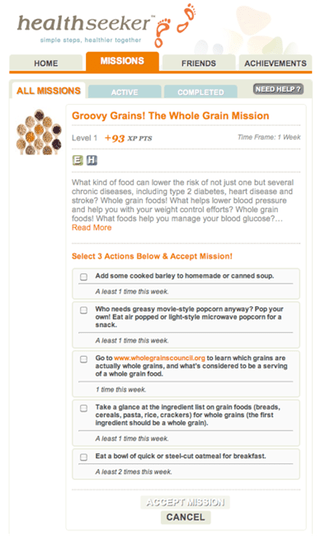
Leave it to Manny Hernandez, founder of tudiabetes and estudiabetes, to come up with a Facebook game to help people with diabetes improve their eating and fitness habits. And the gem is, while you’re learning and doing, your ‘friends’ are helping you through it!

The game is called HealthSeeker and was launched June 14th with Joslin Diabetes Center collaborating on content and the sponsorship of Boehringer Ingelheim. Already, there are more than one thousand players.

How it works is you enlist your Facebook ‘friends’ to be your support circle and ravers as you take action steps that help you meet your healthy lifestyle goals. You’ll track your progress and you can share your game results via Facebook status updates and send them out to your Twitter followers.

 NewImage

As Manny, who has been living with diabetes since 2002 says, “I cannot overstate what a source of support, information and inspiration social networking tools like this can be for someone living with a chronic condition like diabetes.”

HealthSeeker™ provides simple action step suggestions and rewards your success through achievement badges and experience points you earn, kudos your friends can send you and comments they can leave on your Fridge door. (Your game Fridge door, that is!)

While your computer is home base, getting away from your computer is where the action happens – in the supermarket, in your kitchen, on the basketball court, in the pool. Then you come back and share your results.

The game is set up so that you choose “Missions” (healthy actions) as in the lingo of the old TV show, Mission Impossible – “Your mission if you choose to accept it….” 

These missions are the stepladder to achieving your goals. As you complete your mission, you move up in the game and get access to more and more detailed action steps where you will need to sharpen your healthy living-chops. For example, if a mission on Level 1 suggests you eat a certain kind of food once a week, later on you will have to do it twice or three times per week – and that’s the beginning of building new habits.

Manny has made going after health fun to give us all a helping hand to improve our diabetes management, and our life. Further, the fun of playing the game with hundreds of others, scoring yourself, seeing yourself gain more points and sharing your results, may be just the motivation you need to now get in the game. 

So get online and then get out on the field! There’s nothing holding you back now but you.

Way to go Manny!

Vancouver-based social game development group, Ayogo Games, Inc. developed the game code.

The 1st annual “Food for your Whole Life Symposium” shows we know a lot, but aren’t making good use of it


For the public and health professionals, NYC

 NewImage

David L. Katz, M.D., M.P.H., F.A.C.P.M., F.A.C.P.

 NewImage

Michael Roizen, M.D. and conceptualizer ofRealAge

 NewImage

Eat your nuts and berries!

 NewImage


The first of hopefully an annual event was held this past June 6 & 7– the“Food for your Whole Life Health Symposium” – spearheaded by Dr. Oz. It was a two-day free event held at the Grand Hyatt Hotel in New York City to explore how food and lifestyle choices affect overall health. And, to better arm dietitians to help patients make better food choices.

I happened to miss the first day that was open to the general public and drew 1,000 people, but attended the second day exclusively for health professionals, largely dietitians and some diabetes educators, and media. 

I find it interesting with all the constant information coming at us these days on health and healthy eating that people just aren’t indulging in it. So I asked the same questions of everyone I met while meandering between lectures and standing on the long line into the ladies room: “Why, with all the information out there on healthy eating, are people fatter than ever?” “Why are half the people with type 2 diabetes not managing their diabetes very well?” “What has to change so that people change their behavior?”

I heard the same reply from everyone—there is too much information out there and it has become too confusing. Some of it is contradictory, and none of it is laid out for people to act on easily.

In a private interview I conducted (yes, I’m still getting used to this Huffington Post blogger status) with a key speaker at the symposium, Dr. David Katz – a Yale University researcher and authority on nutrition, weight management, and the prevention of chronic disease and a leader in integrative medicine and patient-centered care – he confirmed these observations. He also pointed to the media’s collusion. With an endless need for “new” news and a ravenous appetite to titillate us, the media barrages us with an endless supply of findings that has left the general public reeling with confusion. The result:  heightened stress and not knowing what to do. The other result: people do nothing. 

Katz has been working along with several others on a nutritional ranking system called “NuVal™” that’s being piloted by Kroger, a chain grocery. Kroger is piloting it in 23 stores in Lexington, KY. It’s anticipated they will roll NuVal out to their additional 2500 stores in 31 states.

NuVal ranks foods from 1 to 100 as a guiding system on nutrition to help consumers make healthier choices among a category of food. For instance, you’ll know the healthiest crackers among all the available crackers in the supermarket.

Right now NuVal is in 600 stores with another 400 stores rolling it out later this year.  Katz believes if people begin to choose the most nutritious foods in most categories, these small shifts can make a significant health difference. Katz also shared with me that his wife, a PhD, returned to their house one day with five loaves of supermarket bread and said basically – You pick the healthiest one!  

Katz also said regarding diabetes that many doctors tell their patients in very vague terms what to do, like “Lose some weight” and “Get some exercise.” These directives fall right off patients’ shoulders as soon as they walk out of their doctor’s door. He also said most doctors think diabetes patients are “non-compliant” because they have no willpower, but Katz made it abundantly clear that it is not a matter of willpower, but the enormous lack of translating all this information into easy-to-understand, actionable steps.

The day I attended the symposium, the speakers elucidated us on the upcoming changing dietary guidelines, likely out in November, and took us through a healthy eating map from childhood through old age. The message, throughout however seemed pretty consistent: eat mostly fruits and veggies, whole grains, lean protein and healthy fats.

Dr. Michael Roizen, Chief Wellness Officer at the Cleveland Clinic with numerous other impressive titles behind his name, and Oz’s writing partner, closed the event outlining Cleveland Clinics’ progressive “Lifestyle 180 Program” that they first test-piloted on employees of the Clinic with remarkable results and a cost-savings to the Clinic well worth the investment.

For patients, the program encompasses a six week immersion program that is geared to change the four factors 75% responsible for chronic illness: smoking, food choices and portion sizes, physical inactivity and stress.

Very briefly, the program includes overhauling one’s cultural climate, largely your kitchen ridding it of toxic foods, having participants experience “I can do it” aha moments, muscle memory of right eating and exercise and a buddy system. One of the bottom line messages was – while our genes are our inheritance, our lifestyle determines whether they get turned on or not.

For those with diabetes who have gone through the program, Roizen said 60% were able to discontinue one or more of their medications for blood sugar, cholesterol or hypertension (high blood pressure) within six months.

Most of the people I met at the event thought it was of value and, for me, it only points to the urgency with which we are all recognizing we must turn this ship around that is so badly headed in the wrong direction.   

The principal sponsor of the event was the California Walnut Commission. Affiliated sponsors numbered 7, including Healthcorps and the Wild Blueberry Association of North America.  

I did manage to sample the delicious wild blueberries which I was told are available in my favorite grocery, Trader Joe, as well as other chain groceries. I also got to grab a few packets of 1 oz servings of walnuts – that’s about 7 whole walnuts. Unfortunately, I also managed to forget the bag I stowed them in, leaving it under my conference table. 

Obviously, I need to eat more berries and walnuts to improve my aging memory!

New, less painful lancing device by One Touch


Delica Lancing Device – less pain, more labor 

Unknown

Pelikan Sun – pain free but gone. Too costly for insurers 

Unknown-1

Accucheck Multi-clix – a longtime favorite

Unknown-2

I’ve been trying out a new lancing device sent to me by the public relations firm for One Touch. It’s called the OneTouch® Delica™ Lancing System and it’s available now at some retailers and will be available across the country mid-July.  

A few days after using it I emailed this report:

Pros 

1. Thin needle and non-vibrating action makes lancing less painful than other similar devices (except for thePelikan Sun. However, I am sad to say it’s no longer being made.) 

Cons

1. Device is so lightweight that it’s sometimes hard to hold steady against my finger when lancing

2. Replacing one lancet at a time is time consuming and laborious

3. Thin needle is easy to bend, has happened already

I thought that would be that, and I’d return to my tried and true Accucheck Multi-clix. This is my favorite among typical lancing devices because it’s less painful and 6 lancets come in an easy-to-load drum.

But, I surprised myself. Every other time I lanced my finger I would reach for the Delica™, sturdiness be damned. 

I did actually find it less painful than the Multi-clix. And now I use it more often than my Multi-clix. Of course, I don’t change the lancets each time, probably after 6-10 finger pricks, and I’ll soon run out because my sample only came with 10 lancets. 

So I leave you to decide for yourself. 

The press copy says: 

The OneTouch Delica System features a new, proprietary 33 gauge lancet that is 40% thinner than current industry standard 28 gauge lancets.

In a clinical study of nearly 200 people with diabetes, 4 out of 5 reported the OneTouch Delica Lancing System was virtually painless/pain free and the most comfortable Lancing Device they have ever used.

And yes, I can attest to its non vibrating motion and 7 adjustable depth settings. 
 
The estimated retail price is $19.99 and includes 10 lancets. 100-count OneTouch Delica Lancets have an estimated retail price of $15.99. Both the device and lancets are covered by Medicare Part B and most private insurance plans.
 
Turns out quite by accident, Amy Tenderich over at DiabetesMine is also reviewing pain-free lancing devices today, so you can catch additional info. 
 
As for me, I still like that my Accucheck Multi-clix is sturdy, easy to hold and load so it doesn’t require fussing or touching the needle. 
 
Guess, I’ll have to make the big decision when my Delica™ lancets run out.

Type 1 vs type 2 diabetes debate continues

Which is worse t1 or t2? Keeping another myth alive.

 NewImage

Wow, I am late to this discussion, but felt it worthwhile to join because it appears the debate continues…

Last month Diabetes Health published “What People with Type 1 Diabetes can Learn from Type 2s” by Clay Wirestone  It set off a firestorm of comments, mostly from type 1s, about how dare you tell us we can learn something from those lazy, fat type 2s!

David Spero, blogger over at Diabetes Self Management then wrote this post, “Type 1s Vs. Type 2s?” calling for type 1s and type 2s to come together for the sake of our health and that both sides are not fully aware of what the other side lives with. Interestingly, the comments posted on Spero’s site were almost unanimously empathetic.

It seems to me, Wirestone’s biggest goof was his argument (that t1s can learn from t2s) and his tone. If he’d approached the topic from the point of view that t1s and t2s share some commonalities and we can each learn something from each other, the war may have never ensued. But it is a fascinating study in how we all emotionally hold diabetes.

You should go read the stories and comments to both stories. In reading all the comments to Wirestone’s post, I found Allison Blass nailed it for me:

“The problem with this article isn’t so much that it’s saying people with type 1 can learn something from type 2, but assuming that people with type 1 aren’t already learning these lessons for themselves. Plenty of PWDs with type 1 exercise regularly, take their medication faithfully, and make small changes to get healthy. These aren’t genius concepts divined by the type 2 community. 


I will say that the amount of misinformation and misconceptions about type 2 diabetes in the comments are disgusting. Type 2 diabetes is not CAUSED by obesity – it’s a contributing factor. Type 2 is not cured through diet and exercise – it is managed, just like insulin. Type 2 diabetes does not have the same flexibility as type 1 – blood sugars have to be dropped through extra exercise or changes in diet, not just a simple bolus. People with type 2 diabetes can go years without being diagnosed, which means that many people with type 2 are diagnosed at the same time they find out they have complications. 


Type 2 diabetes is a bitch, same as type 1 diabetes. And yes, they are different. But we both have to do things that are different, we both have a health issues and learning tactics and strategies for handling certain situations could help. 


In any event, if you don’t like people spreading misconceptions about your disease, you should probably be damn sure you’re not spreading misinformation about someone else’s. It’s not nice.” 


-Allison Blass 
www.lemonade-life.com

And then, as I said, even tho I came late to the game, I felt compelled to add my own 2 cents worth and so I posted this today on Spero’s blog:

“As a type 1 for 38 years I understand the cry of type 1s that no one understands how hard and intense it is to live with this disease, and that we are grouped under the same umbrella of those lazy, fat type 2s who did it to themselves.

Yes, many type 2s engaged in poor health habits that may have led to their diagnosis, but not all. One in five are slim actually. For some the genetic component is so strong they would have gotten it regardless of their actions. And there must certainly be type 2s who are annoyed with the bad press their own brothers and sisters bring them.

But one diabetes being worse than the other? It’s all a matter of perspective. I wrote a book recently, “50 Diabetes Myths That Can Ruin Your Life and the 50 Diabetes Truths That Can Save It”  and the myth I always quote is, “Type 2 diabetes is not as serious as type 1.”

It is one of my favorites, because the emotion runs so high and because the answer seems so obvious, but is not. Both are extremely serious because they can both lead to the same devastating complications. While type 1s will never get off their insulin, and endure more intense management, type 2s are asked to undertake preventive behavior, which anyone can tell you, is a bitch.

Since most type 2s are diagnosed years after they have the illness, many already have complications by time they’re diagnosed. And while most type 1s will live with their illness longer than type 2s, many will also live more healthfully with it because they developed healthy habits earlier and they see more directly the positive result of healthy habits.

When “What People with Type 1 Diabetes Can Learn from Type 2s,” appeared on Diabetes Health what incensed most readers was the cavalier notion that type 1s aren’t doing good enough, so obviously we could learn a thing or two from type 2s. That reeks of presumption and offends.

We all have something of value to share from our experiences, and it’s up to us as individuals how we manage our diabetes. And, how we choose to see it – some see themselves as victims and only see hardship, others see diabetes as a welcome wake-up call and get healthier, and others see diabetes as a signal that life is precious and go about making the most of it.

Since no one can argue with your experience, it’s foolish to throw rocks at someone else’s. And while personally, I would vote to change the names of type 1 and type 2 diabetes to better reflect the differences and educate the general public about the differences, when it comes to helping each other out, let’s not overlook that living with any chronic disease we share many similarities.”

What’s your take on this?


A success for “Weekend for Women”

Screen Shot 2015-02-08 at 6.02.55 PM

Okay, I know, a bit of schmaltz with former Ms. America, but for a good cause. I just returned from the first“Weekend for Women” event put on by Diabetes Sisters and sponsored byTCOYD. Actually, the two events dovetailed this past weekend in Raleigh, North Carolina.

Diabetes Sisters was started just a few short years ago by Brandy Barnes, to bring women living with diabetes together and break the isolation so many of us feel. 

As Brandy opened the event Saturday evening she said she couldn’t believe how quickly she was seeing her dream come true as she looked out at the 100 faces staring back at her. 

For there we were: type 1s, type 2s pretty evenly divided, and all ages from early twenties to eighty. I talked with 80 year old Liza, who got type 2 diabetes three years ago and I only hope I have her vitality, and her looks, when I’m 80! Women also came from both the local area and as far away as California, Illinois, New York and Texas.

The event kicked off Saturday night with dinner, socializing and a pampering treatment: massage, nails, hair or make up. 

Sunday former Ms. America and diabetes advocate, Nicole Johnson, gave a truly inspiring talk. She developed type 1 diabetes at 19 and went on, against the wishes of many around her who thought it would be too much for her, to win the Ms. Virginia and then Ms. America title. 

While she is beautiful, her talk – warm, funny and personable – showed she is beautiful on the inside too. And while there was probably no other beauty contest winner in the audience, I think we could all identify with the limitations she talked about that others often put on us and that in mass we turn that around to show just how capable and remarkable each of us is.

The day continued with a host of informational lectures from keeping your heart healthy, feeding your body, mind and spirit and dealing with body image to having a healthy pregnancy and going through menopause. Sheri Colberg was our ending key note speaker and she shared from her book secrets of the longest living people with diabetes. 

As much as we came together to bond, celebrate and learn, it was also inspiring for me to see what Brandy had created bringing us together, and the uncompromising support she appears to have from her beloved type 3 husband and sister. 

There’s another “Weekend for Women” in the works for next year and it may even happen sooner than expected. If you’d like to participate you might want to stay current on the Diabetes Sisters web site.  

Dream a little dream – life after a cure

How would I handle this kind of freedom – pie everyday?

 NewImage

Hmm…maybe it wouldn’t be so bad, after all. But I do seem to have my eyes closed, like a blind person in this new world

 NewImage

 Today, the last of diabetes blog week, the task is to pretend a cure has been found. We are all given a tiny little pill to swallow and *poof* our pancreases are back in working order. No side effects. No more insulin resistance. No more diabetes. Tell what your life is now like. Or take us through your first day celebrating life without the Big D. 

Blog about how you imagine you would feel if you no longer were a Person With Diabetes. 

I realize what a huge shift it is to think of what my every day would be like if diabetes were not in it: To eat without a second thought about what I’m eating and how many carbs are in it and how much insulin I have to load in my syringe. That seems the biggest technical change that would occur. Also, to not stab myself with needles – both for taking insulin and testing my blood sugar – a dozen times a day or see blood sugar trails in my kitchen and on my clothes. 

To not have lows, but get through a string of days, geez every day, without feeling my heart beat out of my chest or that I HAVE TO EAT to save my life. How I hate that. 

To not have to get up in the morning – no matter what the time  – jump out of bed (usually 6:30 AM) and test my blood sugar so I can take that first injection to blunt my early morning rise. Of course that’s followed by a bolus for breakfast and a basal shot for the day. 

Three injections before 8 AM, no more. Sleep, with nothing hanging over me. Now that’s a sweet dream. 

I seem to be caught up in what wouldn’t be. For it’s so hard to imagine what would be if I no longer had diabetes. So hard to nail after 38 years. 

While you know the score – every day is a new day you have to manage your food, exercise, insulin, emotions, time and activities, the daily ongoing chore of doing this has long been my life – it’s just what I know after all these years. To rewind to before what has been two-thirds of my life is a distant memory. To fast-forward to not having diabetes is like a sci-fi-like imagined future. 

And since, for the past seven years my work has been diabetes, thinking of life without it conjures up a multitude of feelings:

1)   Who am I? Diabetes has lived with me for almost 4 decades

2)   Yikes! What the f_ _k am I going to do for a living?!

3)   Whewwww – the sound of every short-term worry and long-term fear slipping off my shoulders

4)   I’m just like everyone else. Hmmm.. is that a good thing?

5)   I’m leaving this space blank for when it really happens. 

After all, I’ve been hearing for years it’s going to happen any minute now .

My Daily Power-Walk


DSC00474_2

As part of our continued town-hall blogging this week, we’re tasked with writing about exercise. If you’ve been here before you likely know I’m addicted to my daily power-walks. I stroll out of my apartment building most mornings, walk along two blocks – that’s streets to anyone not from NYC – and a huge park awaits me that I walk around. 

Most days I walk around the perimeter of the park rather than in it. I save that for weekends when I’m swept up in all the walkers, joggers and bikers. But during the week I enjoy the leafy trees and the brownstones along the streets that hug the park. All tolled it’s about 7,235 steps around the park, 3.7ish miles I figure.

A few days a week I might walk not around the park but to do an errand.  I walk to Trader Joe over in Brooklyn Heights, the library, a great middle-eastern market and through half of Brooklyn to buy discount produce. Luckily living in a city like mine, I can walk almost everywhere – including over the Brooklyn Bridge into Manhattan which takes me 77 minutes or so, not that I’m anal.

I’ve even been walking with an injured toe – it’s got a hairline fracture. And, yes, I’m in a soft surgical shoe. But once I felt I could manage more than walking from my living room to my computer – all 5 feet – I took again to the streets.

Do I go low walking? Sure, sometimes. It’s not an exact science: how many carb grams for how many steps. You can walk everyday the same walk, eat the same pre-meal, take the same amount of insulin yet your body doesn’t seem to know it. 

I carry SweeTarts all the time. They’re in every pocket and bag and half are way beyond their expiration date. I find this out when I have to resort to a roll and it’s stale. But, hey, at least it’s there and still works its magic.

There aren’t many other forms of exercise I do because there aren’t many other forms of exercise I like well enough to keep up. 

But walking: I walk because I am. How nice to slow down the world, see the trees, feel yourself breathe, let your thoughts ebb and flow and know you’re burning calories and helping your insulin work better! 

I walk because I am. I walk because I can.