My Daily Power-Walk


DSC00474_2

As part of our continued town-hall blogging this week, we’re tasked with writing about exercise. If you’ve been here before you likely know I’m addicted to my daily power-walks. I stroll out of my apartment building most mornings, walk along two blocks – that’s streets to anyone not from NYC – and a huge park awaits me that I walk around. 

Most days I walk around the perimeter of the park rather than in it. I save that for weekends when I’m swept up in all the walkers, joggers and bikers. But during the week I enjoy the leafy trees and the brownstones along the streets that hug the park. All tolled it’s about 7,235 steps around the park, 3.7ish miles I figure.

A few days a week I might walk not around the park but to do an errand.  I walk to Trader Joe over in Brooklyn Heights, the library, a great middle-eastern market and through half of Brooklyn to buy discount produce. Luckily living in a city like mine, I can walk almost everywhere – including over the Brooklyn Bridge into Manhattan which takes me 77 minutes or so, not that I’m anal.

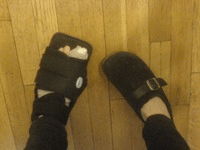
I’ve even been walking with an injured toe – it’s got a hairline fracture. And, yes, I’m in a soft surgical shoe. But once I felt I could manage more than walking from my living room to my computer – all 5 feet – I took again to the streets.

Do I go low walking? Sure, sometimes. It’s not an exact science: how many carb grams for how many steps. You can walk everyday the same walk, eat the same pre-meal, take the same amount of insulin yet your body doesn’t seem to know it. 

I carry SweeTarts all the time. They’re in every pocket and bag and half are way beyond their expiration date. I find this out when I have to resort to a roll and it’s stale. But, hey, at least it’s there and still works its magic.

There aren’t many other forms of exercise I do because there aren’t many other forms of exercise I like well enough to keep up. 

But walking: I walk because I am. How nice to slow down the world, see the trees, feel yourself breathe, let your thoughts ebb and flow and know you’re burning calories and helping your insulin work better! 

I walk because I am. I walk because I can.
Is diabetes worth all the work? Wait ’till you hurt your foot.

Oh, no, a fractured toe!

 NewImage

If you’ve followed this blog for a while you know I’ve had a bunch of minor injuries over the last year or so. Ankle tendonitis, wrist tendonitis and recently a stupid fractured toe. 

Someone was handing me a bottle, I didn’t realize it, they let go of it and bam, it landed right on my toe. My foot took all the impact so when the bottle rolled off it and onto the wooden floor, it didn’t even break! 

My foot is now in this lovely surgical shoe. Truth be told, I could open a lending library of medical braces.

I’m not going to go into why all these injuries are happening. Or karma or any of that. Because frankly I don’t know. 

Some good news resulted from my injury: Days after my new footwear, I  flew to Amsterdam on a night flight and the Delta/KLM ticket agent took pity on me and upgraded me to World Business Class, KLM’s version of First Class. Yes, that was mighty nice compensation for my injury and a breath of human kindness in a world that often feels like it’s all gone. But giddy as I was playing with my reclining bed-like chair, I find something even more rewarding – that the constant care of this annoying condition (diabetes) paid off.

The afternoon I sustained my injury the pain was tolerable until going to sleep. Then it turned intolerable. I searched my medicine cabinet for a sleeping pill. But I didn’t have any. I ended up swallowing two Benadryl cold capsules hoping it would knock me out. It didn’t. The pain was that severe.

My painful sleepless night put every diabetes foot horror into my head. Will I get gangrene? Will they have to amputate my foot? How will I exercise without my foot? Maybe they’ll just take off my toe….C’mon, isn’t this in every diabetic’s head when something happens to your foot?

First thing the next morning I called my podiatrist and heard those blessed words, “Come anytime today.” My podiatrist reassured me, while I fractured a bone in my big toe, that nothing was displaced and that with an ace bandage and a special shoe it would likely knit together in eight weeks time and heal just fine.

So, I hobbled around, went to Europe, cut out my power-walks and have just come from my three-week check up. The X-rays confirm just what he said. The joint at my big toe is unharmed, the little crack or whatever it is in my toe is healing just fine. My toe’s still a little tender, which he said is normal, I’m still sporting a dull purple bruise where the greatest impact hit, and that area of skin remains a dull purple, but everything’s OK.

When I got the upgrade flying to Holland on the 10 PM flight, this sleepless soul on a night flight, was flying high before we even took off. But as great as that gift was, knowing my blood sugar is well-enough controlled that a foot injury causes me no special trouble or damage, that’s the best gift I could have.

It reminds me that when all the work of managing diabetes feels so thankless, you may just find a time when the every day slog of managing your blood sugar really is worth it – especially when the shit hits your foot. 

Now I just have to ask my psychic-witchy Aunt, who predicted when I was in my twenties that in my fifties I’d have a series of troublesome but not dire health problems, if we’re done. 

A diabetes fable

Unknown

Once upon a time a scientist who was enthralled with the exotic emperor moth, (because their wings are as beautiful as butterflies), found a caterpillar ready to spin its cocoon. He gently cupped the caterpillar and took it back to his laboratory. He placed the caterpillar in a glass container and watched as the caterpillar built his cocoon. The caterpillar then fell into a deep sleep. Soon this fuzzy little crawling caterpillar would become an amazingly exotic emperor moth floating in the sky.

Some months later the day came when the moth was ready to leave the cocoon. The scientist watched anxiously as the new tiny head of the moth chewed its way into the light of the laboratory. The moth struggled and struggled to escape its cocoon seemingly getting nowhere. Its body was simply too large to fit through the tiny hole it had made. The moth finally tired and laid its small head on the shell of the cocoon where it had poked out.

The scientist felt so badly he took it upon himself to help the tiny creature. “How could I stand here for so many hours watching this beautiful moth go through such agony and pain?” he questioned. “Where is my mercy?” So he took a pair of tweezers and his scissors and began to cut away the cocoon. As soon as the cocoon was opened, the moth fell from the cocoon. But he did not fall upwards into the sky. No, he was badly deformed and fell on the floor where he died within minutes.

Soon after the scientist discovered that it was precisely the moth’s struggle to escape from the cocoon that allows him to do so. His struggle forces the fluids down into the body of the emperor moth that give it its ability to fly. Furthermore, the struggle perfectly proportions the moth as it works to free itself from the cocoon. Cutting away the cocoon, as the scientist had done in an effort to help, had actually killed the moth and interrupted its natural life-cycle.

The moral of the story: Struggle is not necessarily a bad thing and often it is what helps us grow. Sometimes when you seem to be caught in a struggle, you are actually in a germination stage, like the moth transforming into something even greater.

Food for thought: What happens if you relax into the struggle? 

Diabetes patients learn something special from each other


March 2010 - 06

I’ve just returned from Scottsdale, Arizona. It was a lovely trip. I was attending the annual meeting of thepeer-mentor group I belong to. About 80 of us mentors and staff gathered under sunny skies to learn and bond. 


The programs we deliver as mentors provide some information and education but largely provide inspiration to fellow patients through our own personal stories of struggle and success. 


Patients learning from patients is a very different kind of education than patients learning from medical professionals. And it’s happening more and more. 


Patients go online, follow diabetes bloggers and volley what they know back and forth. Patients learning from patients is about a shared bond and experiences. 


This led me to reflect on an early presentation I gave in Buffalo, New York. It was the first time I was double billed with a diabetes educator. Her talk preceded mine, so I leaned back and listened. What I heard was forty-five minutes of numbers: A1Cs, blood pressures, weight and weight control, exercise, portion control, and carb-counting. 


While this is all important information, I also heard what she left out. That these goals are not easy. That we have to find a way to fit it all into our day. That a small step in the right direction is to be applauded. That we should pat ourselves on the back for every good effort.  


The purpose of my talk I quickly saw would be to say what she did not. To talk about how we hold diabetes in our lives and if necessary how holding it differently can help. Taking the stage I shared my own shock and fear upon diagnosis, my subsequent denial, and my early complications from that denial. The room quieted. I was they saw like them. I see the same landscape they see. I tramp through the same darkness trying to figure out half the time what’s going on. I look for solace when diabetes rains down upon me or drains me out. 


“When you’re so busy testing your blood sugar every day,” I said to my audience, “reading labels, counting carbs, and calculating everything, do you stop to think why you’re doing all this work? Isn’t it to see the grandkids grow up, start that second career, create the best vegetable garden in town, contribute something to the world, or have another million days with your spouse?” 


Heads nodded and people leaned forward. They turned from silent witnesses into curious involved participants. Someone had brought humanity back into the room. Someone had understood and acknowledged this piece of living with diabetes where their heart resides, along with their struggle. 


My predecessor, warm and personable though she was, didn’t have diabetes. That put her not just on the other side of the projector, but on the other side of our experience, where so many healthcare providers sit. 


We patients, however, are the experts of our diabetes and we are in the daily business of chronic illness. We have life adjustments to make, and since we have precious little help to make them, we are reaching out to each other. 


So here are my recommendations for a better tomorrow: 

• Learn all you can

• Appreciate what you hold dear

• Pace your efforts

• Forgive your mistakes

• Keep the vision of your ‘best life’ ever-present

• Spend more time doing what you love. While we’re living with diabetes let’s

   not short-change the “living” part. 

• Consider yourself “more than” not “less than.”  We’re all doing a second 

   job.


After the program people crowded around to thank me, and they were smiling. Well, if anyone can leave a diabetes meeting with a smile then I figure I’ve done something right.


Smaller size vial of Humalog for hospitals and possibly patients

Asante-Snap-Insulin-Pump-4-Humalog-Humalog rapid-acting insulin

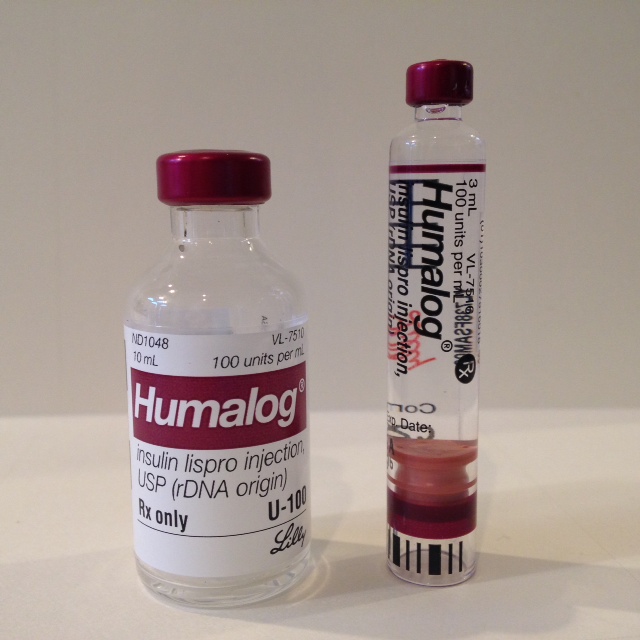
In January Eli Lilly, maker of Humalog rapid-acting insulin, began supplying hospitals with a smaller size vial– 3 ml instead of 5 ml

I got a flier about it because I’m a member of the Association of Diabetes Educators. My curiosity was peaked to know if there’s now a smaller size available for patients?

In truth, I don’t use Humalog anymore. I switched to Apidra about a year ago. I find Apidra works a little faster for me and this means I can also use a little less. Of course, since I eat a low-carb diet, I don’t use much mealtime insulin anyway. I use about three units to cover my morning oatmeal (my big carb meal) and then about 1 unit for lunch and 1 for dinner. My carbs in those meals being vegetables and beans.

This means at the end of every month, when I have to start a new bottle of rapid-acting insulin, I have to throw the one I’ve been using away – and it’s still 4/5 full. 

So I called Lilly and asked if a patient could buy the smaller size vial. I was told a patient could ask their pharmacist to check with his or her supplier whether they could get it. 

Not a wholly satisfying answer, but if you, like me, use very little mealtime insulin, and you use Humalog, you may want to check if you can get less.

Kitchen Table Wisdom

Screen Shot 2015-02-07 at 9.42.33 PMPhysicians learning to be human

I’ve just finished a book of stories I learned so much from. Particularly how medical training wipes the humanity out of our health care providers. You may not be surprised, except for how strategic and intentional it is.


Kitchen Table Wisdom by Rachel Naomi Remen is full of small stories that include her own experiences as a physician for more than 30 years and observations of fellow physicians, and, as a patient suffering with Crohn’s disease since her teenage years. 


Her stories illustrate how most medical training depletes physicians of their humanity by actually outlawing any show of emotion or authentic aspect of themselves. Physicians are judged weak to by these standards and strong if they share nothing but their medical expertise; no heart, no humanity. Her stories also reflect the courage and grace as patients find their courage to live, and often die, with illness. 


You cannot come away from these stories without having a new understanding of our medical system. And the healing power of being with patients in a sacred space that does not judge, but allows frailties to just be. You will better understand why most doctors treat us like interchangeable parts and how far we have to go till this changes. Especially treating chronic illness.


Today, though, maybe there is a movement afoot. I just read Amy’s post over on DiabetesMine about a new ideal for treating the whole patient with a dedicated team. Perhaps it is happening, somewhere. Perhaps it will happen, someday.


In the meantime, pick up a copy of Kitchen Table Wisdom. Your soul will thank you.

Diabetes Moods

DSC00898_2

I have one of those 3″ x 6″ plastic mood-visuals hanging on my refrigerator. It comes with a little red cut out square that you place over the face that illustrates the mood you’re feeling. 


One thing I’ve noticed about this little mood chart is that out of the 30 moods on offer, 25 are negative and only 5 are positive. What does that say about us?


Here’s a sample of the negative choices 


Exhausted

Confused

Guilty

Angry

Hysterical

Frustrated

Sad

Embarrassed 

Disgusted

Frightened

Enraged

Anxious

Lonely

Jealous

Overwhelmed


Here are the five positive choices

Happy

Ecstatic

Confident

Lovestruck

Hopeful


I have two thoughts about this and I’m going to share both with you. 


1) We are so ingrained to see the fly in the ointment. Is it so hard for us to name positive emotions that they only gave us five? Do we spend so little time feeling positive that the words don’t come more quickly to us? 


2) I can go through each of these negative emotions and tie it to diabetes. For instance:


Exhausted – After 1 billion blood sugar tests it gets a little tiring!

Confused – This isn’t the number I usually get when I eat that!

Guilty – A night of eating everything I love that just gets away from me

Angry – Stopped by security at the airport because of my insulin pen!

Hysterical – Stopped by security at the airport because of my insulin pen!

Frustrated – Having to eat just because I’m low. Damn!

Sad – I may really not make it to 80

Embarrassed – Shooting up in front of people I don’t know

Disgusted – Leaving blood trails on my newly renovated white kitchen cabinets 

Frightened – What will they find in my lab tests this time?

Enraged – This disease costs a shit-load of money

Anxious – Left the house without testing and have no idea where my sugar is

Lonely – No one else knows what this is like!

Jealous – Of everyone else’s freedom

Overwhelmed – I feel lousy yet I still have to get up to test my blood sugar, see if I have to refill my meds, god, I got it wrong again?


That said, I can go through each of the positive emotions and also relate it to diabetes:


Happy – I’m in great shape overall and better shape than if I didn’t have diabetes

Ecstatic – Just started blogging for the Huffington Post as a patient-expert

Confident – I’m generally on top of things

Lovestruck – My partner couldn’t be more supportive 

Hopeful – This will continue to get easier to live with


But I’d add a few more positives to my mood meter:


Peaceful – Just had my labs done, everything’s OK

Contented – Overall, I love my life 

Excited – Going to the AADE to present this August

Joyful – I’ve found my passion and am in my ‘element’ as Ken Robinson says

Grateful – For everything I have: partner, home, work, friends, family, chocolate

Delighted – Lovely surprises come on a regular basis these days

Proud – While I thank my lucky stars, I did a lot to get here


The truth is we can look down and we can look up. I rarely change where my square hangs – it’s usually on “happy”. For even when I’m not happy, I’ve noticed that glancing at my happy square, makes me feel happier and think of something to be happy about.


Just an observation, make of it what you will.


Diagnosing diabetes with the A1C may mean you’re cured!

A fellow type 1 friend of mine was trying to get a CGM to better control her blood sugar. 

She’s had diabetes for more than two decades. Her blood sugar bounces from high to low often enough that her doctor felt a CGM would be extremely helpful, even though her A1C is just below the American Diabetes Association recommended 7%. 

Of course the A1C is an average of your last two to three month’s worth of blood sugars. That means you can have lots of blood sugars around 250 mg/dl and lots around 50 mg/dl, and average out at 150 mg/dl – just below an A1C of 7%. 

While this averaging game is nothing new to me, what was new to me is that her insurance company would not cover a CGM because the liaison between the insurance company and the CGM company said my friend’s diabetes was cured. Why? Her A1C is under 7%. 

My friend’s doctor told her he’s seen this coming ever since companies decided to diagnose type 2 diabetes with the A1C test. The American Diabetes Association has recently recommended this along with an international committee from several other diabetes organizations including the International Diabetes Federation and the European Association for the Study of Diabetes.

One main advantage they cite for using the A1C test to diagnose diabetes is that it can be taken any time of day, and without fasting. 

Yet, at what cost does this come? If an A1C of 7% or above will mean you have diabetes then will insurance companies say a well-controlled diabetic, who has an A1C under 7%, does not have diabetes? If that’s the case then I’ve been cured for years and didn’t know it. Funny, though I still experience hypos and highs no non-diabetic gets.

Will patients lose having tools that could help them better manage their diabetes with this diagnosing criteria? I know one who already has. 

Dr. Oz, won’t you please set the record straight?

Unknown

If you missed it, Oprah did a show on diabetes ten days ago where Dr. Oz confused and scared a lot of people about diabetes with misinformation. As one diabetes educator said to me, “Dr Oz is a SURGEON.!!!  Diabetes is NOT in his area of expertise!!!!!!” Read my post on the Huffington Post.

Now I ask you to join me in letting Dr. Oz know that we are worthy of accurate information to help us manage our diabetes, not myths and fear, and that if he truly wants to help patients he should correct the misinformation he’s put out there. 

Spread the word, tweet, twitter, leave a comment on the HuffPost and let’s send the message that the diabetes community deserves the respect it’s so often denied. 


Sharing our experiences makes diabetes easier

Screen Shot 2015-02-07 at 9.48.26 PMPeer-mentor, Bob Kolenkow


Eight years ago, when I first started thinking of myself as someone who works in diabetes, I attended aTaking Control of Your Diabetes(TCOYD) event in San Diego. I was covering it for Kelly Close of Close Concerns.


Wandering around the exhibition hall I started chatting with a gentleman who was eager to answer my questions. He told me he was a peer- mentor and that he speaks to patients around the country helping them manage their diabetes, in part by sharing his story. 


He neglected to tell me he was a former physics professor at M.I.T. Thank goodness I didn’t know, I might have been intimidated. But that’s not Robert Kolenkow’s way to intimidate anyone. 


Because of Bob, I’ve been a peer-mentor for the past three years and it’s one of the most rewarding things I do.


I told Bob about a year ago that he’s one of my mentors because he led me to this work, and he welled up with tears. You can meet Bob in his recent article in The New York Times. He epitomizes the saying that “a life examined is a life worth living.”