Timesulin launches Indiegogo campaign today


Today Timesulin, the little company that makes this great insulin timer cap, goes live with a crowd funding campaign on Indiegogo

If you want to send a message to the FDA that we in the States should have great, useful, life-saving products as quickly as anyone around the world, sign up at the link above. 

With a small contribution, you can get one of the first caps when released in the States – and like me, find you don’t wonder whether or not you took your shot. You can also get a copy of my latest book, “Diabetes Do’s & How-To’s.”

I’ve been using this cap for more than two years, since the day I met John at the IDF World Congress in Dubai. I can’t tell you how many mornings I sit down at this computer, start working and wonder whether or not I took my long-acting insulin shot. Timesulin always lets me know. The reason I love this cap.

Share the news – yes we can get products over here that we want and need faster by pulling together. 

Would it surprise you to know, Timesulin is already in 40 countries around the world? Be part of the solution and you and millions will benefit.

The marvelous cartoonist Haidee Merritt

Screen Shot 2015-02-06 at 4.31.29 PM

Here’s my solution for diabetes burnout. Pick up a book with Haidee Merritt’s fabulous, funny, satirical cartoons. 

You can find them on her website, as well as in my book, “Diabetes Do’s & How-To’s.” They are little energy-boosters in your diabetes instruction manual.

After all, we’ve all heard it, “laughter is the best medicine.” And, once you:

• know how many pills/insulin to take for each meal and snack

• test your blood sugar ten times a day

• get your hour power walk in

• bypass that chocolate muffin for a carrot 

• do some hot, sweaty yoga to get rid of all your stress

…you are definitely ready for a belly laugh. Just don’t look down at your belly while you’re taking it or you’ll be upset all over again.

Love blooms, quiets, grows, yells, deepens and is

RivaBouWeddingParis photos-05 - Version 2

I’ve been married almost twelve and a half years. That’s significant for two reasons. My husband is Dutch and in Holland they celebrate twelve and a half year anniversaries – half of 25 years. And, I didn’t get married ’til I was 48, so this may be historic. It was my Virgo pickiness. 

Truth is, there are times I’d like to act on what my Aunt told me on my wedding day. “Just don’t be surprised, Riva, when you have a day where he’s standing in front of the window and you have to stop yourself from saying, “Just back up a little honey…” I’ve told him that story; it makes him nervous, and makes him laugh.

But most often my love, our love, brings up memories of a documentary I saw on PBS while we were engaged. I watched it alone, he was in Holland. 

It was about couples who’d been married more than 25 years. I remember at the time, even though we were engaged, I thought, ‘Really? Can you really be married more than 25 years and still be happy? Have something to say? Not be bored? How’s that possible? 

But there they sat, most couples hand in hand, grey-haired, glasses slightly askew, wrinkled, grinning, “I couldn’t live without her,” he’d say. Usually the man said it first; men are such mushes at that age. She’d poke him in the ribs. And smile.

So Happy Valentine’s day honey. We still do find something to say, most days. And when we don’t, that’s okay too. I’ve come to know that’s part of the contentment of being known and seen, accepted and loved. Amazing. 

And happy valentine’s day to everyone out there, married, engaged, partnered or single. I once read the way to get love is to give it away. So true.

So I give it away every day twelve and a half years later. Of course I also keep the window open. 

Bringing new ideas to a unique diabetes clinic in Bangalore, India

DSC01162

This is my report from three weeks in Bangalore, India, working with a clinic that serves the poor with diabetes. Almost 30% of India’s population are illiterate and live in rural areas. India has the second largest population growth of diabetes.

I realize I’ve never been to the third world before. Jakarta, Taipei, Bangkok, Gualin, these places, or at least where I was in these places, was second world. But here in Bangalore I have entered the third-world worm-hole and I am overwhelmed.

DSC01131

I arrived a week ago. It wasn’t at the invitation of Erin Little, an amazing 27 year old American woman who’s single-handedly, with the help of one of India’s most renown diabetolgist’s,. Dr. S. Srikanta, developing and executing a leadership program for community village health workers here. No, when I heard about this from Erin, I invited myself.

So here we are. We being my incredible husband and me. Here in an airbnb Homestay for which I’ve just bought my first-ever pair of flip-flops; the shower floor is so sqishy I can’t bear standing on it without shoes. I’m afraid to touch the walls because they’re grimy with decades of caked grease and dirt. The single blanket has burnholes, the linens are stained even after they’ve been washed, we take a pill with each meal to try and avoid getting ill, boil the water to brush our teeth and wash the dishes and I’d say I have a good case of the heebie-jeebies.

Most of the furniture is broken. The lighting is single sockets most of which are without bulbs. The wall décor consists of wires hanging out of holes. No closet door hangs properly or closes, and you don’t want to open the kitchen drawers. My husband and I did not come sponsored, we did not stay in a 5 star hotel; we lived like the local population. We wanted to contribute and make life better for people with diabetes, and yes, it is third world. I know there are worse apartments, but as uncomfortable as I am inside, I am more so outside.  

The advantage of our residence is we are only a seven minute walk to the diabetes clinic where Erin is living and Dr. Srikanta works from sun up to midnight taking care of Bangalore’s poor and wealthy, many of whom have diabetes.

traffic

Bangalore traffic is murderous. Motorbikes, rickshaws, taxis and private cars all following their own personal driving handbooks. We are on an amusement park ride every time we get in a tiny open rickshaw. I feel for the seat belt continuously, which doesn’t exist, as drivers and pedestrians expertly, yet heart-stoppingly, come within, literally, an inch of each other, every few feet.

Yet the seven minute walk to the Jnana Sanjeevini Medical Center is strewn from start to finish with garbage. There are small fires along the walk acting as garbage disposal. Yesterday two ravenous crows were tearing apart a rat. The dogs are thin and haunted. The air is filled with dirt.

By time we arrive at the clinic I have breathed only garbage, so much of it, it feels like I am chewing dirt. All these signs are how I know now I have never been in the third world before. I also know somehow there is also a fourth world where this would be heaven.
 IMG_5648

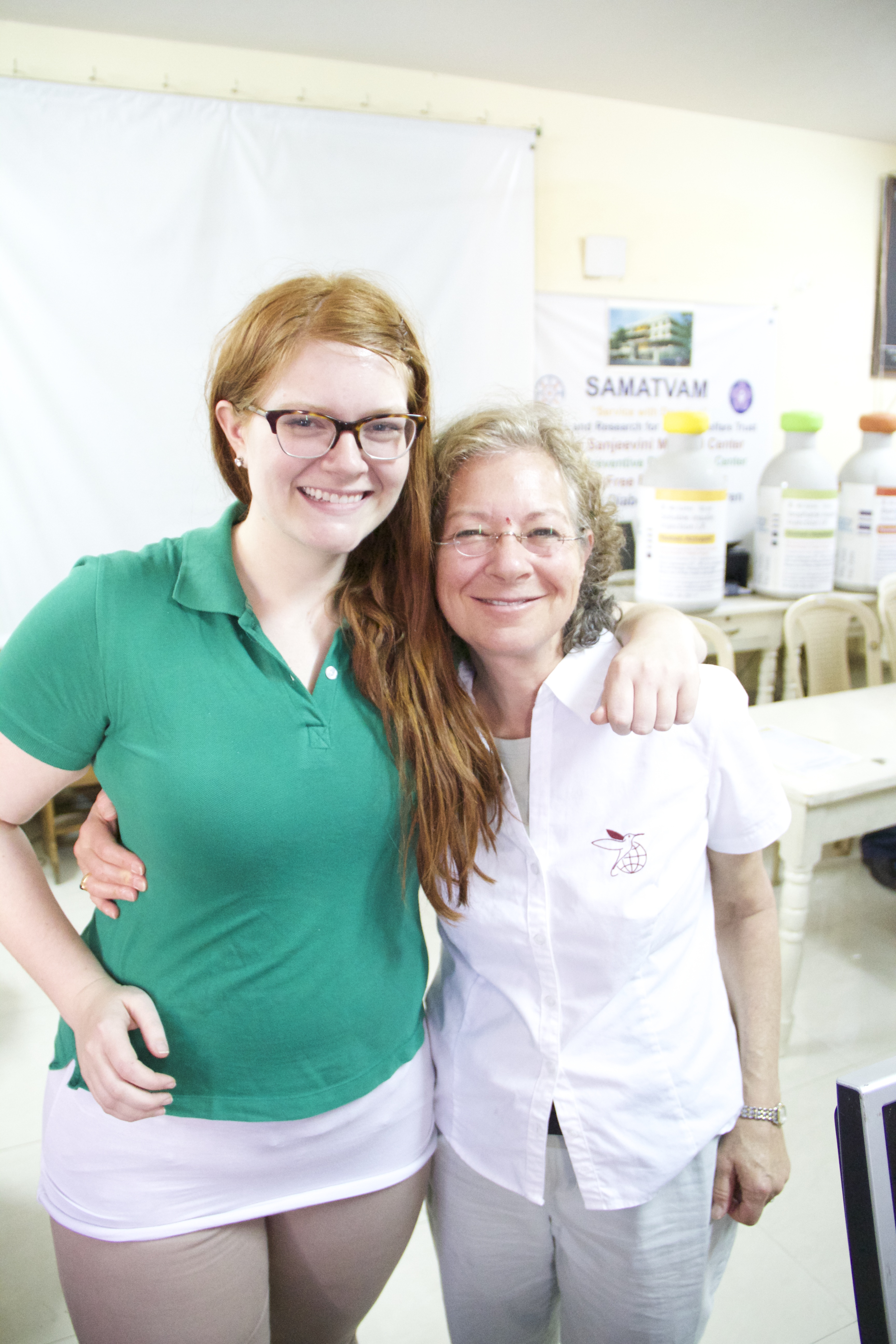
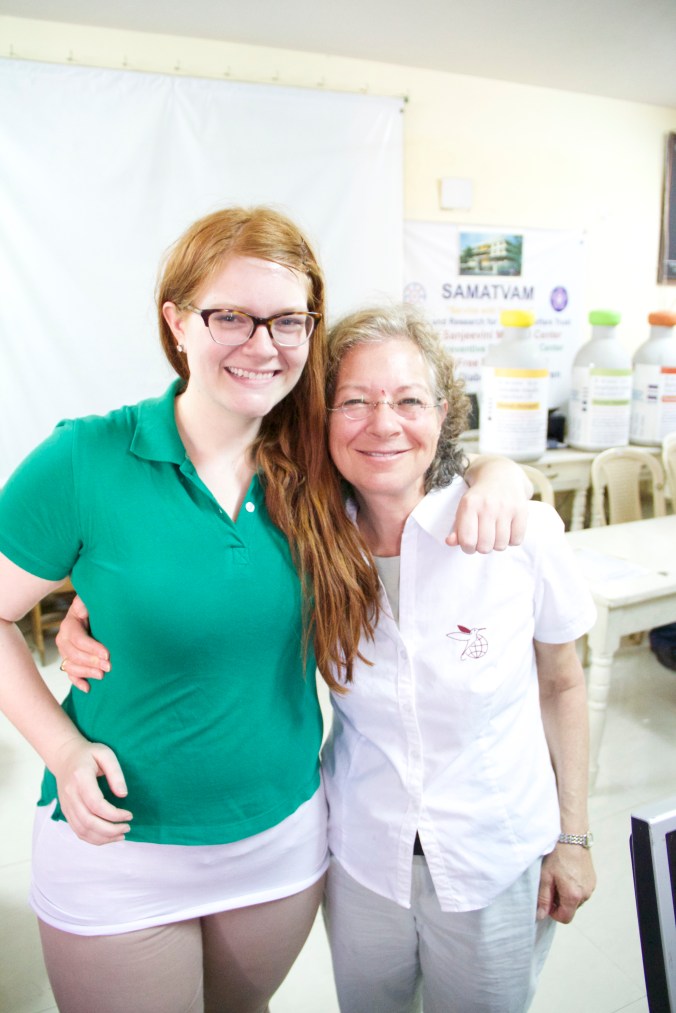
The clinic is an oasis here. That’s me above with Erin. It is open to everyone and it is served by a committed, well-trained, passionate group of doctors, educators and administrators. The clinic was also closed for two years when Dr. Srikanta would not pay extortion money. Retalience was bombing part of the front of the clinic. We are reminded of this each time we step over the rubble in front and are greeted with smiles and “good mornings.”

Once inside the clinic, I am distracted from the poverty outside and reminded why I am here. The dedicated staff, including volunteers, work tirelessly. Everyone wants to give, to help, to improve the lives of their patients, neighbors and extended tribe. Some staff members below as I show them my Dexcom CGM.

Screen Shot 2015-02-06 at 4.51.11 PM

They want to learn from me – what I teach in America about managing diabetes, how to inspire behavior change, creating a new space for patients to move into where, while not “cured,” healing is possible. And, how I live as a successful patient – how and what I eat, how I manage my blood sugar, how I’ve had type 1 diabetes for 42 years, am “sixty years young” as they say here and have no major complications. Of course I joke with my husband by time we leave I will look sixty. My hair feels like straw from the water; I fear my face will be marked by every bit of garbage burning in the air.

I spent the Sunday after I arrived here giving a workshop for the children who come to the clinic with type 1 diabetes, and their parents. Some come from two hours away, on several buses. They come the first Sunday of every month. 

Needless to say, having a girl from Brooklyn standing in front of them was not an everyday occurrence. I know I gave them a sense of hope seeing one can live well with type 1 diabetes. I gave them a sense of pride as I taught them the raised finger salute I learned from Jason Baker of Marjorie’s Fund, that one can have type 1 and be proud. 

Although, sadly, I have since learned with only access to older insulins and one test strip a day from the clinic, some will not live to be eighteen. To be sure they gave me more than I could give them; a reason to keep doing the work I do.

Screen Shot 2015-02-06 at 4.52.26 PM

I came both to teach and to learn and I am learning more than I could have imagined. Daily my husband and I go to the clinic and sit in on patient consultations. I have been invited to share my observations of how they are doing and what can be improved. It is an exchange of learning on both sides.

One afternoon we accompanied Erin and several staff members from the clinic to a village two hours drive away. Erin’s mission and work, through her non-profit organization Sucre Blue, is to train local village women in rural India to survey their village people’s health and then have a mobile team of doctors and educators come provide medicine, care and counseling. 

Screen Shot 2015-02-06 at 4.53.56 PM

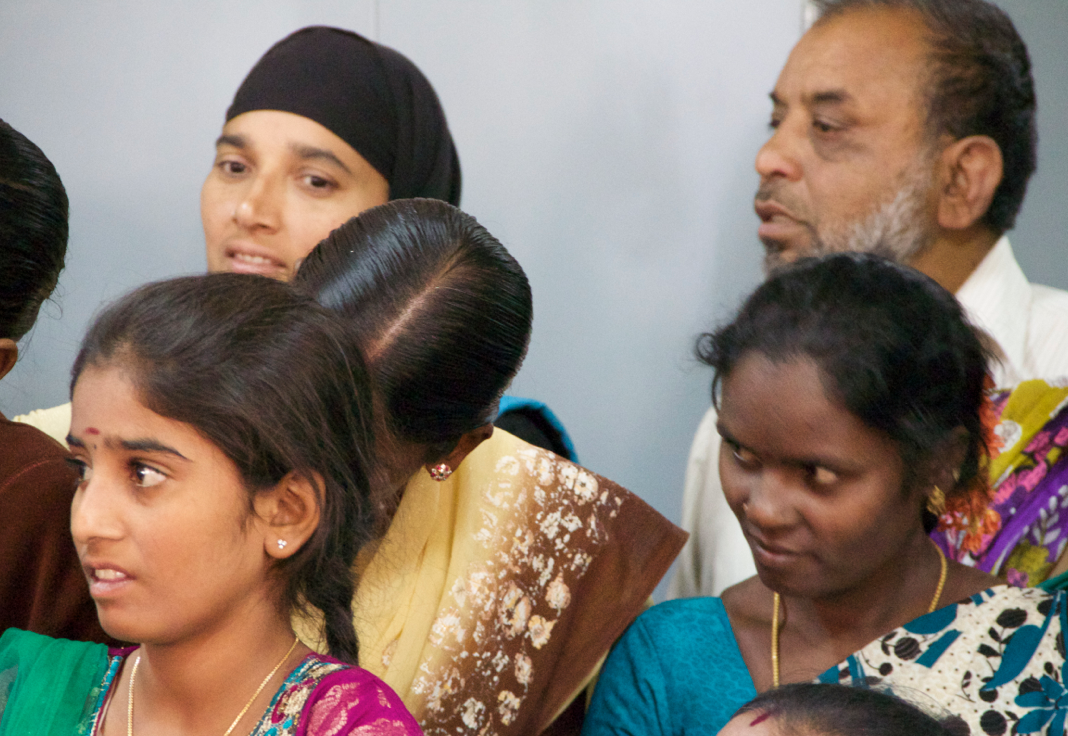
Waiting on an outside floor of dried cow manure, I watched as villagers arrived from across the road to have their fingers pricked for the first time in their lives for a blood sugar reading, had their blood pressure taken, stood on a scale to record their weight and were then given instructions from the doctor along with any necessary medications. 

I watched all this, as I lifted my Dexcom CGM discretely from my pocket to see where my blood sugar was in that moment. It was other-worldly. But it is programs like this that can potentially change history, and more importantly, provide futures.

Here, in this place where many are poor, have difficulty affording vegetables, eat a traditional high carbohydrate diet, do not have a concept for self-management, where women put themselves last, there is so much work to be done. This is when you know the difference between first and third-world.

While Erin, who has been in India for several years, is dedicatedly, back-breakingly picking up stones to clear paths to better health, I came to offer ideas about working with patients so that they flourish, change behavior and create healthier lives. Remarkably, my ideas, new and alien here, have also been seen to have stone-moving power, and have been received with open arms and enthusiasm by Dr. Srikanta and his staff.

In fact, toward the end of our stay, Dr. Srikanta felt what I offered had the means to provide a true tipping point for enabling and inspiring patients. He proposed that we do a six-month patient study. The doctors and educators would employ my flourishing methods and tools that I have shared with them to help a control group of patients flourish. Another group would be treated as usual. Within a day the staff decided not to go ahead with the study. They felt it was unethical not to share these tools with all patients. That is what they plan to now do and see if the positive results they have achieved from their practice with these tools continues. 

During my time here I have given six mini workshops and lectures – about leadership both in how to work with patients and inspiring patients to be leaders in managing their own diabetes. I have spoken to the children and their parents, to the doctors and educators at the clinic and to doctors completing a certificate program on diabetes to expand their knowledge. I have been accorded the respect of a wise elder.

Yet it is a long road before them to travel. Here in Southern India I have found food to be a constant challenge to manage my own diabetes. The diet is largely vegetarian consisting of enormous amount of carbohydrate: rice, dal, lentils, nan, roti, pakora, lentil pancakes, peas, and curries swimming in oil. I must also admit my surprise my first day at the clinic when served coffee and masala tea both heavily sugared.

I immediately asked if they could make it for me sugar-free. “Sugar-free?” they asked uncertainly. “Yes, please, I have diabetes.” And I smiled. And that is how it has been coming for me. The patients and staff continued to be served sugar-rich coffee and tea as it is traditionally taken.

Tradition runs much of India. Tradition keeps the diet from changing. Pressing the point about lowering carbohydrates for better blood sugar control, I was told, “The Gods would be angry if we don’t eat these traditional foods.” 

Also poverty makes vegetables hard to buy and prepare for a family. 70% of the population lives in rural areas and are illiterate, and a culture of others taking care of you makes the concept of self-managing diabetes unrecognizable.

Can you talk about flourishing with diabetes in a third world world? I don’t know. Yet even here in a culture up against so many obstacles for diabetes health, an educator bounded up to me the day after I gave out an exercise for the medical staff to do with their patients, all smiles. She had done it and seen the smile on her own patient’s face as she had him discover his strengths.

So it seems even here you can use the principles of “flourishing” to create better outcomes. That medical professionals can create greater rapport, help patients focus on what they’re willing and able to do, help them see their strengths and use them to take a step forward, provide hope, raise happiness and build confidence – all of which motivates more positive action. These principles cross cultures, I think, because they appeal to the most base instincts in all of us.

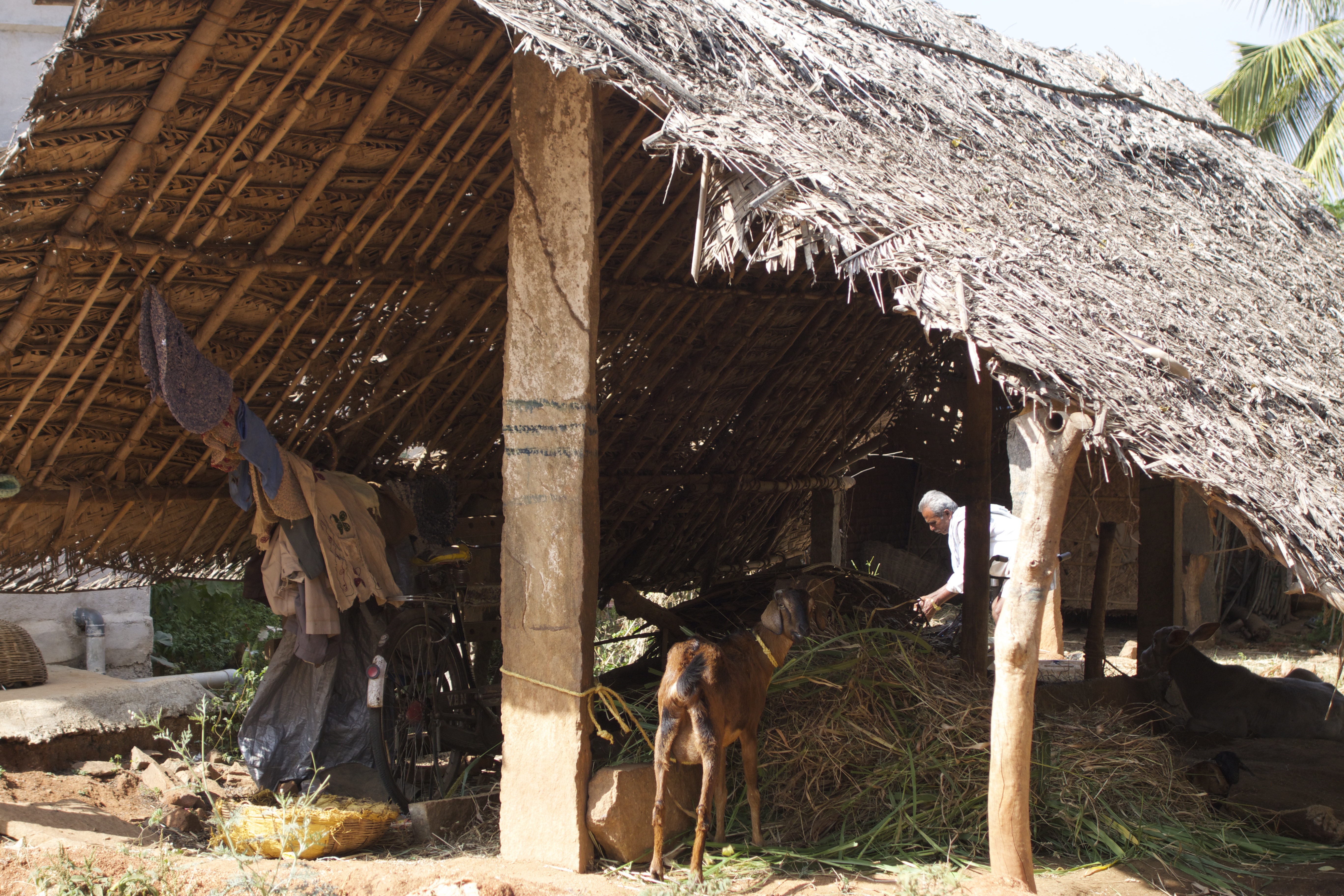
I know, like those at the clinic, I am making a difference. In a place where cows wander the streets, beggars follow and touch you for blocks with their outstretched hands, here among the shantytowns where mud and straw huts have laundry hanging on them, something in one small clinic is changing.

Like the story of the boy on the beach surrounded by starfish that have washed ashore. As he tosses a starfish back into the ocean, a man comes by and asks, “Boy, what are you doing?.” When the boy says, “I am putting the starfish back into the ocean.” The man responds, “Child, there are thousands of starfish here, you cannot possibly make a difference.” Tossing another starfish back into the sea, the boy responds, “I just made a difference to that one.”  

Leaving Bangalore I have felt and seen the difference I have made and Dr. Srikanta has told me he wants to continue to work with me to spread the idea of flourishing with diabetes throughout India. And just perhaps, my greatest legacy is the clinic now only serves sugar-free coffee and tea to everyone.

You can see more photos of this journey on my Facebook page

cowScreen Shot 2015-02-06 at 4.55.35 PM

Happy Holidays from the Blue Mountains of Australia

Flourish

We spent last weekend, and will spend this weekend, in the Blue Mountains of Australia. Two hours from Sydney, it’s a stunningly beautiful area, graced with a huge variety of shades of blue and green trees and other foliage, thus its name. 

Of course we knew our friend’s property had suffered a terrible fire two months ago; the worst fire on the mountain in 50 years. She saw it unexpectedly roll right over her hilltop and then carry its blaze quickly and decisively. She worked all night tip 2 in the morning, with the volunteer fire brigade and neighbors, to save as many trees as possible, and her home. 

The house is untouched. 15 acres of trees are burnt. As we walk the trail behind her house we see many uprooted, hollow. The community of 200 residents on the mountain, who pitched in in every possible way, are closer than ever. And my friend? She mourns the loss of all the work she had invested planting trees and vegetables, creating an amazing flower garden, and now having to start over. Of course there are economic costs as well.

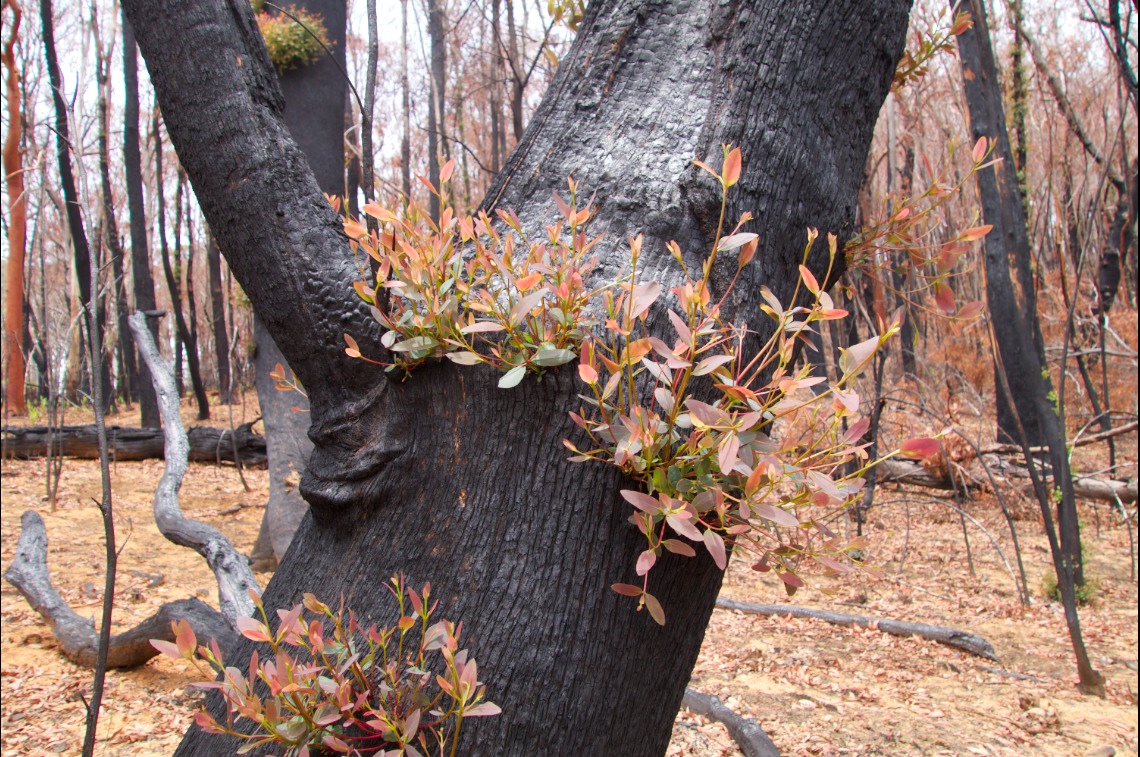
Luckily, being the stalwart individual she is, she is also able to see a certain beauty in what remains. The charred trees are a panorama in black, grey and orange. Their shapes are quite remarkable. And many are going through a process of photosynthesis; green and red leaves (how perfect for Christmas) are sprouting along their trunks. 

Like the trees’ display of resilience, my friend appreciates the view now open of the mountains around her and she is working with renewed vigor and focus to rebuild and reshape.

Of course I would tell you there’s a message here for living with diabetes; to rouse ourselves to see something beneficial from our new state and have a deeper appreciation for all we have and a renewed commitment to rebuild and reshape our lives. Resilience, the power of nature and very human.

Happy Holidays. I hope you enjoy all the gifts all around you, particularly those that come not tied with ribbons, but with open hands and hearts.

IDF World Congress in Melbourne comes to an end

Screen Shot 2015-02-07 at 11.23.29 AM

The IDF World Congress in Melbourne closes today, and it’s been a delightful five days. 

For me, it began with my address to the “Young Leaders” Friday night – 137 diabetes advocates between the ages of 18 and 30 from 70 countries who are working to increase diabetes awareness, education and healthy living in their country. If you spend an hour in a room with them, you will marvel at how passionate, committed, mature and hopeful they are.

I addressed the Young Leaders as Novo Nordisk’s Keynote speaker and then facilitated a workshop to help them develop their personal stories of living with diabetes and include some of the major findings from Novo’s DAWN2 (Diabetes Attitude, Wishes and Needs) study. Predominantly to live well patients need: 1) Family involvement and support; 2) Education and 3) Fair Treatment.

Being quite honest, in some ways it’s a double-edged sword to come to a diabetes conference. To sit for five days and hear lecture after lecture about the biology, medicine, devices and psychology of diabetes  On the one hand I am lifted by the work being done in the field – and the passionate, caring, genuine experts who are wedded to the cause. I revel in learning what is new, about the advances we’ve made, those around the corner and five and ten years off, and I am among my own. The easy new friendships and conversations that spring up are a rare treasure.

Yet, I am also reminded non-stop of my condition: that no matter how hard I work managing my type 1 diabetes there are no guarantees for a continued healthy future. By its very nature, while we try to control the beast, blood sugar is unpredictable and intense management, while our best card to play, is to some degree a wild card. It was upsetting as well the first few days to learn at this conference that two of my fellow diabetes advocates, even with all their hard work managing their diabetes, each have a new complication. Yet, I have also heard some positive news, that longevity with type 1 diabetes does not necessarily mean you will get complications. In the end, all we can do is our best each  day. 

So what have I learned? That the IDF have two inspiring stewards, President, Sir Michael Hirst, whose own daughter has type 1 diabetes, and new CEO Petra Wilson. That both are committed to the cause and come with many skills, talents and new ideas. 

With Sir Michael’s background in Parliament, he aims to help reform governmental and environmental policy to make healthy choices easier. Wilson’s tech and healthcare background at Cisco will serve her aim to improve the reach and efficiency of healthcare through online technology.

I have also learned that:

• Too many healthcare providers (HCP) still talk in terms of patient “adherence” and “compliance.” 

• The behavioral sessions were too small for the overflowing crowds that couldn’t fit in the room. 

• HCPs think they involve their patients in their treatment while patients largely do not. 

• Diabetes only continues to increase around the world and insulin is still in short supply in third world countries. 

• We have more evidence showing the value of a closed loop system for better blood sugar control and less hypos and so we continue to inch toward having a mechanical “cure,” and that the tools we use today, while a giant leap forward from decades ago, are still enormously primitive, leaving us again only to do our best. 

And so I have come to an awakening. That those of us who have type 1 diabetes, particularly those of us in positions of advocacy and influence, as educators and role models, are, while trying to show the world how we can do anything with type 1 diabetes, unintentionally hiding how much work it takes and how unpredictable it is. 

So I hope to never hide again the fact that my blood sugar is going low before giving a presentation, or that I didn’t properly dose for a meal I had no knowledge had hidden sugar in it, because I have to be a “perfect diabetic.” 

Because when I do hide those things, I am denying the very nature of type 1 diabetes, and inadvertently, denying my fellow patients and the general public, what I want them to know. That the often unreinable blood sugars of type 1 diabetes are often not our fault, and that both exist – I can thank my diabetes for much it has given me and its management takes a great deal of discipline, hope, humor and dedicated effort.

137 “Young Leaders” at IDF’s World Congress in Melbourne

Screen Shot 2015-02-07 at 11.25.37 AM

I’m in Melbourne Australia where Friday night I spoke to 137 young people from 70 countries, largely with type 1 diabetes. They are known as the“Young Leaders” and are part of a program sponsored by the International Diabetes Federation (IDF). 

Tomorrow IDF’s World Congress brings together 10,000 global health care professionals, members of industry, pharma, patients and media who have gathered to hear about the latest advances in diabetes, treatment  and education as diabetes only continues to grow at rapid rates around the globe.

Yet while diabetes seems to run rampant with no end in sight, Friday was an enormously special evening. I was the kick-off speaker for Novo Nordisk, one of the largest pharmaceutical companies, if not the largest, headquartered in Denmark. And it is also an exceptional company. Their mission and values include helping patients manage the psycho social aspect of diabetes.  

From 2011-2013 Novo conducted an impressive study on what patients need emotionally to live healthy lives with diabetes. Top findings were: 1) family involvement and support, 2) Education and 3) Fair treatment. The study, called DAWN2 (Diabetes Attitude, Wishes and Needs) follows an original DAWN study conducted by the company in 2001. 

Throughout the World Congress this week DAWN2 study results will be shared with attendees. But Friday night they were shared exclusively with the Young Leaders.

Following, I had the distinct pleasure to co-facilitate a workshop to help the Young Leaders develop their personal “stories,” and with the major findings from the study, create powerful, persuasive messages for their advocacy.   

As I told the group, our stories of living with diabetes are one of our most powerful tools to elicit change. They are the string that goes out and ties us together, inspires hope and possibility, and moves mountains – which is frankly what we need today and in the coming years to stop this epidemic. 

I am especially gratified to know that these young leaders will be moving mountains when they get back to their home country. And, frankly, that inspires me. 

The antidote to living with diabetes

Screen Shot 2015-02-07 at 11.30.57 AM

As Diabetes Month closes, this is the title of my latest article on The Huffington Post. I believe it with all my heart and so want to share it with you perhaps as an early Thanksgiving gift.

“…for me, having lived with Type 1 diabetes almost 42 years and with no end in sight, I have to find hope somewhere. So I take it in the attitude I’ve adopted: You can have a great life, not despite but because of diabetes.

Don’t get me wrong: I am not denying the work, the hardship and the fears diabetes brings or it’s potentially damaging consequences. I am suggesting what Randy Pausch told us in his “Last Lecture” and what Michael J. Fox has been telling us since he got Parkinson’s. That you can make meaning from tragedy and find not just a way to bear it, but joy in a meaningful life.

I have used diabetes as a catalyst to create a purposeful life: to become fitter, stronger, more compassionate, passionate, bolder, less fearful and help others. Many others have told me the same.”

To read the full article click here.

Addressing Sanofi’s global device developers

Screen Shot 2015-02-07 at 11.35.07 AM

Yesterday I had the pleasure of speaking to 80 people involved in, and committed to, the development of medical devices. I was addressing Sanofi’s global device developers offering the “Patient Perspective.” How I interact with devices – how they help me manage my diabetes, and my life, where they let me down and what else I’d like to see.

For me, it’s always a joy to share what living with diabetes is really like, and help others understand the good, the bad and the ugly. I calculated that living with type 1 diabetes 41 years, I have taken 76,115 shots and 60,972 finger pricks. I have spent over a billion seconds of my life calculating how many carbs are in what I eat, when I will take my walk, whether I need to refill my scripts, see my doctor, take a correction shot and on and on.

The heads nodding in the audience told me they either “got it” or their eyes were being opened. I also shared my views about what devices I use – glucose meter, Solostar insulin pen, Timesulin insulin pen cap, ACCU-CHEK Multiclix lancing device, Dexcom G4 CGM and a low-tech little key chain that carries 4 glucose tablets.

The t:slim insulin pump was on my “cool” list, looking as it does like an iPhone. And the Lantus Solostar and Apidra insulin pens on my “oops” list. So similar in design and color, I know too many patients who have confused them and landed in the hospital.

In the end, my advice for Sanofi’s team to better know how to design products we want to use is to “Be a patient.” La vida loca, “live the (crazy) life” of someone with diabetes. Check your own blood sugar 8-10 times a day, log your blood sugars and count carbs in your meals.

And spend time talking to people with diabetes. How else would you know why I love my CGM (affectionately known as “Pinkie”) yet don’t use an insulin pump?

My parting image was this little girl up there – me at three. She had no idea diabetes was coming down the pike in 15 years; that that diagnosis would change her life forever.

Yet, she and I are hopeful for the devices that will still come. And the one I’m truly waiting for is the one that lets the one I use most often, my brain, retire.

It will be the device that when I’m walking, eating, watching a movie, standing on line at airport security or making love doesn’t have me wondering, “What’s my blood sugar now and what do I have to do about it?” Because it has already taken care of it for me.

Did you know insulin is a biohazard?

Unknown

As we approach the eve of Diabetes Month, November, I think it funny that my recent episode with my insulin pen ended up the way it did. 

Last month I spent ten days in Scandinavia. I packed all my diabetes supplies and I had a few days left on my Lantus Solostar insulin pen and packed a second pen. 

When I went to use my new Solostar pen, the pen jammed: I couldn’t press the plunger and get any insulin out of it. This has never happened to me before. Given this had been my back up pen (well, for the first few days of my trip) I had no back up pen. 

My husband and I went to a local pharmacy in Copenhagen where the pharmacist was very friendly and accommodating and said, even without a prescription she would sell my a new Lantus Solostar pen. The trouble was I couldn’t get one. They come in boxes of five and I would have to purchase five pens for the equivalent of $120.

Well, that was not my idea of salvation, so I decided I would just withdraw the insulin from my pen with a syringe until I got home. And that’s exactly what I did and basically it worked fine. 

The funny thing is when I got home I called the number for the Solostar pen to register an adverse event and I was told I would be sent a replacement pen, thank you very much, and I might need to return the faulty pen so they could see what went wrong. FYI, the rep told me on the phone, chances were the pen needle somehow was blocked, which caused pressure to build up in the pen and didn’t allow the plunger button to work.

Two weeks later a huge box arrives at my door. It contains what you see here. A number of bags marked “biohazard” and a tube. I am to put my Solostar pen in the tube, and then put the tube in the clear bag and then put the clear bag in a paper bag and then put the paper bag in a box. 

I am aware it is law that when someone is dispensing insulin in a hospital they must be accompanied by another someone. Yet, it struck me as funny. We, who live with diabetes and use insulin, do so so casually, we would never think of it as a biohazard. That is not to dismiss insulin’s side effects – possible low blood sugar which can be dangerous. But the every day taking of insulin, is something we do all the time and don’t have to put on a zoot suite to do so. 

It’s just a little strange when the scientists decide insulin cannot be handled in transport other than locking it in three vessels because it is potentially so dangerous. 

Ah, just another example of the disconnect between those in the lab and those of us on the ground.