Diabetes advice going low-carb

Screen Shot 2015-02-06 at 2.58.57 PM

The American Diabetes Association (ADA) has long advised a high carbohydrate diet which seems counterintuitive given diabetes is a condition of high blood sugar and carbohydrates more than any other nutrient cause blood sugar to rise. 

In response to the ADA’s stance, many of us who live with and write about diabetes complain about such advice, and personally follow low-carb diets. As do I. 

I used to scratch my head wondering why the ADA would so tirelessly recommend eating a lot of carbs until I read sufficient literature that they feared people were eating too much fat and fat caused heart attacks (not my belief), the greatest cause of death for people with type 2 diabetes. Thus, they wanted people to give up their fat and thinking there was no other way, they pushed them to eat more carbs.

This too kind of stuns me as I eat a low carb diet and haven’t replaced carb with more fat, I just eat sensibly – a bit of steel cut oatmeal most mornings with nuts, seeds, a few berries and Greek plain yogurt, other days cottage cheese, eggs or a protein shake. For lunch a salad with veg and grilled chicken and for dinner fish and veg mostly and snack on a bit of cheese, handful of nuts, piece of dark chocolate. 

So, I’m glad to see in the last several months the ADA finally seems to be coming ’round to advising PWDs lower their carb intake, and it’s making its way into the general advice on diabetes management. 

In today’s DiabetesInControl is one such article. Here are the highlights: 

  • Dietary carbohydrate restriction has the greatest effect on decreasing blood glucose levels.
  • During the epidemic of obesity and type 2 diabetes, caloric increases have been due almost entirely to increased carbohydrates.
  • Benefits of dietary carbohydrate restriction do not require weight loss.
  • Studies show that carbohydrate restriction is the best intervention for weight loss.
  • Adherence to a low-carb diet in people with type 2 diabetics is at least as good as adherence to any other dietary interventions and is frequently significantly better.
  • Replacement of carbohydrate with protein is generally beneficial.
  • Dietary total and saturated fat do not correlate with risk of cardiovascular disease.
  • Plasma saturated fatty acids are controlled by dietary carbohydrates more than dietary lipids.
  • The best predictor of microvascular and to a lesser extent, macrovascular complications in patients with type 2 diabetes, is glycemic control (HbA1c).
  • Dietary carbohydrate restriction is the most effective method of reducing serum triglycerides and increasing HDL.
  • Patients with type 2 diabetes on carbohydrate restricted diets reduce and frequently eliminate medication and type 1 diabetics require less insulin.
  • Intensive glucose lowering by dietary carbohydrate restriction has no side effects comparable to the effects of intensive pharmacologic treatment.

Full article here.

The Big Fat Surprise uncovers a big fat lie: fat is not the enemy

Screen Shot 2015-02-06 at 3.01.50 PM

I’ve long thought our reverence for a low and no fat diet has failed us. Just look around. Ever since the US government began pushing more carbs and less fat, and food manufacturers all but wiped full fat products off the shelf, as a nation we’ve grown fatter than ever.

Now, The Big Fat Surprise uncovers 9 years worth of investigation by its journalist author, Nina Teicholz, tracing how one man – Ancel Keys – convinced food experts, scientists, researchers the government and the American public that saturated fat was the devil – and changed our diet. 

Keys massaged much of his research to fit his notion that fat and red meat was our downfall. Study after study was faulty and wrongfully reported. Keys also liked being the persuasive savior and his charisma filled a room until all were convinced.  

I am two-thirds of the way through the book so I can’t tell you if we will find at the end the Big Truth, but I do believe sugar and carbs have increased our waistline, not fat, and the sooner we drop those containers of skim milk and no fat fruit yogurt and add some eggs, red meat and cheese back into our diet, the better off we’ll be. 

Unfortunately as pointed out in the book, the studies that contradict the merit of low-fat eating, you don’t read or hear about. Because they fly in the face of 30 years of our adopted “wisdom” they never get published. And, I know from marketing, if you hear something often enough you think it’s true whether it is or not.  

Here are a few snippets from the Wall Street Journal review:

In the great morality play of modern diet, the angels, we have been told by a host of experts, favor egg-white omelets and skimmed milk, while the devil gorges on red meat cooked in butter. For 50 years we have been warned to fight the good fight on dietary fats if we want to stay healthy. In “The Big Fat Surprise,” as one might guess from the title, Nina Teicholz plays the devil’s advocate—convincingly.

when skeptics, including the National Academies of Science, weighed in on Keys’s impoverished data, and on related claims that multiplied over the succeeding years, the media attacked the skeptics, heedless of statistical reasoning. Meanwhile, the food industry—apart from the protesting cattle and dairy lobbies—happily ministered to the new dietary wisdom. Government agencies weighed in with dietary guidelines that emphasized carbs and vegetables and warned that red meat was something one could only risk eating a few times a month. And when this miserable diet, shorn of taste, wearied its adherents, as it so often did, the pharmaceutical industry stepped in, offering drugs to lower cholesterol.

Read the book and judge for yourself.

Among the bulk fruits at Costco – me!

Screen Shot 2015-02-06 at 3.05.22 PM


A week ago I got an email from the publisher of Costco’s website for diabetes health information and care. “Would you guest post for us? We’ve become a popular site for our Costco customers.”

Sure. So here’s to sharing with the Costco community – love those big jars of artichokes and cheap Charmin –  what it takes to be healthy with diabetes 42 years – including two secrets you’ll rarely hear. 

For the article, click here.

Doctors Tell All – And It’s Bad

Screen Shot 2015-02-06 at 3.18.40 PM

The recent article, “Doctors Tell All – And It’s Bad,” published in The Atlantic is confirmation how troubled our healthcare system is, with a new twist, how unhappy doctors are caught smack in the middle.

Meghan O’Rourke describes doctors’ difficulties, our system’s breakdown and the effect on patients’ care, outcomes and comfort. 

Some notable excerpts:

Without being fully aware of it, what I really wanted all along was a doctor trained in a different system, who understood that a conversation was as important as a prescription; a doctor to whom healing mattered as much as state-of-the-art surgery did. 

“Yet empathy is anything but a frill: not only is it crucial to doctors’ humanity and patients’ dignity, it can be key to medical efficacy. The rate of severe diabetes complications in patients of doctors who rate high on a standard empathy scale, Ofri notes, is a remarkable 40 percent lower than in patients with low-empathy doctors. “This is comparable,” she points out, “to the benefits seen with the most intensive medical therapy for diabetes.”

Medicine today values intervention far more than it values care.”

I long have been following the writing of doctors who have been themselves chronicling how care has gone missing from healthcare – Doctors Danielle Ofri, Sandeep Jauhar , Victoria Sweet, Rachel Naomi Remen. 

This is another worthwhile read to understand what’s really below the icecap.

Join the Big Blue Test movement

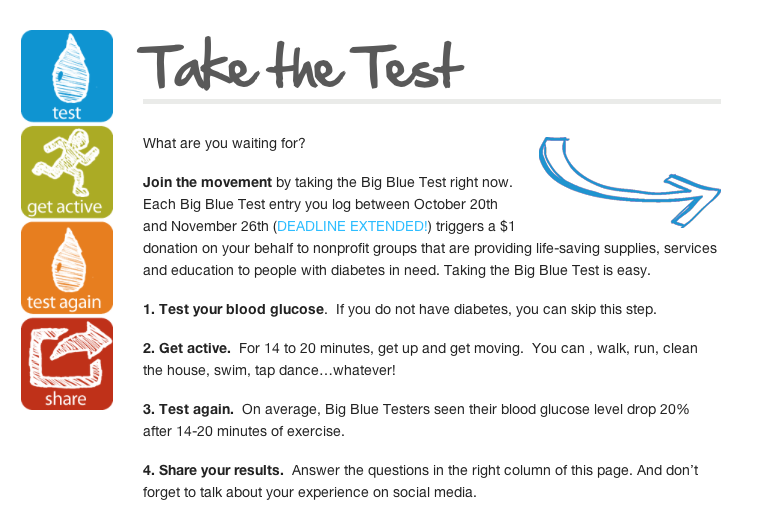
For the fourth year Manny Hernandez, founder of the Diabetes Hands Foundation, is making sure we experience the benefit of activity on our blood sugar – and as a result, getting diabetes supplies and insulin to children in need around the world.

The movement is called the BigBlueTest – and you can’t fail.  

Sign up here and this is what you’ll do: 

Screen Shot 2015-02-06 at 3.21.11 PM

Record your results on the sign up page above – and if you can spread the word. With 35,000 people taking the test, $35,000 will go toward life-saving supplies. And, you’ll see what a little activity can do!

Send your thoughts about living with diabetes directly to the FDA


Six days ago, Adam Brown, T1D and senior editor of diatribe, sent out a call to the Diabetes Online Community – to encourage people with diabetes to take a 5 minute survey. The survey results will go directly to the FDA and inform a groundbreaking patient=led discussion with the FDA November 3.

The event will include patients, both with type 1 and 2, representatives from the American Diabetes Association, JDRF and diaTribe. Presented, will be the numerous challenges we face every day – that’s what will be captured in the survey. Those insights will then be shared directly with the FDA.

Help us tell the FDA what matters to us and what we need, including what the biggest barriers to diabetes management are. This truly is an event where your voice will be heard and will count.

Immediately, numerous patient advocates in the DOC took up the cause to spread the word. Here’s a quick from the heart video appeal from  fellow advocate Manny Hernandez.   

How doctors get groomed

Screen Shot 2015-02-06 at 3.24.40 PM

In my last post, I talked about the patient filling gaps in healthcare. Dedicated to researching how we can help improve care for other people with diabetes, and how health care providers can be more empathetic and present with patients – what I see as critical to care for people who live with a chronic condition – I love reading books written by doctors that describe their world. 

I’ve already shared I’m a big fan of physician/authors’ Danielle Ofri and Rachel Naomi Remen and I’m currently reading the book, “Intern” by Sandeep Jauhar.

Jauhar describes his first year as a resident at a big city hospital. As he points out, efficiency and getting through rounds seeing patients is more important than any quality time spent with patients. It’s a stunning, shocking, eye-opening revelation how grueling medical training is, how little “care” is actually given patients and how the process all but completely trains empathy out of burgeoning doctors. 

Here’s are a few excerpts:

“By this point in my internship, I had already come to appreciate that there was a fundamental disconnect in the hospital. Good relations with patients weren’t rewarded; efficiency was, which meant focusing on the work at hand, operating with a kind of remote control, in front of computer screens and nursing charts and requisition forms, and on the phone. Face-to-face time was a relatively insignificant part of the job. The high counters around the staff workstation delineated not just a workspace but a type of kingdom, too. It might as well have been ringed by a moat…

If internship was supposed to stoke intellectual curiosity, I never saw it. Like me, most of my classmates seemed disengaged, mentally exhausted. With patient rosters of fifteen or more each, we were preoccupied with getting our work done. Anything that got in the way- even a bona fide medical mystery- was more often seen as a bother than a learning opportunity…

The worst was when you were alone with patients and you realized you knew next to nothing about them. They’d be on bi-level positive airway pressure ventilation or something, and you didn’t want to go through the chart to figure out why, but you felt guilty, so you hedged and read a little bit and learned a little bit, and read some more and discovered some more, and you realized how much you learned was dependent on how deeply you were willing to look, and what was pushing you was a sense of duty, but the cut was ill defined and couldln’t you just ignore it and go home? …

There was a constant tug of war between desire and duty: Your desire was to get the hell out of the hospital and have a life; your duty was to be a good doctor… If you did everything you were overwhelmed. If you didn’t you felt guilty…So I compensated by writing off-service notes, hoping someone on the next rotation would address the issues my team had ignored.”

As Jauhar writes as well, for all the work loaded on nurses’ shoulders without equivalent power, they are the force in a hospital who can make your life hell or tolerable. 

I find the book engrossing and it helps me to understand the fierce pressure, competition, opposing forces, desire not to show any weakness or ignorance and time constraints being a good, kind and caring medical professional costs in our healthcare system. It’s a sad and unfortunate revelation.

The new doctor: the patient

new patient

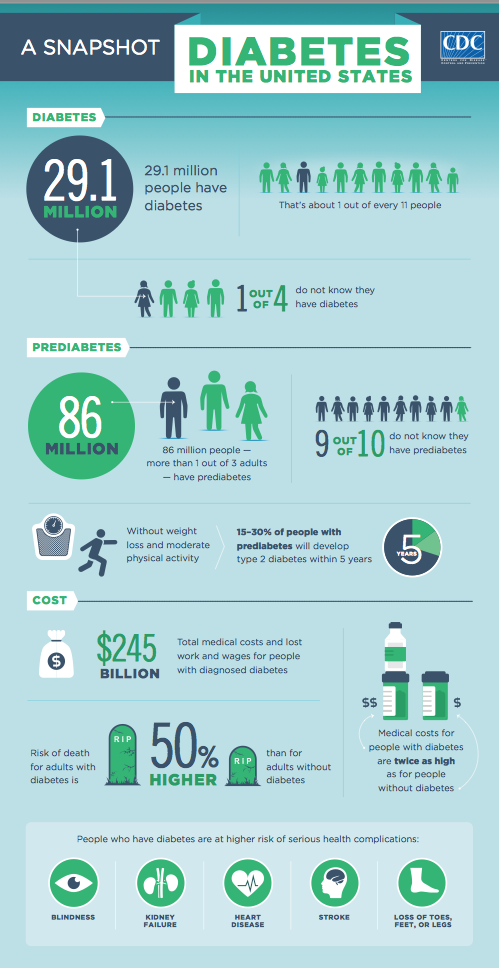
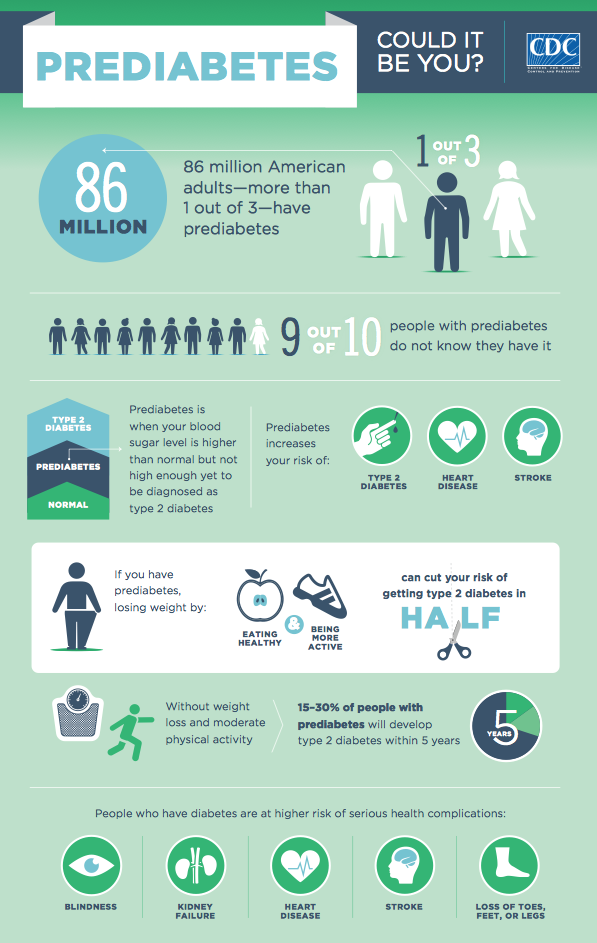
As the number of people with diabetes continues its astonishing rise – from 26 to nearly 30 million and in pre diabetes from 79 to 86 million – the number of endocrinologists who specialize in their treatment remains flat. 

There are roughly only 5,000 endocrinologists and 19,000 diabetes educators across the country today. How are we going to take care of the millions more people with diabetes adding to the statistics every year?

Few primary care providers refer patients to a diabetes educator and most patients with Type 2 diabetes are treated by their family doctor. Unfortunately, many are not up on the latest research, medical guidelines and/or drugs – and don’t want to spend the time titrating new patients on insulin.

But an unexpected and critical new member of the diabetes team has lately appeared: the highly informed or ‘smart patient.’ 

More and more smart patients are filling the educational gap – and filling a gap health care has been slow to recognize, the — “I get it” gap. To be blunt, health practitioners who don’t have diabetes for the most part simply don’t “get it.”

Looking at how patients are inserting themselves into the health landscape, we should be encouraged by our influence to continue and congratulate ourselves. We are making a crucial difference to thousands, maybe millions, of others living with diabetes.

The educational influence of patients

Since the first social media sites began popping up to widely share  knowledge, advice, experience and wisdom, offerings have grown more sophisticated catering to specialized audiences — Type 2s, Type 1s, parents of children with diabetes, women, athletes.

8 note-worthy social media/blog sites:
Children with Diabetes
DiabetesDaily
DiabetesMine
DiabetesSisters
Glu
Mendosa
SixUntilMe
TuDiabetes

Further, take a look at this year’s Top 10 recognized social health makers in diabetes. 

My first inkling that patients held sway was five years ago when Roche invited 30 top diabetes bloggers to their headquarters to better understand how to talk to their customer base online. Several other pharmas, including Medtronic and Eli Lilly, quickly followed suit.

More recently, patients have taken the stage at major diabetes conferences – the International Diabetes Federation World Congress, American Diabetes Association, American Association of Diabetes Educators and Children with Diabetes’ Friends for Life – sharing personal wisdom, device knowledge, social media information, and their distinct expertise.

I conduct workshops with health care providers to help them extend their repertoire from working with people with diabetes from a “coping approach” to a “flourishing approach”

Kelly Close, editor in chief of diaTribe, who has type 1 diabetes, said one of the most notable developments at the recent 74th American Diabetes Association Scientific conference, where more than 17,000 top diabetes medical professionals, scientists, researchers and trade people gathered, was the room given to the patient voice.
 

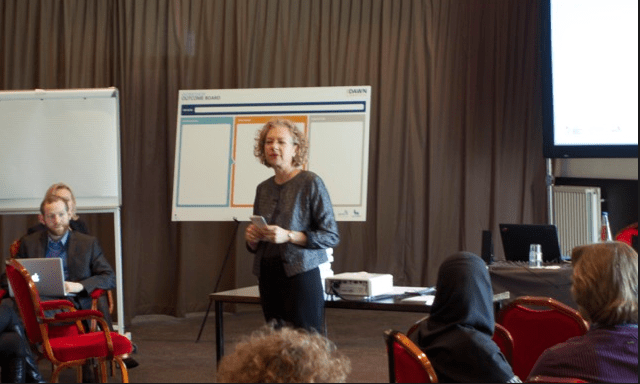
innovation summitAmy Tenderich, founder of the top patient news-reporting blog, DiabetesMine, has been running an annual Innovation Summit at Stanford University School of Medicine for four years. Patient advocates, device designers, researchers, clinicians, pharma R&D leaders, mobile health experts and regulatory experts gather to develop new ideas, products and tools to improve life with diabetes.

Two years ago big pharma, Sanofi, launched a similar initiative. Patients are nimble and quick where corporations and institutions often are not. A few months ago Tenderich launched “TestKitchen,” video reviews of diabetes products by and for people with diabetes.


Patients as mighty advocates

Diabetes blogger, Kim Vlasnik, launched her inspirational video, “You Can Do This”project three years ago from a personal passion to validate and share “honest talk” among people with diabetes and their loved ones. It’s popularity is the benefactor of the “I get it” factor.

The Diabetes Online Community this past Valentine’s Day asked people to buy their ‘Valentine’ 11 roses instead of 12 and contribute the change left over to Life for a Child, the humanitarian organization that provides clinical care and insulin to children in developing nations.

The campaign brought donations from 24 countries and raised more than US $27,000 dollars. That’s an additional year of life for 454 children.


stripsafelyBennet Dunlap, who has two children with type 1 diabetes, created StripSafely. It’s hard-charging message – to tell the FDA that people with diabetes want glucose test strips checked for accuracy both before, and after, they enter the marketplace – was driven across the diabetes space by advocates.

Last March, Bennet hosted a Q&A webinar with the FDA whose public docket on meter accuracy received record levels of comments from the diabetes community. The FDA is now creating a post-market surveillance-testing program.

This is a mere slice of what patients are doing – and only in diabetes. 

AtPatientsLikeMe patients are tracking and sharing their health information, according to the Company on more than 2,000 conditions – from medical diagnosis to treatment plans and outcomes. In addition to patient-sharing, data from this rich repository of real-world experiences is being shared with pharmaceutical companies to improve and quicken drug development and treatments. 

When I wrote my second book in 2009, 50 Diabetes Myths That Can Ruin Your Life, my book agent said we’d never sell it without a doctor’s name on the cover. She was wrong, only my name is on the cover, but five medical experts who vetted the work are prominently listed inside.

Now, every month, books written strictly by patients appear in my mailbox.

Peer-mentoring is supplementing healthcare

Medscape’s article, “Peer Coaching Improves Glucose Control in Diabetes,” confirms both the value of peer-coaches to help create clinical improvements in patients and their ability to fill the gaps where primary-care providers are in shortage, particularly in low-income and rural areas.

Since 2007 I have been a peer-mentor in the Sanofi A1C Champion program. Having grown from three peer-mentors in 2003, today 87 of us contribute and criss-cross the U.S. on any given day delivering five different educational programs.

Henry Anhalt, D.O, Interim Head of Sanofi U.S. Diabetes Medical knows the strength of the program, and of patients. As Anhalt told me, “We recognize that the patient’s voice is extremely powerful in motivating other patients to adopt positive health behaviors and become more engaged in their health.”

Rachel Sexton, Vice President of VPR POP, the company that manages the A1C Champion program, hears often from physicians after a program, “I’ve been telling my patient this for years, but it didn’t sink in until they heard it from another patient.”

Part of the magic peer-to-peer programs offer is what’s often missing in healthcare, empathy. Sanofi has already developed with VPR peer-mentor programs in two additional disease states – Gaucher and Multiple Myeloma.

Expanding opportunities for patients 

HealthDay just reported that one in ten visits to the doctor involves diabetes. The epidemic is growing. While patients should never, and will never, replace health professionals, we can offer something medical practitioners cannot.

Not bound by the restrictions of a mammoth health care system that providers and insurers labor under, we can be fleet of foot, more innovative and across the internet reach thousands like ourselves. One day millions. 

The influence of patients also benefits practitioners. By reading diabetes social media sites and books written by people with diabetes, practitioners can learn what patients think, feel, need and are concerned about, and – in our time-starved medical system – share these resources with their patients.
young leaders
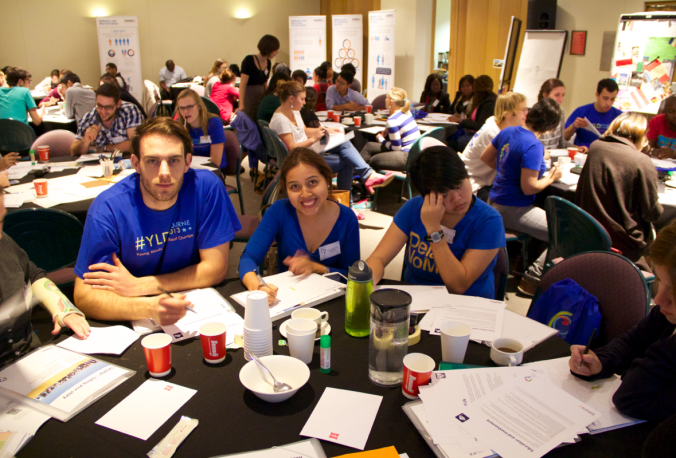
International Diabetes Federation’s ‘Young Leaders in Diabetes’ conference, Melbourne 2013. 124 diabetes patient leaders from more than 60 countries. 

I believe what Sexton foresees – patients will be inserted into more programs and places including educating medical students, those at healthcare corporations and anyone with a vested interested in health.

We should be looking now at creating ever more opportunities where people with chronic illness can serve as educators and inspirers.

We should be more fully leveraging this powerful and critical “smart patient” movement to educate, cut costs, amplify resources and offer the sole province of patients – shared empathetic understanding.

For in the end, no one “gets it” like the one who has it.

For a list of more diabetes social media sites, blogs, books and more on the A1C champion program click here.