
Just one of the several companies racing to bring out an artificial pancreas.
Learn more from Diabetes Self Management about this promising device currently being researched.
Just one of the several companies racing to bring out an artificial pancreas.
Learn more from Diabetes Self Management about this promising device currently being researched.
Of late, I’ve been sent, with my permission, three different food items that claim to be low glycemic index. This is not a post to contest that. They are. I just want to share what they are so you know and can decide whether you’d like to try them yourself.
Tom & Jenny’s – They produce caramels that are frankly luscious and sugar-free. I don’t typically eat caramels, but if you do, I think you’ll be very happy. Jenny is a dentist who wanted to bring her patients a candy that wouldn’t stick to their teeth or contain sugar. Tom left his career as a management consultant to become their Chief Candy Officer. 
I was sent two bags – the plain caramels and chocolate. I brought them to a luncheon of 22 people and handed them around. There was only one dissenter and most wanted more. Needless to say they’re long gone so I can’t tell you how many carbs are in each caramel, but I’m sure if you write to Tom he’ll let you know.
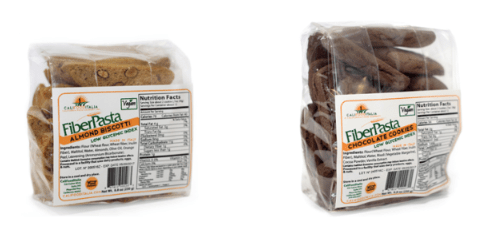
FiberPasta – Mary Rose, a CDE, sent me a note on Facebook asking if I’d like to try these pasta and biscotti products made in Italy and made with high protein, high fiber and low carbs. Of course I would. The pasta’s glycemic index is 29 (compared to typical 40), with 15 grams of fiber and 12 of protein. In all honesty it tasted fine, although a bit bland, so I only tried it once. I just don’t eat much pasta. But if you’re looking for low glycemic index pasta you should try it. Now, the almond biscotti (11 grams of carb in 2), I loved. Not sweet and gorgeously nutty.

Raw Amour – These chocolate truffles (I was sent two packages – the certified low glycemic and the coffee flavor) come six in a pack. The low glycemic truffles have a glycemic index of just 6. The package was a little misleading as it says, ‘Delicious Organic Truffles for Dark Chocolate Lovers.’ That surprised not just me but also Kyle, whom I shared them with (another T1D) last night, since they taste mostly of cashew butter, which was in the center while surrounded by what looked and tasted like milk chocolate. I’ve since been told they’ll be named ‘Cashew Truffles’ which is appropriate.
The coffee flavored, which I haven’t tried yet, does contain raw agave and maple sugar, yet still has a glycemic index of 15.

According to Raw Amour’s website, they’re the only certified organic low glycemic chocolate in the marketplace. You can also read this review on One Drop where the reviewer tested the carb impact, feeling true amour for Raw Amour.
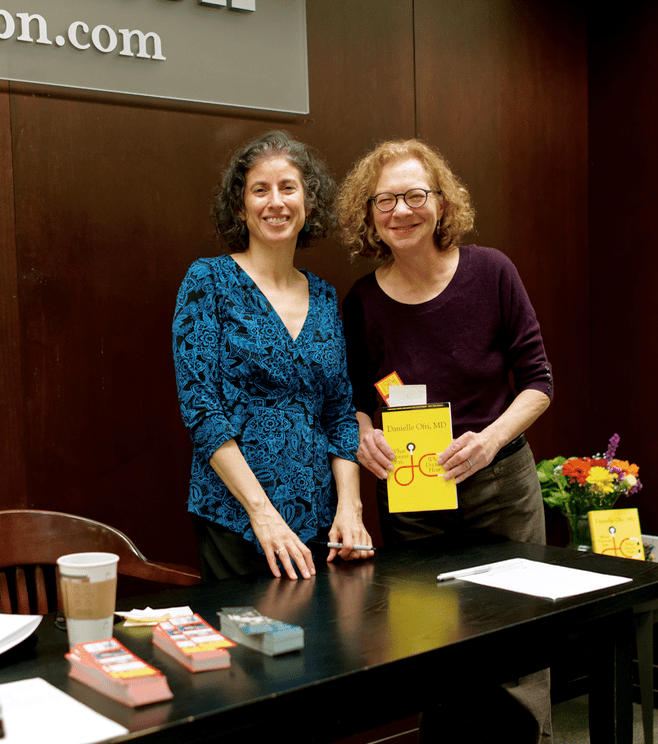
…is the perfect title for this sixth book by Dr. Danielle Ofri, internist at NYC’s Bellevue Hospital, author and regular contributor to the New York Times.
I’ve read all of Ofri’s books and enjoyed the candor, conversational tone and heart with which she writes. She is a voice and witness for both patients and providers trying to do better with this fragile union.
I wrote a full book review on the Huffington Post.

I stole this photo from my Facebook friend, Richard Vaughn. He posted it on Facebook along with a lovely and lengthy write-up about what’s been learned by studying people who’ve successfully lived with type 1 diabetes more than 50 years.

Richard, above, has had type 1 diabetes for 71 of his 76 years. He’s also become a wonderful advocate for the community.
If you’ve had type 1 diabetes for more than 25 years, and you notify the Joslin clinic, you will be sent a certificate. For 50 years or more you get a very special award – and the opportunity to participate in the Joslin Medal study. This is a fabulous study because it’s looking at what people do, and what their bodies do, to create health; they are researching how people with type 1 diabetes manage to live a long life to share with all of us.
I’m going to pull out from Richard’s post pretty much the answer they have thus far found to that question:
Dr. George L. King, the head of the Joslin Medalist Study in Boston, is working with more than 800 people in the Joslin Diabetes Medalist program —people who have been awarded medals for living with type 1 diabetes for 50, even 75 years —to uncover how they have managed to avoid many diabetic complications through the decades.
“They are very interesting people,” King says about his study group. “Some of them built their own glucose meters in the 1960s and 70s, before they were widely available to the public.” Aside from being avid do it yourselfers, King found other shared traits of those who have minimized the complications from diabetes, despite living with the condition for many years.
After discounting genetic factors, King’s research so far reveals that most of the Medalists exercise regularly. They are also very careful with their diets. But, more than this, King noted another shared trait that, although fairly abstract, is very important. “They are very good advocates for themselves,” King says of his subjects. “The are always on the lookout for new treatments. They are definitely a proactive group. They’re not sitting on the sidelines waiting for something to be done for them. They’ll do it for themselves first, if they have to.”
King, and other researchers, also discovered that HDL levels, the so-called “good cholesterol,” is high in Medalists without complications.” We are looking into that,” King says about the implications of the HDL levels.
By examining the Medalists King hopes to uncover the specific, if not the actual molecular ways in which they are protected from complications. Is it lifestyle? Genetics? Life choices? Or, is it something else? “The hope is we look at humans who are protected, then see why they’re protected, and come up with answers about lifestyle,” King says. “Then, by looking at their tissue and biochemistry (after death) we can perhaps develop medications to simulate the biochemistry that protected them.”
On that front, King says they have discovered a way that naturally-produced human insulin prevents arteriosclerosis. “Can we design an insulin to prevent arteriosclerosis?” King says. “I think this may be possible in the next five years.” Because up to 30 percent of people with type 2 diabetes use insulin, such a breakthrough would be good news for more than just for type 1 diabetics, he points out.
Meanwhile, as researchers like King work to understand the factors that protect some people from the complications caused by diabetes, and until the development, and testing of medications as a result of those findings come to market, there are things diabetics can do to help themselves avoid retinopathy, neuropathy, kidney disease and cardiovascular disease.
“Don’t smoke, watch your diet, and exercise,” King advises. “Also, advocate for yourself. Be proactive. That’s the main trait of the Medalists—they stick up for themselves.”
All good advice and nice to see a study looking for how people do well so we can share that with others.
I met Mary twice. Although one time was really more of a sighting. I was walking down the street in Manhattan when all of a sudden she appeared walking past me. I remember because, after all, it was Mary Tyler Moore.
The same Mary Tyler Moore I spent my high school and college years with along with Rhoda on the groundbreaking TV sitcom, The Mary Tyler Moore show. TV Mary was loved for her come-back-up-from-being-knocked-down, can-do spirit. The real Mary showed much of the same spirit as an advocate for type 1 diabetes (T1D) for decades. At times people said, “Isn’t she too old?” But she widened the circle; she showed the world T1D wasn’t just a disease of children.
Moore got T1D in her thirties. She lived with it for almost 50 years, and had complications like vision loss. Yet, I never heard her grumble.
The first time I met Mary was at a book signing she was doing at Barnes & Noble. I went. When I reached her to sign her book, I was awful cheeky. I handed her my own book, The ABCs Of Loving Yourself With Diabetes, “Please,” I said, “allow me to share a gift with you. I hope you like it.” She was gracious. It was a moment.


Life is moments. As you get older you realize how quickly they go. This week, after just returning from 18 days in Israel, I have a funeral to go to tomorrow after a friend just lost her mother. Last night the husband and I attended a memorial service for another friend’s mother who passed.
I heard a long time ago, “Life is not a dress rehearsal.” Israelis know this. Maybe because of the precarious place they occupy in the world, both geographic and political. Things happen quickly there. You mention something and someone gets on their cell phone immediately, a meeting is called and it takes place within days. There’s something to be learned from that. Let’s not waste these moments.
Among the many articles I’ve been reading about Moore’s death, this was an interesting tidbit. The original theme song to the Mary Tyler Moore show (Love is all around) opened with these lyrics – “How will you make it on your own?/This world is awfully big, and girl, this time you’re all alone” They were changed to enhance Mary’s and the show’s optimism – “Who can turn the world on with her smile?/Who can take a nothing day, and suddenly make it all seem worthwhile?”
Since I’m sharing ‘flourishing with diabetes’ it spoke to me. Part of what we create is based on how we see our circumstances. Mary had her demons – two alcoholic parents, alcohol abuse herself, a son die young due to either an accident or suicide when handling a gun, two failed marriages, and a series of failed TV programs after she, Rhoda, Phyllis, Lou, Ted, Murray, Georgette and Sue Ann huddled for their tearful goodbye as the lights went out at WJM Minneapolis. But she was resilient and a fighter.
With love, Mary. Thanks for making us laugh and thanks for fighting for us. You’ll be missed.

In 2015 the International Diabetes Federation honored me with the distinguished IDF Lecture Award. That honor came with the opportunity to give a lecture on the topic of my choice. I shared the Flourishing Treatment Approach (FTA), a different way for health professionals to work with people who have diabetes (or another chronic illness). A way that helps people flourish not merely cope.
At the end of that lecture, Dr. Ilana Herman-Baham, Director of Internal Medicine and a diabetes clinic in Israel, came up to me and asked, “Would you come to Israel and share this with our diabetes nurses? They need to hear this.”
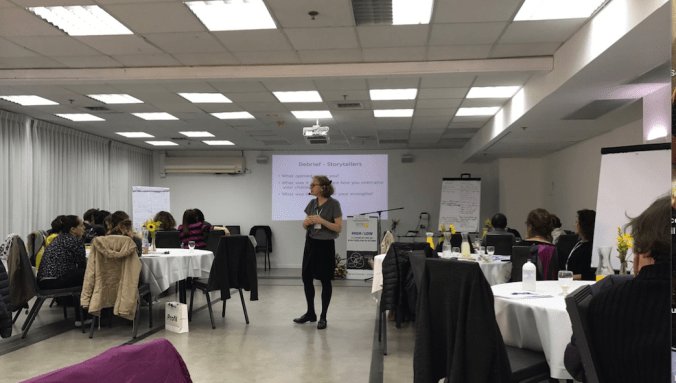
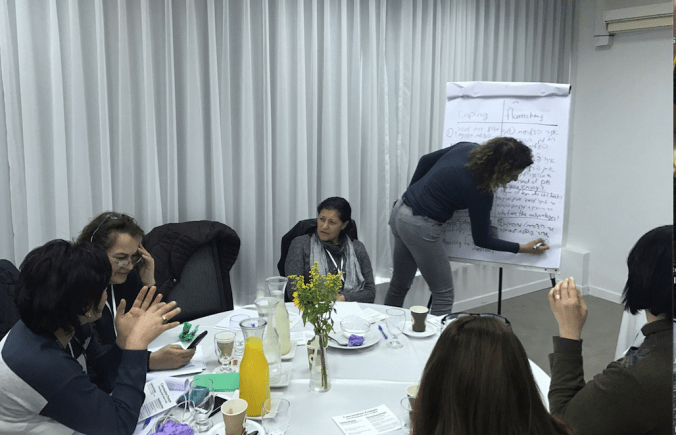
That’s exactly what I did in Zikhron three days ago at the ALUMA Israeli diabetes educators conference. It was a joy to work with them and to experience once again, as I had educators practice listening, communication, connection, strengths-discovery and inquiry skills, that the FTA works everywhere in the world regardless of culture, economics or health specialty. We are stitched together by our humanity and it is humanity that we must put back into medical training.
As much as being taught what to do, people living with a chronic illness need providers who can hear where they are and skillfully inspire them forward. I am grateful and appreciative to all who have and continue to invite me to do this work.


This month’s issue of Diabetes Care and Education’s On the Cutting Edge (screen shot above) features game-changers in healthcare – how it’s administered, taught, innovated upon. Topics include patient-generated health data, teaching culinary skills in medical school and unique partnerships in diabetes – along with our article.
This is the second piece the hubby and I have written for this nutrition and dietetics peer-reviewed journal. You can access the full article if you are a member. Should you be, or interested to become, here is the website. This particular issue is 2016/Volume37/Number 6.
To give you a taste of the Flourishing Treatment Approach, here is the Abstract from our article:
The predominant treatment approach today for people with diabetes focuses on the biomedical aspects of the condition. We term this disease-centered approach the “Coping Treatment Approach” (CTA). Its aim is to treat the disease and, thereby, help people cope with diabetes. This article examines a fresh perspective and new approach, the “Flourishing Treatment Approach” (FTA). This relationship-centered approach is based on salutogenesis, the causes of health, rather than the pathogenesis of the disease. The FTA provides a strengths-based, customized framework for wellness to emerge. This game-changing philosophy and practice includes practical tools for health professionals to improve patient outcomes.
I am soon leaving for Israel where I will be presenting the Flourishing Treatment Approach, and facilitating a workshop on its skills, for the Israel Diabetes Educators Association. This game-changer in healthcare has resonated with many who work with people who have diabetes.
When the journal was published, I received a postcard from the editor:

It’s a gift to work with like-minded and supportive colleagues. I hope you too feel you have many gifts, of the immaterial kind, as we hold those we love close and reflect on our blessings this holiday season.
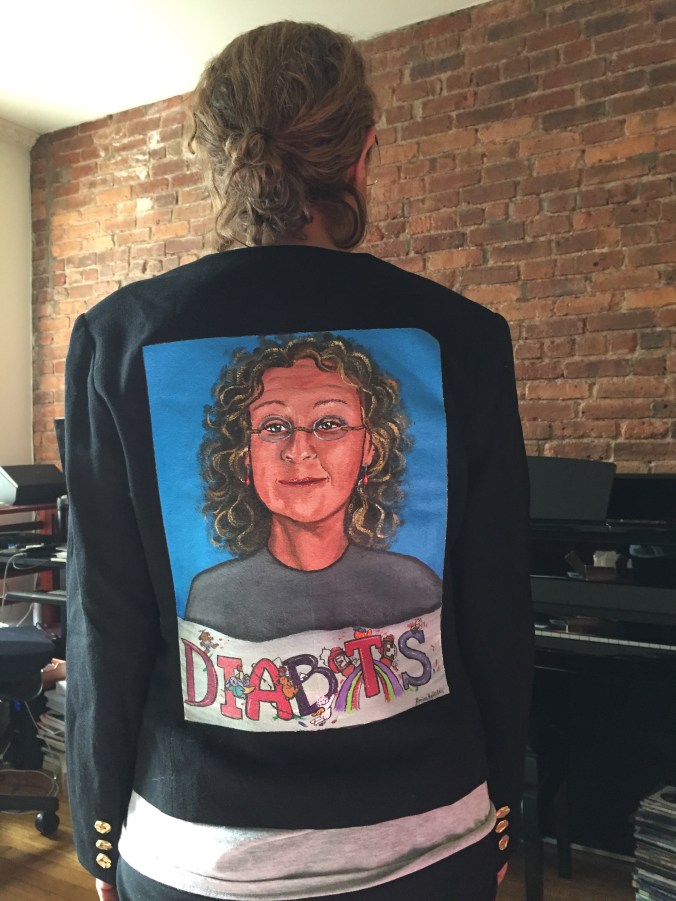
March of this year I read an article about Regina Holliday. Regina lost her husband to cancer, and also to a medical system that was thoughtless, inept, at times cruel and secretive.
Coming back from grief, Regina picked up her paintbrush and painted her sorrow. With that paintbrush she became a patient activist and has been painting patients’ stories ever since. Her mission is to help elevate patients to partners with their providers and to push for transparency in medical records and health information.
She paints her murals for a donation. You send her a jacket, tell her your story and when you get the jacket back with Regina’s mural painted on the back, the mutual agreement is you wear the jacket to at least 3 health events you attend.
I immediately sent Regina a jacket, and since I knew it would probably take a few months to get it back, I just as quickly forgot about it. Imagine my surprise when this October I was invited to speak at a health marketing conference and Regina was the keynote speaker.
I mentioned the jacket and told her about my work and, voila, today my Regina-painted jacked arrived in the mail. An early holiday gift!
These jackets Regina says is a way to display our patient stories and keep them alive in the public eye. If you attend health events and would like to be part of Regina’s Walking Gallery, click here for the information you need.
Thank you Regina. My jacket is off to Israel where I’ll be addressing the Israeli Diabetes Educators Association in January, Wisconsin next March for an ADA conference, and I’ll be strutting your stuff at the premiere Charles Best Diabetes Center in Toronto next April.

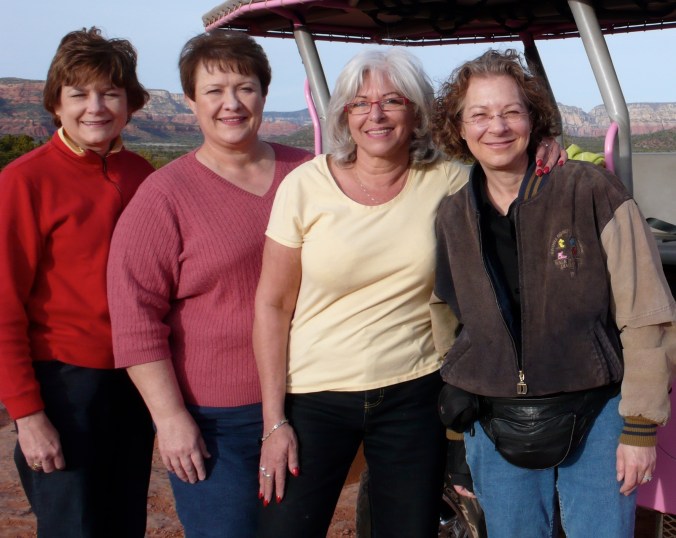
‘Tis the end of an era. This month the last A1C Champion peer-mentor programs are being given across the U.S. I have known my fellow 70 plus Champions for these past ten years, since I joined the group in 2006. Remarkably, nary a one has dropped out. But then maybe that’s because we’ve gotten as much, or perhaps more, than we’ve given. It’s how peer-mentoring works.
For my reflections over these 10 years and Sanofi’s business decision, click here. It’s a full article on the Huffington Post.
To my fellow Champions, here’s to you who dedicated your time, energy and compassion to sharing, educating and inspiring people with diabetes. Sorry to those I left out, I love you all.


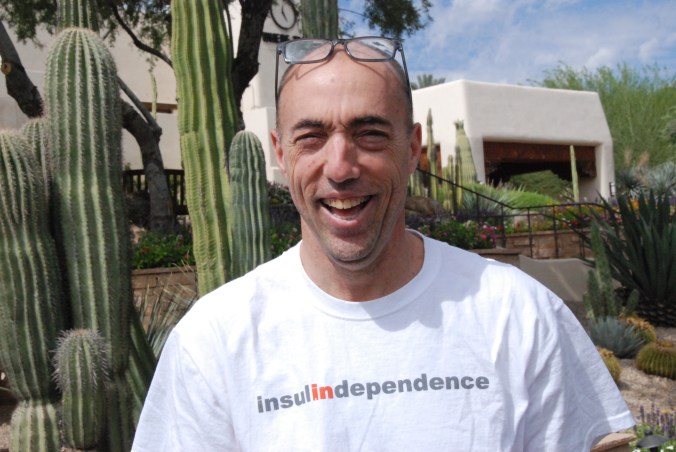
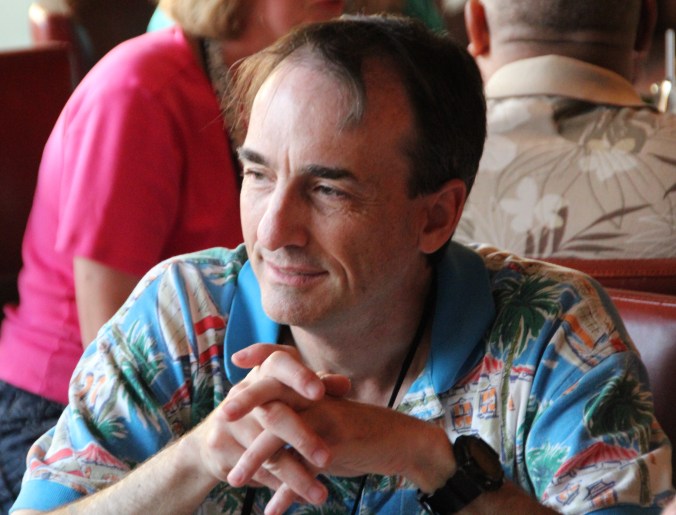









Anders is 25 years old and has had T1D since the age of 2. Anders needs your vote to enter a 300 km dogsled race – to prove we can do most anything with diabetes. Go here to vote.
I’m asking you to take 30 seconds and help Anders’ dream come true. I had to after he sent me this email – “I want to show that anything is possible, even with diabetes. To achieve this I’m entering a contest where the winner will do a 300 km dogsled race. I must get the most votes by December 15th. Usually I never ask for these kind of favors, but since this is something I really want, could you maybe share the link where you can vote for me. I understand that I’m asking for a lot, but I just have to try and would understand if you decline.”
How could I say no? So if you can you spare a couple of seconds, why not help Anders’ dream come true too.
http://polar.fjallraven.com/contestant/?id=777&backpage=2
Done? Thank you. I also asked Anders to tell me more about himself so this is who this young man is:
“I’m 25 years old and currently taking a masters in civil engineering. My parents have always said to me that nothing is impossible and that I shouldn’t let my diabetes be an obstacle. As long as you are careful about what you consume, think about how your day has been and follow up by enough glucose test, you can do everything. Of course you’ll have some bad periods, but I think that as long as you stick to the basics and figure out what works for you, you will be okay.
I’m a spinning instructor and personal assistant for a friend that needs assistance when she goes alpine skiing with her biski (Please let me know if you know what this is). I’ve also run a marathon and done several bicycle races, cross country skiing and kite boarding. Some of the competitions I participated in, I’ve had either too high or low glucose levels and that can happen. It’s not the end of the world. It just makes it even better when things are going your way.
I love challenging myself and as my last challenge I’m participating in the Fjällräven Polar dogsled race. I hope by doing so I can also teach the other participants a bit more about diabetes. I try my best not to let it limit me.”
There are times in life you have to say “yes” to someone else’s dream – especially when it’s so simple and easy. Thank you for also saying yes and sharing.
 Diabetes Stories