How circadian rhythm affects our sleep, diabetes and obesity – and the keto diet and fasting

Screen Shot 2018-07-26 at 5.00.00 PM.png

All week I’ve been watching a 9 episode summit from co-hosts Naomi Whittle and Montel Williams. Naomi is a best selling author and “Wellness Explorer” and Montel, has had Multiple Sclerosis for the past 20 years. Both are into the science of metabolism, health and weight loss.

The summit largely covers the ketogenic diet and fasting. Ketogenic eating is a very high fat very low carb eating style. I do eat low carb but I could never follow a keto eating plan. Fasting, apparently, is the new hot strategy for restoring health. Not a juice fast, horror, all those carbs! A plain water fast or something called a “mimicking fast” where you get to imbibe a few things that don’t let your body know you’re not really fasting. Things like green powders, bone broth and maybe some avocado.

The theory is during a fast the body switches from burning sugar to burning fat because you aren’t feeding it, and it starts chewing up your unhealthy damaged cells and remaking healthier cells. The simplest fast is a 16 hour fast. Don’t eat from after dinner around 8 PM til lunch the next day. It’s called intermittent fasting. You can also do a one day fast or a 3-5 day fast which is supposed to regenerate stem cells. I’m not going to go into more detail here but you can find scads of information googling both ketogenic diet and fasting.

I will, however, give an overview of something we rarely pay any attention to that was also discussed on the summit – and that’s how our natural circadian rhythm significantly affects our sleep, metabolism and insulin resistance.

Dr. Felice Gersh was the expert talking on circadian rhythm. From now on I’m going to shorten circadian rhythm to CR. Dr. Gersh’s main point is every organ and cell in our body has a CR, a clock it goes by to do what it does. When we don’t live in sync with our internal clocks we mess up our hormonal system, metabolism, microbiome, brain, well  pretty much everything.

Here are a few take-aways:

• When your CR is off the body’s melatonin production that occurs naturally at 2 AM  doesn’t happen efficiently. This interferes with a good night’s sleep and prevents the brain from restoring itself. We also know by now a poor night’s sleep raises our hunger hormones the next day and we are ravenous and tend to overeat, especially carbs.

• The liver is key to our metabolic health. When you’re not in sync with your CR, your liver doesn’t function well. This plays havoc with your body’s enzymes and the liver and gut (microbiome) become inflamed. Some fallout from this is the liver starts pouring sugar and fat into the bloodstream and doesn’t signal the pancreas to produce as much insulin as the body needs. Blood sugar rises and insulin resistance increases. Triglycerides also elevate.  Insulin is a fat storage hormone and with too much of it circulating in the bloodstream it begins storing carbs as fat in our cells. Fat clusters in and around our organs. It’s unhealthy. Fat in the liver is literally called “fatty liver” which many people with type 2 diabetes have.

• Too much circulating insulin from insulin resistance puts you in a state of constant growth where your body can’t trigger fat burning or cell rejuvenation. Inflammation in a body set for chronic growth can lead to cancer, due to the overgrowth of abnormal cells. It’s also the perfect environment for chronic diseases like diabetes, obesity and dementia.

Dr. Gersh points out society has set up a perfect storm for us to be out of sync with our CR. How can you disagree? How many of us sleep enough hours, eat healthfully and not too much, push away from our screens and devices hours before going to bed? How many of us spend time in nature on a regular basis, move our bodies every hour from sunup to sleep and eat all our meals on time and relaxed?

So what to do. Here are a few suggested tips. You can research further how to get back on track with your circadian rhythm:

• Go to bed between 10 and 11 pm. Sleep in a very dark room.

• Wake up on the weekends the same as during the week

• Spend more time in nature, go camping and sleep on the ground, watch the sun set

The last tip leads us back to the beginning. Dr. Gersh recommends a four day fast for resetting our inner clocks and putting the body into an overall state of rejuvenation.

As a result of the summit I’ve decided to try intermittent fasting so for the past few days I have stopped eating by 8 PM, except when I have to raise my blood sugar before bed with a prune or teaspoon of honey, and not eat again until 1 PM the next day. Days 1 and 2 were remarkably easy. The trick was keeping myself occupied in the morning.

Day 3 I was so hungry I could have eaten a cardboard box. That’s when my friend and fellow type 1, Ginger Vieira, told me it’s working! I still managed to hold off lunch til  12:30 that day, but this morning I gave in to a smaller than usual breakfast and tonight I’m going to fast again. I make no promises but I am enthralled by seeing what this experiment of fasting may do.

It makes perfect sense to me that fasting is healthy and that we overfeed ourselves. Our ancestors lived not having food much of the time, while today we are constantly eating which causes inflammation in the body which I believe is at the root of most disease.

For further reading on keto and fasting here are a few links Ginger shared with me:

1. https://drhyman.com/blog/2015/12/27/separating-fat-from-fiction-10-fat-facts-you-need-to-know/

2. Cheatsheet: Good fats vs. bad fats
4. Another great podcast/article on saturated fats:
I wonder who decided we should eat breakfast like a King, lunch like a Prince and dinner like a pauper?

Health insurance companies’ strategy – confuse, deny and don’t pay for anything

This was posted on Facebook today. I know Meri, she’s one of the loveliest people I’ve ever met, and she has the good and bad fortune to have three of her four sons have type 1 diabetes. I’m so overwhelmed by what she wrote, I will let you read it yourself –

Screen Shot 2018-07-03 at 7.36.35 PM.png

In addition to health insurance companies no longer protecting us, their rules and regulations are eating away at our health, our time, our hearts and our sanity.

Screen Shot 2018-07-03 at 7.46.42 PM.png

Meri’s children above. It is inexcusable.

Medicare’s Donut Hole – Get caught inside and you’ll find nothing sweet

Screen Shot 2018-06-28 at 8.57.30 PM.png

This is not so much an informative post as one of outrage. Quiet, desperate, stomach-churning dissolution and despair, the smoking embers of what I learned 29 hours ago.

My brilliant stroke of outrage came yesterday sitting in the office of my now Medicare broker when I was told how much my insulin is going to cost me after only four months on my Medicare drug plan. I start Medicare in September. By January I’ll be paying outrageous amounts of money for insulin.

My questions during the meeting were about the workings of Medicare, a four-headed beast – Part A (Hospital), B (Doctors & Tests), Supplemental (Who knows but you need it), D (Drugs), but the questions I left with were societal: Where are we headed as a country that’s making medication unaffordable? Is America a society if it only cares about making rich people richer and providing for those in power?

If you want more in-depth Medicare information as someone with diabetes, please go to Laddie Lindahl’s web blog, Test Guess and Go. Laddie did us all a great service taking us through her learning curve as she approached and signed up for Medicare recently.

This post is about outrage and here’s the bottom line: If you have diabetes and you inject insulin you are going to pay just about as much, maybe more, per year for the cost of your Medicare than a commercial health insurance policy. Why? Because of the unregulated inhumane increase in the cost of insulin over the last decades, particularly the last few years.

For this reason you will get caught, a few months into your Medicare drug plan, in the “Donut Hole” also known as the Coverage Gap. You will be required to pay 35% of the actual cost of insulin each month for the rest of the year once you’re in the Hole. For me, and my insulin doses are low, that calculation is $144/month for my insulin. Contrast the $25 I pay currently on my ACA plan for a three month supply. That’s less than $10/month. For type 2s, who use much more insulin than me, the cost will be much, much higher.

What does this mean beside the fact that Canada is looking pretty good as a stop & shop vacation? That this fight to bring down the twenty-fold increased price of insulin since 1970 is essential. I won’t go into the big pharma, lobbying, middlemen bru ha ha but this is a good article if you’re interested. We on insulin also get caught in the donut hole because there are no generics for insulin. Insulin is a Tier 3 brand name drug, the most costly. Basaglar, which is a biosimilar for Lantus, while not a generic may be lower than a Tier 3 drug, I don’t know.

I wrote “injected insulin” earlier. Now get this – If you are on MDI, Multiple Daily Injections, like me you will get your insulin through Medicare’s Drug plan, Part D. If, however, you use an insulin pump, all the insulin you need for your pump is covered under Medicare Part B – durable goods. Part B pays 80% of the cost of your pump, pump supplies and insulin and your supplemental plan covers the remaining 20%. You pay nothing!

To add to the crazy logic – only tubed pumps are covered in Part B. Omnipod, a tubeless pump, is covered in Part D. But think about it – that means you will still be paying for the insulin just as if you were on MDI. You will still end up in the Donut Hole. Sob, I had a shining hour when I thought well maybe going on Omnipod wouldn’t be so bad, but that dream faded when I learned it was covered in Part D.

I don’t profess to be an expert on this; I told you that up front. I am still reading the plans I selected, and hoarding insulin so I can make it through the first year of Medicare sidestepping the Donut Hole. It’s funny, for years and years people asked me why I don’t use an insulin pump. I always said the truth, I am diligent and disciplined and don’t mind shots, so a pump would offer me more elegant management, but it was not worth the trade off to be tethered to an external device. And now that I use the Dexcom CGM, it would be a second device. Who would have thought Medicare may be the reason I finally go on a pump. It remains to be seen.

While this post has not made you significantly more intelligent about Medicare, maybe you now share a bit of my outrage. Let’s do something. Sign the petition on the American Diabetes Association website to lower the cost of insulin. It takes seconds. Get more informed about what the Diabetes Patient Advocacy Coalition (DPAC) is doing to promote and support public policy initiatives to improve the health of people with diabetes and how you can be part of that.

If you are nowhere near the age of 65 I won’t tell you that by time you get here Medicare will be here to greet you. It may no longer exist. All the more reason for each of us to do something now to make our outrage heard and tell those cyclists up top if they have diabetes and take insulin injections they have little to be smiling about.

Medicare approves seeing Dexcom G5 numbers on your phone

dexcom-g5-mobile-app-large2_0.jpg

Let’s not talk about how ridiculous it was to take this feature away from people over 65, but celebrate that the flood of advocates who pushed up against it made them change their mind.

As of yesterday you can now download the G5 mobile app on your phone and share your numbers with anyone who has an Apple watch, enjoying the full functionality of your CGM as people under 65 do.

Given that I’ll be turning 65 this September, yes I know it’s hard to believe, I’ve been alerted that there is a group relevant to me now on Facebook, Seniors with Sensors. Oh, who would have thought 46 years ago when I was diagnosed at the tender age of 18, a freshman in college, that this would be in my future!

For a fuller explanation, if you know how to read legal documents, apparently this is the one you want to read. If you’re like me, and this makes absolutely no sense to you, here’s an easier read from Dexcom.

#10 HuffPost – Dear Santa, Will You Please Take This Diabetes Away?

Screen Shot 2018-06-10 at 5.07.45 PM.png

Okay, it’s Christmas in June, but completing what I started some weeks ago, here is my last selection from the more than 150 articles I’ve written on the Huffington Post over the past seven years.

It begins:

Dear Santa,

All I’d like this Christmas is for you to take this diabetes away. I’m so tired of it already. All the time stabbing my fingers for blood and guessing when my sugar’s too high or too low.

Now that I’m in menopause I can barely tell whether I’m sweating because I’m losing estrogen or because my blood sugar’s crashing at 50!

And, can we talk… I mean the constant figuring out how many carbs are in a ravioli or bread stick or that fried calamari that will be at the company Christmas party. Some days I just want to lie down and shoot myself. Please, please, Santa, would you take this diabetes away?

Sincerely,
Riva

And it continues….

Loving a partner with type 1 diabetes

Screen Shot 2018-06-04 at 2.04.53 PM.png

That is my husband’s job. And he does it brilliantly, or should I say beautifully, as both his head and heart are involved. Actually I could not imagine having a more supportive partner. And while we knew each other a dozen years as friends before we got married, and he “knew” I had type 1 diabetes (knew is in quotes because in-depth knowing is different than superficial knowing), his knowingness, appreciation for what i live with, and admiration, grew with each passing day of our married life.

He wrote a beautiful piece about what it’s been like for him to be the partner of someone with T1D here. Page 8.

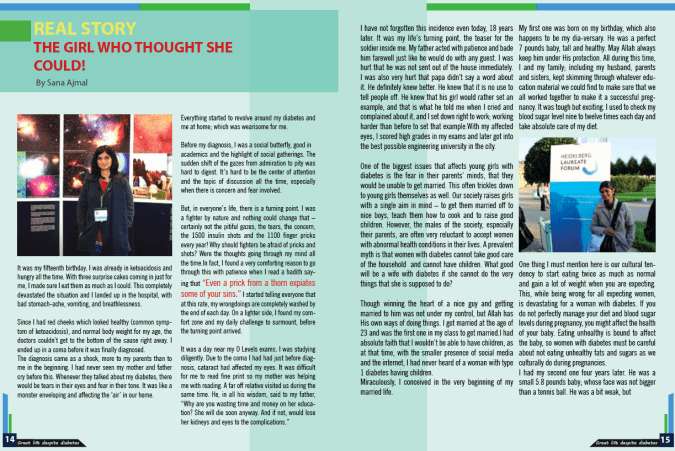
I want you also to read the article on page 14 (pictured below) written by the publisher of this magazine, Sana Ajmal, and utterly amazing young woman who lives with type 1 diabetes in Pakistan, with her loving husband and two young boys in a country that DOES NOT encourage men to marry women with diabetes. Beyond wife and mother, she has gotten her PhD in engineering and is working on producing an affordable insulin pump, is a tireless diabetes advocate and inspires those of us fortunate enough to know her.

Screen Shot 2018-06-04 at 2.05.13 PM.png

My latest Thrive Global post is about the power of strengths and positive emotions

Screen Shot 2018-05-22 at 4.18.32 PM.jpg

Whether you’re looking for a way to bolster yourself in general or during those god dang frustrating moments with diabetes, I have always found acknowledging your strengths and spending more time with positive, rather than negative, emotions a doorway in.

I got to see the effects of sharing this with a dozen women recently at a DiabetesSister’s POD group in Princeton, NJ and with about 40 participants at the recent JDRF TypeOneNation Summit in Manhattan.

Full article –

Resilience Tip: Weaken Negative Emotions, Strengthen Positive.


DiabetesStrong agrees flourishing is the way to look at diabetes

I met Christel and her husband Tobias at the Afrezza product meeting we attended a few months ago. They founded and run the web site DiabetesStrong and frankly – they are. Christel has had type 1 for 20 years and Tobias has her back.

Screen Shot 2018-05-23 at 3.11.44 PM.png

We got to talking and Christel asked if I would write a guest post on my mantra, “flourishing with diabetes.” It’s now resting comfortably on the DiabetesStrong website.

Through the grace of Sanofi, we reposted an article I had originally written for Sanofi DX a few years ago. It captures exactly the sentiments Christel and I are excited about –  that living with diabetes you can do more than cope, you can flourish.

Since as far as I’m concerned classics are always in, it’s nice to report this classic. Or, would this be considered regifting? In any case, if you want to be inspired hop on over to DiabetesStrong have a read and a look around the site that covers it all – food, nutrition, recipes, exercise, technology, products.

You won’t help but come away just a tad diabetes stronger.

Stanford Medx’s April conference theme – Innovating on medical education


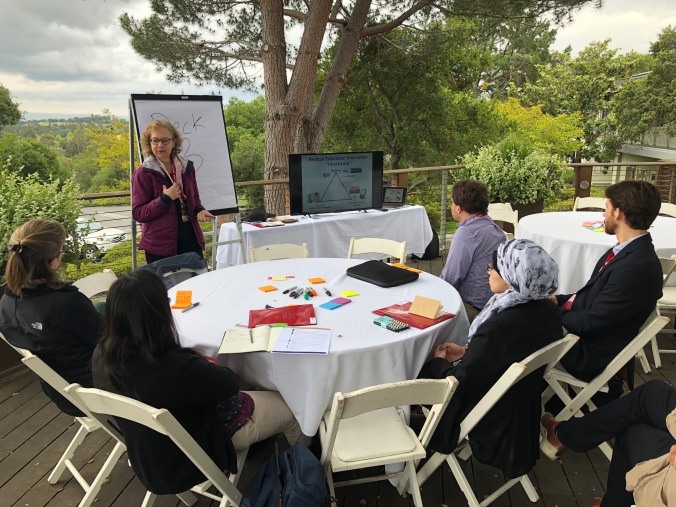
S Medx.jpgTwo weeks ago I presented my Flourishing Treatment Approach (FTA) at Stanford Medx. The conference theme was innovation in medical education. The FTA is surely one.

It is a science- and neurology-based method of working with people, seeing them as resilient beings with strengths and capacities. The FTA and its tools recognize the possibility of flourishing in life with a chronic condition, not merely coping. Even, and often, not despite but because, of one’s condition.

While the number of attendees was small, around 150, immediately apparent was how many “patients” were participating. My hat’s off to this conference which says it is the intersection of people, technology and design, placing patients and caregivers at the center of medical education, in partnership with medical learners and teachers.

Many people were walking with the use of canes, others with a slower gait, others with heads covered by colorful scarves. Adam, whom I met, has a brain tumor and a prognosis of three years to live. Yet he and everyone I met, while at moments facing their hard truths, were inspiring.

The day before the conference began one of my heroes, Dr. Victor Montori, Professor of Medicine at the Mayo Clinic, gave a Master class where we looked at how to fix our broken healthcare system.

Montori reminds me of the fabled character Don Quixote, brave against all odds. He spoke of the inherent conflict between healthcare, which is a profit-making business, and “care” as a means of individuals coming together in love and relationship, where clinicians come from service. Montori’s professional quest, beside being this emissary of care for his patients, is taking up the challenge to humanize and de-industrialize modern medicine.

“Without a relationship of love,” said Montori, “care cannot happen.” So while empathy was a centerpiece of the conference, along with design-thinking, few speakers were brave enough to say true empathy cannot happen without love.

I also admire the conference’s other keynote speaker Bon Ku, MD and Assistant Dean for Health and Design at Thomas Jefferson University. He gave a fascinating and revealing presentation on how design works and doesn’t work in today’s hospitals and education of medical students, and how we can design more caring communities.

The healing power of story-telling and story-listening, admitting to failures in medicine, changing our language to change thinking and attitudes, were all centerpieces of the conference, as well as an inspirational message from a doctor with a spinal cord injury who shared the bias he had encountered on his professional medical journey.

It is a ripe time to enlighten our medical students before they become fixed in what they learn to better understand the lived patient experience. Otherwise, how can we expect our future clinicians to be able to keep people healthy and well over the long term?

It is time we have more conferences like this that break down the walls between provider and patient and build bridges.