No urgency in Emergency

Lying in bed at 6 A.M. a few weeks ago I felt a sting and when I brushed my hand against my wrist, felt something fuzzy there. I didn’t know it but I had just brushed off a hornet or wasp or bee that had stung me. I jumped out of bed, ran to the kitchen to inspect my throbbing wrist, ran back to the bedroom (mind you these runs are only 10 feet long) to wake my husband. We turned on the light and there was my attacker on the wall near the lamp on my dresser. I began to freak out.


While I expected my husband to nurse me in some way, he sat down with his computer on his lap, his typical early morning work routine. I was flabbergasted until he began reading off a web site what to do for bee stings. As he read the anaphylaxic (allergic reaction) life-threatening symptoms: throat closing, light-headed, dizziness, weakness etc, I was having them all. I was so weak I had to sit on the kitchen floor, my head spinning and my legs falling out from beneath me. Then through my fog I heard my husband’s voice, “Check your blood sugar, check your blood sugar, check your blood sugar.” With shaky hands I did and it was 57, most likely the cause of my weakness and shaky symptoms — along with a good dose of panic.


After I gobbled some glucose bits, my blood sugar returned to normal but my panic was only slightly abated. I’ve never been stung by a bee. How serious is this? My Aunt is allergic, if she gets stung I know she can die. Is there a stinger in my wrist we have to get out? We followed all the steps advised on the web site should there be an embedded stinger and then I said uncharacteristically, “Let’s go to the ER.” It was Saturday and I knew I couldn’t reach my doctor.


We walked the six blocks to the hospital, and as we walked I questioned whether I really needed to go. But I was worried and wanted someone to tell me it was O.K. so we kept walking. 


Entering the ER was nothing like on TV.


We arrived at 7:15 A.M. Only two people were in the waiting room and I thought this is great, I’ll get seen soon. Then the drunk showed up strolling the room and talking aloud to no one and then the woman who’d been sitting there quietly started yelling and every 10 minutes went to the public phone nearby to yell to someone how much pain she was in and no one was paying attention to her. More like she was off her meds. I saw they paid attention to her when security finally came to calm her down. What a freakish scene I found myself in, on an early Saturday morning, in a place I’ve never been, hoping for quick medical attention.


When we had first entered the receptionist asked me a bunch of questions, only one having to do with my bee sting, and typed my answers into her computer barely looking at me. A half hour later I was called up to another desk where the woman asked me the same questions and typed my answers into her computer. As I tried to engage in at least some conversation, we spent more time talking about her failed diet than my bee sting. 


When I finally saw a physician’s assistant, 3.5 hours after arriving, including the one hour wait after being called into the inner sanctum of the E.R. where I was utterly ignored, she told me all looked fine, go home and take some pain reliever. 


In truth, I was relieved to hear a medical person say, don’t worry, it’s O.K. I guess that’s what I came for. And I surely understand that if there were people arriving on stretchers then my bee sting could wait. But having one simple nurse up front could have sent me home in less than a half hour and receiving one simple smile could have ameliorated the cold, fearful wait. 


As I left I thought let me never come back here again unless it’s through the back door on a stretcher. 
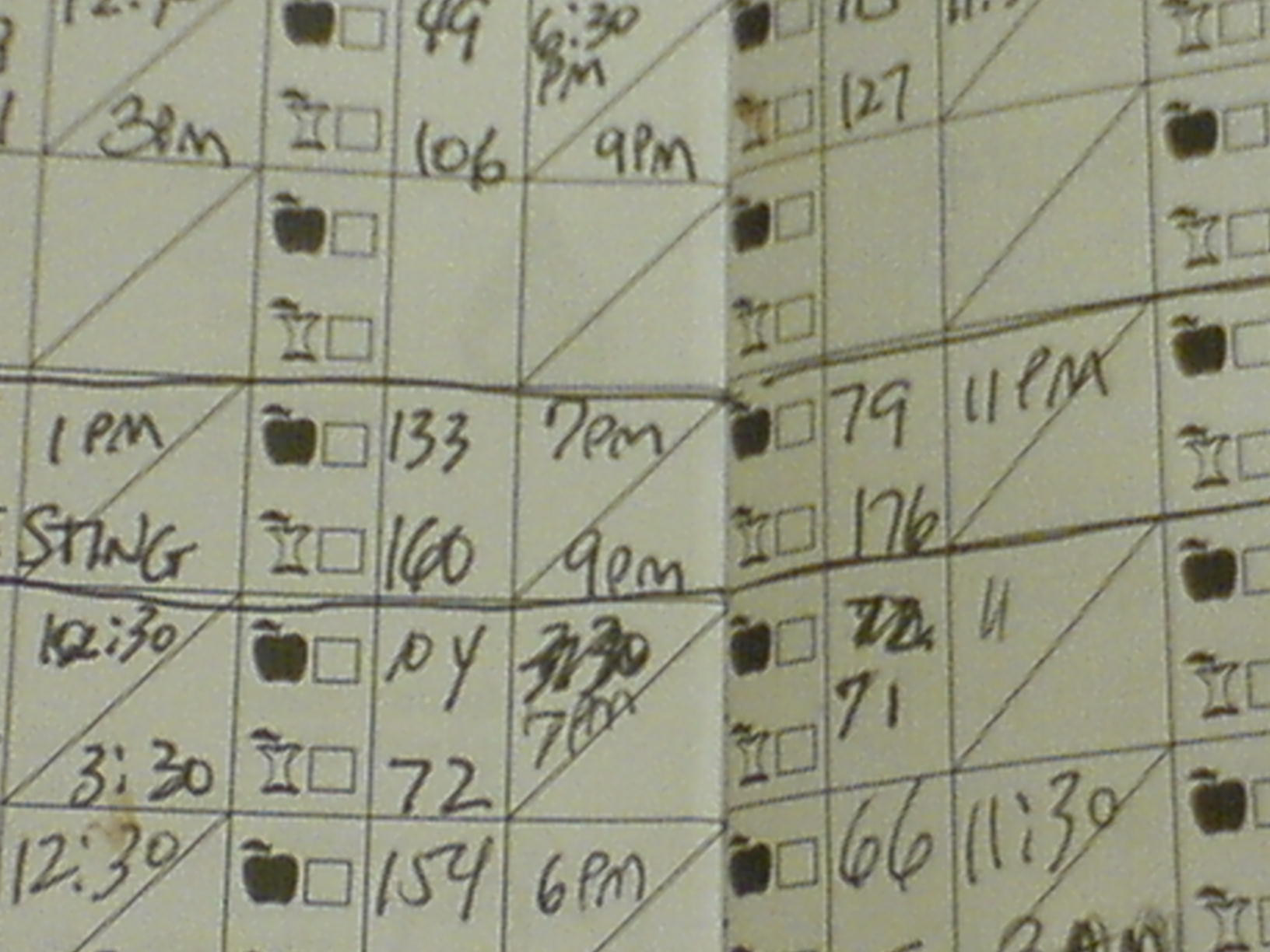


Ready to torch my blood sugar log

DSC00587


For the first time in I don’t know how long I’m keeping a log of blood sugars. No kidding, it has the blood smears throughout to prove it. 


The reason? Two weeks ago I started with a new endo whose main task has been adjusting my insulin dose and when I take my Lantus so I have less lows. Personally, I wasn’t particularly concerned about my once or twice a week low, and I particularly liked that my A1cs are in the 5’s, but endo said the fluctuations in blood sugar irritates the blood vessels and it would be healthier to be mainlining more around 100 and up to 140 two hours after a meal. 


That meant two changes: 1) Cutting down from 14 of Lantus to 10 units and 2) Switching my Lantus from before breakfast to before bed.  Switching to before bed was to override the morning highs (dawn phenomenon). My sugar was rising so fast in the morning it was thought my Lantus wasn’t lasting 24 hours and by moving it to before bed I’d have better coverage for the morning. I’d been taking a first dose of Apidra by 7 AM to blunt my blood sugar rise and then a second dose for breakfast. The cutting down on the amount of Lantus I was taking was because endo thought I had too much Lantus in my system overall the 20 or so hours it is working, and it may be contributing to my lows. 


But cutting back to 10 units, the immediate result was HIGH blood sugars. I was freaking out. And, I had such unpredictability with my numbers that I  was unexpectedly at a loss how to deal with my rapid-acting mealtime Apidra. I had had my routine sooooo down pat before this all started that this lack of control was, and is, driving me insane. So we upped my Lantus to 12 units which seems to be working a little better except for the 261 I had out of the blue after lunch the other day and the 30 that awoke me at 2 AM with my heart beating out of my chest. 


I’m not liking this new routine much. Can you tell? The unpredictability is driving me nuts, did I say that already? If so, it’s worth repeating. But, I have to commend my endo for checking in with me weekly to discuss my numbers and for listening to my frustration. That can’t be fun. I’m giving endo another half point.


And I’m going to give this new regimen, which now includes dosing my Apidra for dinner higher since those evening hours may be when my Lantus is wearing off now, another week to see if things settle down, which I tell myself daily, hourly they will. And while I wanted to jump ship this morning and go back to my old ways, endo said let’s give it another few days and I know endo is right. I know I am biting at the chomp to cut the process short because I’m so impatient to be back in control. However, this morning endo revealed another reason to try and get my sugars to be more consistent: lows can lead to insulin resistance. Oy!  


One thing I can say from all this stomping around in my sugars is I see a clearer case, personally, for using a pump. To have as I’ve always described it, “more elegant control” – greater flexibility in the moment and to be able to preprogram for more and less insulin as the body needs it at various times of day. Personally, I was waiting for the pump to get small enough that it wouldn’t feel like an intrusion on my body, and it seems to have done just that with the soon-appearing-near-you Solo MicroPump


So while I’m still futzing around with my calculations I can offer you some advice from two diabetes educators I checked in with about what the ratio should be between your Lantus and rapid acting mealtime insulin if you use both. 


How much to dose: “Historically/Mathematically the total daily dose of insulin (both Lantus and Apidra or Novolog or Humalog) would be divided in half, Lantus being half and the prandial (mealtime) insulin being the other half which is then divided further by 3 to give the dose before each meal. This usually coincides with eating a minimum of 30 – 45 carbs/meal. Not everyone’s body, however, matches what can be figured out mathematically. But it’s a place to start and then you tweak it just like you are doing.”


My other educator added that since I eat a low carb diet, maybe 15 grams of carb/meal at most, except for breakfast, that I shouldn’t expect my Lantus/ Apidra ratio to be 1:1 but more like 2:1.


General rule for where your sugars should be: 80-100 before meals, 125-140 post meals and 120-140 before bed. 


My advice: Find the best match between your medicine and your blood sugars even if it takes some doing. Make it a priority – both for your diabetes health and your peace of mind.  


A crowded corner in diabetes-land, Lonelyville

Bryant park - 1

I live very near a coffee shop called, “Lonelyville.” I pass it on my morning walk. I always think what an odd name it is for a coffee shop. After all, the people sitting there chatting in groups of two and three and the ones on their own bent over their laptops are all there precisely to leave their lonely selves out the door, and feel unalone. 

When diabetes patients are surveyed about the challenges of living with diabetes, loneliness is always at or near the top of the list. Living with chronic illness is a lonely affair, whereas short term illness not so much. For instance, break your arm and it will mend in a few weeks or months: You know the experience will end. That allows you to get lost in, and commune about, your poor arm: “Hey there, buddy, what happened to you?” people ask and you get to tell your tale of woe or anecdote. You can show off your cast, people sign it with endearments, and you complain about how itchy your arm is and people commiserate, “Oh, poor baby.” And even if you feel lonely for a while, it will end and your arm will mend.

Diabetes doesn’t end. And for most of us there’s no outward appearance of it, nor how hard you work at managing it. I was out to dinner this week two nights in a row. The first night my husband and I were meeting an acquaintance of his and his new girlfriend. When the conversation turned to my work, she said brightly, “My brother in law has diabetes!” Deducing he had type 1 and had gotten it recently, I asked, “How’s he doing?” She said, “He’s doing really great.” Her enthusiasm let me know that she really had no idea what he’s living with. My husband must have felt similarly for he began to tell them what my typical day looks like: Pricking my finger up to ten times a day, calculating carbs at each meal, constant injections, all the daily planning and organization and on and on, and on. Their eyes widened just getting this small insight. And, I thought listening to my guy, Wow, look at how much I do in addition to my “normal” life! Yet I can’t allow myself to think of it as more than “normal life” or it would be too overwhelming, or make me feel sorry for myself, and that would impede my every effort. 

The next night we dined with a friend and met her beau. When she and I both took out our Apidra to shoot up for dinner, hers was in a pen and mine in a vial. The beau looked mystified and asked about the difference. A little more conversation told me he didn’t know much at all about managing diabetes. Whether my friend chooses not to share much with him or he’s not that interested, I don’t know, but I wondered, isn’t that a lonely place for her?  

At some level diabetes just is a lonely place some of the time. I’m sure this is true of any long-term illness or grief experience. But I’m not drawing any comparisons here, only remarking on an essential reality of living with diabetes. And, even though I work in diabetes, know a multitude of patients and diabetes educators, have an unimaginably supportive husband, diabetesjust is often a lonely affair. My loneliness lessens in those moments when I talk with my friends who have diabetes because diabetes is always part of our conversation, even when it’s just sitting there beside us unspoken.

So really, all those blog posts that went out from the diabetes bloggers at the Roche social summit after we returned (a few posts ago), all those shouts while we were on site of, “Gosh, it’s so great to finally meet you!” or “We ought to do this on a regular basis!” or “I couldn’t wait to get here!” All the uncontained joy and bonding and merely sharing the same air and recognizing this complex dance we do every day with all its machinations and emotions, well, it was all about for a few moments not feeling so alone.

Oops, no insulin on board

For the first time since I don’t remember when I left my apartment and went around the corner to my local pub restaurant, and forgot to bring my insulin. 


Wow, it didn’t even dawn on me until still seated at the bar after a glass of wine and an appetizer, the entree came and my husband said, “Aren’t you going to shoot up?” Oh, my gosh, I thought, not in a bad way, no, sort of a tickled how could I be so mindless way, “I forgot to bring it.” I answered the look of concern on his face with, “That’s OK, the wine will drop me and I’ll shoot up as soon as we get home.” Home only being two blocks away.


Then I sat back and enjoyed the absolute freedom that “normal” people experience every day, actually several times a day. No calculating carbs, no pulling out the syringe and vial, no turning away to give myself an injection, no wondering if I just took the right amount of insulin. No afterthought that I’d have to check my blood sugar two hours later to see. No making a mental note when two hours later would be. No, I just sat back and enjoyed the utter, overwhelming freedom, and the incredible wiener schnitzel in front of us in this super Austrian pub. 


I don’t know what caused me to forget my insulin, although I can guess. I was doing a million things before I left the apartment, my mind was equally in a million places, forward and backward, and I had just had an upsetting phone call with a friend. In part, that’s what prompted the last minute desire to go out for dinner; I needed to get out of this tiny apartment and change the view and my head. 


But whatever the reason, it’s amazing that forgetting my insulin doesn’t happen more often, like once a day or once a week, really, and so I have to give myself credit for the 99 times out of 100 that I remember to bring my insulin with me. 


So even my mistake gives me justifiable cause to pat myself on the back for all the times I succeed. OK, here’s the part where you laugh with me. 

In the air and on the road with diabetes

Relaxation, except for managing my diabetes

NewImage 

A cycling beast who knows better now

 NewImage

Every night a swan party

 NewImage

I just returned from two weeks holiday in London and Holland visiting friends and family. It was truly a fabulous trip, rich in every way, unfortunately also including the almost constant and frustrating lack of control I had over my blood sugar. 

I have decided perhaps there are five basics to managing diabetes: food, activity, medicine, stress-management and routine.

Here at home what I eat, including my carb load, and when I eat doesn’t vary very much, including an hour walk I usually take in the morning. Checking my blood sugar at home, usually four or five times a day, I pretty much get the blood glucose numbers I expect.

But, whoosh, get on an airplane and everything goes out the window. Just how do you manage your blood sugar when confronted with the following: 

– Airplane food, and I use the term “food” loosely. Coming home they called something oozing from its little box, “quiche” 

– Losing five hours in your day

– Jet lag that mucks up your mind

– Breakfasting on a cheese sandwich on country slabs of thick dense bread (delicious but awful for my blood sugar). There’s no way to know how many carbs it contains and I won’t be caught dead paying 30 euro ($47.40) for a hotel breakfast. I’ve also discovered the muesli I love that comes in bags with no carb count, or at the breakfast buffet where breakfast is included in the cost of your room, requires three times the insulin my at home oatmeal breakfast requires.  

– A two hour bicycle ride through eye-popping rural Holland that exhausted my blood glucose bank for two whole days causing constant lows

Well, you get the idea. Getting blood sugar numbers I did expect, checking pre and post every meal, was the exception, no longer the rule. I was under- or over-guessing my insulin with so few clues to go on. How do you shoot up for bread fresh baked next door at the bakery rather than bread at home that comes as a plastic-wrapped loaf from our over-refining processing factories? 

I have no great wisdom to share how to do this better for I don’t know. An abundance of restaurant meals and lack of routine will always be my Achilles heel and my only recourse currently is to test frequently and correct. Further, as much as long- acting and short-acting insulins have released most of us from having to eat at a certain hour, guessing the match between insulin andnot your usual foods, for me is a Herculean mental task. 

Then, admittedly, when cows, sheep, ducks, pastures and canals beckon me to turn to my sister in law after 75 minutes of cycling and say, “Let’s go just another 45 minutes,” I now know better. That will require less insulin for the next 24-48 hours. Boom, those were mighty drops! Six years ago I stopped cycling when I removed my bicycle from my closet as my husband’s clothes moved in (there’s nowhere to put a bicycle in a tiny city apartment). And I realized riding around New York City was just as likely to get me killed as well toned.

So, I’m home now and while a piece of my heart is still in Europe, the piece of my head that’s going to make my morning oatmeal, spinach salad for lunch and fish and veggies for dinner is feeling so relaxed by merely not being on vacation. 


Diabetes. O.K, she’s done

Screen Shot 2015-02-08 at 12.45.28 PM

Have you read Blindsided by Richard Cohen? I’ve mentioned it before, and you really should. Already suffering with MS for 20+ years, Cohen got cancer, twice. Thus the title. There’s a presumption, I think most of us make, that if we already have something, like diabetes, that’s it, we’ve got “ours” and so cancer, parkinsons, MS, MD, Alzheimer’s should pass us over. But, life being life, by now we’ve learned there’s no such thing as fair, (although it seems I  have to be constantly reminded) and we are as vulnerable to getting anything as the next guy. 

Lately I feel like Mr. Cohen, blindsided. Not by anything major like cancer, but by lots of little ailments. Last year I had an ankle incident and had my foot in a boot cast for three months. It came out of nowhere. I stepped out of my friend’s car after a nice day in Connecticut visiting my parents and walking down the street I felt my ankle go out from under me. Bam, I spent the next three months in a cast.

A week ago, my wrist started hurting. Of course I ignored it the first few days, then when it didn’t subside I went to the doctor to hear a diagnosis of tendonitis. Why? Probably overuse at the computer. Ah, modern day ails. 

So now I’m in a wrist brace debating whether to go to the hand surgeon I got a referral for. And, I’m in intermittent pain, waiting to see if it subsides. My increasing hearing loss seems makes me nod my head even though I may not have heard you and my tinnitus, that began a few years ago, I wouldn’t wish on my worst enemy, not that I have any, of course. 

These aren’t big things, really, but in a life already defined by taking 3-6 shots a day, pricking my fingers 4-7 times a day, calculating everything I eat, eating when I don’t want to because I’m low, adhering to  a rigorous walking regimen, having several mild to energy-robbing lows each month, don’t I have enough to contend with? Didn’t someone write this down in the big Book of Life? 

Riva Greenberg: √ Diabetes. Done. 

Anybody listening?

2:10 A.M. to 2: 25 A.M., just another night with a low

I woke up last night at 2:10 AM and just felt off. My first thought of course was low blood sugar, even though my thoughts weren’t rising like scrambled eggs and my heart wasn’t beating out of my chest. I crept out of my bedroom into the kitchen, flicked the light and tested. Darn, a borderline 65 and it was only 2 A.M. I should have known when I was 123 before bed that I wouldn’t make it through the night. 

Typically, when I have some wine with dinner my blood sugar needs to be about 140 before I go to sleep since I’ll drop about 60 points overnight, and there I was 20 points shy. I wore a CGM once for 3 days to see if my blood glucose followed any trends. What was revealed to me was that indeed it did–I drop significantly overnight. When I asked my diabetes educator, “Why?” and, “What can we do about this?” the answer was “We don’t know why, it’s just how your body responds” and “Let’s move your Lantus from before bed to the morning. The drop may be less severe.” And it is. So now I follow a fairly doable system  knowing where my blood sugar needs to be before I go to sleep based on whether or not I’ve had two glasses of wine. I just have to be alert and make the effort even when it’s the last thing I’m in the mood to do at midnight.

Anyway, back to the kitchen. After discovering I was 65 I ate one glucose tablet, a few strawberries and a small bite of an Extend Bar. A few bites before bed help keep my blood sugar more level overnight. Then I tiptoed back into the bedroom. My husband who was now on the verge of wakefulness said, “Are you OK?” I said “Yes.” And I was, and I wasn’t. I don’t often have this thought but I did last night, How unfair and frustrating that this is how I have to live! How amazing that this is my life?! The thought that followed seconds later was a resigned acceptance, Well, if this is how I have to live then this is what I have to do. This is my life.

But there’s a second act to last night’s show. Now back in bed I lay there having a debate with myself whether my 1 glucose tablet, 2 strawberries and bite of Extend Bar was enough to get me through the next five hours. After a good ten minutes debate, because I really didn’t want to get up again, my sleepier side lost and I walked back into the darkened kitchen and retrieved and chomped down another glucose tablet. 

This morning I woke up at a stellar 86. Yet I’ve been mulling all morning about how hard I work at managing my diabetes and the only reward is maybe I’ll get less complications, maybe they’ll be postponed, maybe I will make it to 80 years old and won’t have more than my share of heartache. 

Of course now that the sun is making its way over to my living room window, my thoughts shift along with its brightness. Living side by side with my intermittent anguish is the hopeful expectation that within the next five to ten years there’ll be more advances in diabetes research, tools and procedures that will make managing diabetes almost effortless and ensure us much better control. 

How odd that all that we do to manage diabetes, particularly for type 1s, just becomes mundane in an egregious life, and that we exist in a constant ebb and flow from fear to faith and night to day. 

Want to live a long life with diabetes? Be positive and dance!

Unknown

In the fall 2008 Countdown magazine, {the quarterly magazine of the Juvenile Diabetes Research Foundation} I found the article, “Research for Life.” The article is about whether people who’ve had type 1 diabetes for many years still have any insulin producing beta-cell function. If they do the hope is it can be a means for regenerating their insulin-producing capacity and curing themselves of diabetes.

I’ve been familiar with this line of research for some time but something in particular in this article caught my eye. That is that researchers discovered among the type 1s who had participated in the Medalist Program at Joslin Diabetes Center, (type 1s who’ve had diabetes for 25, 50 and even 75 years and received an honorary medal), the presence of complications did not correlate with typical risk factors for complications such as — how long you’ve had diabetes, your insulin production or even A1c levels. About 40% of the medalists did not have any serious complications, even after 60 and 70 years living with diabetes and they had less than ideal A1cs and no presence of any insulin production — amazing! What scientists think these patients do have in common is some kind of endogenous protective factor, and they are trying to discern exactly what it is.

The medalists’ longevity did, however, seem related to two things. One, exercise- typically 30-40 minutes of moderately vigorous activity almost daily. Many were actually active ballroom dancers. And, they seemed to have a high level of HDL, the good cholesterol. 2) Positivity. I found it particularly interesting that they also shared being unusually friendly. In the words of the key researcher, Dr. King, in a roomful of patients he can identify the medalists purely on personality. A psychological study seems to back him up: Medalists were found to rate high on a positivity index.

So, I think the key lesson is make sure you get your exercise and when your partner steps on your dancing shoes, smile and keep on dancing!

Even diabetes gods have occasional hoofs of clay

So there I was at the Norfolk, Virginia airport having just gone through security and Starbucks (aren’t they both required?) when I feel my  heart beating rapidly, my hands shaking and I know that it’s not the caffeine: I’m entering low blood sugar land. The airport is relatively empty so I drop my rolling case where I am, not far from my gate, fish for my key, unlock my case, then open the zipper of my packed knapsack and rustle out my meter. 

What must I have been thinking, (or not), when I packed my meter inside my knapsack and locked it inside my small suitcase that would get handed to the baggage guy just outside the plane door as I board? I had flown down from New York to Virginia to speak at a health fair to fellow patients about developing healthier habits for living with diabetes — admittedly this isn’t one of them! Was I unconsciously packing away my diabetes now that my job was done and taking the day off? Going incognito so to speak?

My meter on top of my case now proves my suspicion correct: 51 mg/dl, and while I don’t have a CGM I clearly know I’m going down. I close up my case and wheel it, and me, to my gate so if anything should happen there will be others around. I sit not far from a grandmotherly looking passenger in the waiting area and unpeel the tangerine I also packed in my locked case. Well, at least I was smart enough to bring a sugary food in case this should happen. So somewhere at base camp riva I wasn’t going to let anything too drastic happen. (Yes, I had my SweeTarts with me but wanted to use up that tangerine already, and knew I had the low blood sugar window open enough to do so.) I actually brought that tangerine down with me from Brookyn two days earlier. Now it was doing its job. Peel, munch, ask grandma where she’s going like I’m perfectly in my body, peel, munch, “Really, on a cruise you say, around Asia? How nice.”

Fifteen minutes or so later, another low handled and danger averted. As my collective brain cells kick in I revisit why I didn’t have my meter easily accessible and was willing to have it in cargo during the flight. After all I was in the perfect situation to have a low: traveling, off my routine, and while I ordered from room service that morning my usual hot oatmeal, the hotel didn’t know the secret “riva receipe:” a dollop of low fat yogurt and cottage cheese on top for stabilizing protein, bits of apple and berries for more rapid glucose, and a tablespoon of peanut butter for fat to sustain and level my blood sugar rise. 

Best I can figure, on some unconscious level there are just times I want to be an ordinary jane (I’d say ordinary cow, see photo, but it doesn’t sound very nice even in a frilly pink dress) and I yearn to put me, riva, before my diabetes. Judging from results I guess I’m willing to walk the line at times between being fully at the ready and knowing I can pull out my Super-Diabetic cape at any moment and save the day. 

I’m sure that confidence comes from knowing that cape is with me wherever I go: All my knowledge, learning and experience, and so maybe that’s why at times I pack it rather than wear it. For all of us who recognize this scenario, yesterday was just another day in funky-town, one for rebooting and reflecting and with that, maybe I’ll see if that cape can drape over these cow shoulders if I do want to wear it next time. 

Back, back, back in the USA

IMG_2106 copy copy

It’s a slow re-entry here in San Francisco from Tokyo before heading home to New York. I would have liked to add a post while in Tokyo, but I was just too busy. Having lived in Tokyo for six years, from 1986-1992 and worked for Dentsu at the time, then the world’s largest advertising agency by billings, I was just having too good a time visiting friends and soaking up every lovely and kooky thing about Japan. 

Part of that soak included an overnight stay at an onsen (hot springs) in the countryside in a traditional Japanese inn with hot, relaxing baths both inside and under the stars. The kooky part included warm-seat high-tech-toilets in every major department store and restaurant with so many buttons for cleaning and air drying one’s self that I feared pressing any one of them– and often had to search voraciously just for the flush button.

Suffice to say my answer to Asia in general is: “Drink wine,” it will help lower your blood sugar after all the noodles and rice have raised it. And, as therapists advise, use your numbers as information, not an excuse to beat yourself up. My blood sugars throughout this trip have been far less “in the zone” than usual because my eating has veered from my routine low-carb diet and my exercise has been erratic. I tried for the most part to accept that and to see anew how different foods affect my blood sugar. Luckily, most of the time, I was successful in this attempt.

I did learn while in Japan that the rising epidemic of diabetes has not left them untouched, and why should it when McDonalds and Kentucky Fried Chicken are now staples. Also, one doesn’t speak of diabetes very openly. There are no TV commercials selling meters and strips and if you’re standing in the bookstore in the toonyobyo (diabetes) section you keep your voice down, because to have diabetes is seen as very unfortunate. The Japanese will admit to having “metabolic syndrome” much more easily than diabetes, for that is only a syndrome, while diabetes is an illness. And with many things Japanese, presentation is very important.

Yet, you can see my friends didn’t mind that I have diabetes, and in fact they used it as a great learning opportunity. They got to see up close what it really means to have and live with diabetes and how to take care of it. The constant shots and blood sugar testing were eye-opening, and of course gained much sympathy. And, my friends also went out of their way to provide the unofficial Japan launch of my book, The ABCs Of Loving Yourself With Diabetesat a Chinese restaurant. To my great surprise the book is posted on Amazon in Japan, as well as the U.S., as is also my new book arriving in book stores in July: The 50 Diabetes Myths That Can Ruin Your Life: And the 50 Diabetes Truths That Can Save It. 

In all, it’s been quite a ride. Home Saturday to nurse my coming depression ;(