Diabetes + My Response = My Life

Screen Shot 2015-02-08 at 1.55.06 PM

If you’ve rambled around this site a bit and read some of my posts you know my work aims to help you look for whatever good you can in having diabetes, since after all, you have it. And let the bad roll over you as best you can. And, to push the envelope so far that you create an exceptional life, not despite having diabetes, but because of it.

Granted, that’s easier said than done, and you have to be in the right place in your life and your head, and there will be days you’ll feel, “yea, I got it, whoo hoo, and days you’ll think, “I can’t bear another moment of this, another fxxckin’ high blood sugar, another low, another muffin calculation….! Well, you get the point. Still, I believe, looking for the good in life is a more worthwhile way to live.

So it struck me while reading Amy Tenderich’s blog, DiabetesMine, last week, that while Amy focuses as an experienced journalist on sharing what’s going on in diabetes research, technology and pharmaceuticals, and I know she has a whip-smart cynical sense of humor, that at the end of one of her posts she wrote, “Living well and being happy with diabetes is a delicate construct that is tested every day with fluctuating BGs, imposing tasks, and endless responsibility…  Better to appreciate the life I’m living than pine for the one I can’t have.” 

I can hardly put it better myself. Each one of us confronts the challenge of diabetes on a daily basis and how you respond to it, as how you respond to anything in life, is what creates the quality of your life. If you’re doing really well with this, or really poorly, I’d love to hear from you.

Counting my blessings, large and small

images

Of course you’d expect it, but today is the day–although it’s a good practice to do it every day–to take a few moments and think about what we’re thankful for.

So here’s my list:

1. The love, support, friendship and encouragement of my husband (I’m also thankful he works in Holland, particularly since we live in a tiny one-bedroom apt.)

2. That my parents are still living — close enough, and far enough away

3. My friends who truly know me and like me anyway. Some even offer to bring me soup when I’m sick. Hmm, maybe I should reconsider the others…

4. This work that I do that I didn’t even have to go back to school for! In fact it seemed to come out of thin air. (My husband says that’s not true, I did the hard work, but then he’s loving and supportive.)

5. All the people I meet through doing this work: fellow patients and diabetes professionals. There is an immediate bonding, and while I might prefer not to be in this club, at least this club doesn’t have cliques like high school did. Ugh!

6. Peanut butter and yogurt. I discovered it decades ago and still don’t understand why Danon doesn’t have such a flavor.

7. The beauty of where I live: brownstones, trees, sky — 20 minutes from Manhattan, and ah, only 20 minutes home.

8. My health: I’m not missing any body parts, I have all my senses and outside of diabetes, I’m fit as a fiddle.

9. That nobody asked me to create a list of “10 Things I’m thankful for,” so I can stop here.

10. But then, just as I was posting this list a friend (#3) sent me these photos, and I love them. So, there is a #10 after all. I’m thankful for a good laugh and tender moments.


Some simple thoughts as Thanksgiving nears

P1010077 copySimple pleasures: put time aside  to enjoy them

What if we had to purchase happiness and self esteem the way we purchase most things? Would you value it more? Would you feel it more? Would you recognize it as a tangible commodity you owned? Would our lives be happier, easier, more joyful overall? It’s an interesting notion I think.

Somehow it seems negative emotions:  anger, fear, guilt, worry get more of our attention and feel more at home in our lives than positive emotions like happiness, hope, pride and success. Is it just fear of failure or something else at work. I don’t know, but if you had to pay for simple pleasures –  a sunny day and clear blue sky, a field of flowers, to have the loved ones in your life that you do, the satisfaction of a job well done, a fun dinner with friends, coming home after an arduous trip, having your kids put an arm around you – would you enjoy these things more? 

I try these days, as too many of my contemporaries are getting ill and passing away, to recognize how fortunate I am and cherish the day and all it brings. Time passes much faster than it used to, so I’m trying more and more to follow the words of a very wise man, “Be the change you want to see in the world.” These were Ghandi’s words. So, if you want to have love, be love. If you want to enjoy peace, be peace. If you want to find joy, be joy. If you want to see yourself live well with diabetes, live well with diabetes. 

And I think the way to appreciating things more is, while not necessarily easy, pretty much as simple as what Christopher Robin said to Pooh: “You must remember this: You’re braver than you believe, and stronger than you seem, and smarter than you think.” Hmmm…that’s a lot to take in, and yet, some pretty good stuff to live by.

What will you do today that matters?

Cow jumped over the moon

I recently read this quote and put it where I see it often:

“Everyone stands alone on the heart of the earth transfixed by a sun ray and suddenly it is evening.”

In other words:

What are you doing with the substance of your life?

What will you want to have accomplished when it’s over?

What do you want to be remembered for?

What could you do today that would add something to your life or that of others?

What will you do today that matters; that honors that you’re here?

…for so suddenly it is evening.

I would gladly credit the author of this quote but do not know who it was.

You can be awakened from sleep with a kiss – or a trophy

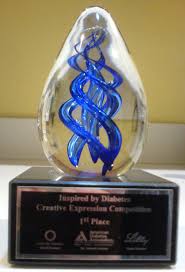
imagesMy ‘Inspired by Diabetes Competition’ wake-up trophy

I’ve been going along these last several months nose to the grindstone working on my book, when last week a package appeared for me from the arms of my FedEx guy. I couldn’t recall ordering anything and I didn’t recognize the shipper. The box was one of those delightful boxes, not colorful or funny-shaped in any way, actually quite the opposite — a perfectly medium sized, square, brown paper-wrapped box that could contain almost anything.

I opened the box and there my eyes fell on a letter telling me I was a first place winner in the Inspired by Diabetes Creative Expression Competition sponsored by Eli Lilly and the International Diabetes Federation (IDF). I had entered last year and had pretty much forgotten about it. My winning submission is a photographic treatmentand a narrative about how living proudly with diabetes helps my management and brings greater joy to my life. My executive husband said, “Where’s the judge’s report?” “Huh?” I said. “We want to know why they picked your submission.”  Seemed pretty clear to me, they liked it. However to satisfy his curiosity I called and asked if there was a judge’s report. “Huh?” the girl said who answered the phone at the Inspired by Diabetes office. After I explained she gave me the judging criteria: relevance to diabetes, creativity, narrative and emotionally impactful. Yup, just like I thought, they liked it but at least that satisfied the executive.

The competition received 800 entries from around the world capturing the challenges and triumphs of living with diabetes in either photographic form, essays, poetry, drawings, paintings or music. There are four Grand Prize winners and 1st, 2nd and 3rd place winners. As a first place winner a donation of $500 is being made in my name to provide scholarships for children from low-income families to attend diabetes camps and in IDF’s Life for a Child Program which provides life-saving supplies to more than 1,000 children with diabetes in 17 developing nations. Winners of the U.S. competition are now being entered in the global competition, winners of which will be announced in the fall. This is an annual competition so if you are just hearing about it and want to enter next year, check out the Inspired by Diabetes web site.

But back to the box. The box that my letter of congratulations came in contained a second box submerged under a hundred puffy pink Styrofoam chips. I didn’t open that box however for two days, not until my husband returned from business in Holland. I thought it nice we open it together so he could share the moment as he is my biggest fan and supporter. The evening he came home we opened the box and pulled out this trophy you see. We looked at the trophy and then looked at each other wondering what it was. I can’t remember what he guessed and I thought maybe it’s a double helix DNA pattern indicating stem cell research. But we really don’t know. All we know is we’re pleased as punch to be honored, contribute to such a worthy cause, and it woke me out of my deep and long slumber.

Sometimes it’s easy to forget when you work at home alone most of the time that what you do does have an impact on others. That is until a mysterious box arrives and a letter saying local media may knock on your door to hear more about your life with diabetes.

So, trust me, sometimes you can be awakened from a sleep by a kiss, as in fairy tales, and sometimes by a trophy. I’m just happy to be reminded now and then as I sit in my quiet living room typing away that I do make some kind of difference from time to time. Now you would really make a difference to me if you could tell me what this trophy represents, any guesses?

Leonard says learn to love the plateau

Screen Shot 2015-02-08 at 2.50.15 PM

Learn to love the practice


I guess I’m into absorbing new ideas these days as my last two posts are about books I’ve read. There’s an interesting idea expressed in George Leonard’s paper and e-book, Mastery – The Keys to Success and Long-Term Fulfillment. Leonard is a social scientist and Aikido master and I’m intrigued by his call for us to get lost in the ‘practice’ and make peace with riding the plateau.

Early in life we are pushed to “do” to “get” and focus on what comes next rather than where we are. We are urged as children to study hard so that we’ll get good grades. We are told to get good grades so that we’ll graduate from high school and get into college. We are told to graduate from high school and get into college so that we’ll get a good job. We are told to get a good job so that we can buy a house and a car. Again and again we are told to do one thing only so that we can get something else, be somewhere else. We spend our lives doing stuff so tomorrow will be better. But where does that leave us today? Sort of checked out from our lives.

See any parallels with diabetes? We are told to control our blood sugar so we don’t get complications, exercise so we’ll lose weight, lose weight so we become less insulin resistant. Of course we need to do all those things, but what if we were also taught at the same time to be one with the doing, enjoy the doing, don’t put all your eggs into the arrival; like a Zen master, see value and pleasure in the practice, get lost in it so that you are in the flow, totally in the moment. If you do that, not only will you be more present in your life but you will be creating the best chance for the positive outcomes we all want, and we may even notice and enjoy the journey.

When you’re ‘in the practice’ you’ll actually taste your food, maybe for the first time in a very long time. You’ll begin to enjoy the nutty flavor of whole grains by paying attention while you eat them, you’ll notice the natural sweetness in peaches and berries. When you exercise from the practice, you’ll feel your body’s strength and agility, its growing power, you’ll notice the endorphin-rush and Serotonin uptake, you’ll feel happy. Controlling your blood sugar when you are in the practice will imbue you with confidence, you will notice your growing capability, you will actually tune in to feeling proud. When we are so focused on the long, far away and abstract goals of living longer, staying healthy and avoiding complications, we are missing the moment, dismissing the pleasure in the moment and the opportunity for peace and pride in the every day practice.

“The real juice in life,” Leonard says in his book, “is to be found not so much in the product of our efforts as in the process itself, and how it feels to be alive.” We are taught in countless ways to value the end product, the prize, the blue ribbon or Olympic medal at the end of an endeavor, that climactic moment, not the pleasure of the moments that lead up to a medal, and then the next medal you might hang on your wall.

If our life is focused on mastery instead of wins, most of it Leonard says will be spent on a plateau–that long stretch of diligent effort with no seeming progress, for there are numerous inherent plateaus on the journey: learning, musing, germinating, reflecting, taking baby steps with only little bursts and puffs of what society deems as celebratory, noteworthy movement forward in-between. How much better if we were taught to love the plateau. If you honor the practice says Leonard you will enjoy the plateaus, “if not, a large part of your journey will be spent in restless, distracted, ultimately self-destructive attempts to escape the plateau to move faster and farther,” hither and thither missing the moment. I hope I pass you on your plateau as I sail by on mine and we are present enough in the moment to wave hello.


Diabetes can awaken you to your life’s purpose

Screen Shot 2015-02-08 at 3.45.51 PMUse diabetes to create a greater life and a new earth

March 3rd Oprah’s launching the biggest book club ever on her web site – it’s global and they’ll be reading a book I read two years ago and was so taken with when I lifted it up off my friend’s coffee table in Scottdale, that she had to gift it to me. Which she did.  Since the world is beginning to pick it up, I dipped in again last night. The book is  A New Earth- Awakening to Your Life’s Purpose by Eckhart Tolle.

A new earth is about detaching from your ego and waking up to your inner consciousness. When you come from your inner spirit, not your ego, you will be an instrument for positive change in the world, so says Tolle. This is the act of leaving your identification of yourself as your ego behind; residing in the consciousness that you truly are, whose purpose is to create good, both in your life and the world, and can do so supremely better than our small, defensive, judgmental egos.

The passage I read last night struck me in relation to this journey we’re on living with diabetes. Talking about loss Tolle says, “there are many accounts of people who experienced an emerging new dimension of consciousness as a result of tragic loss at some point in their lives. Some lost all their possessions, others their children or spouse, their social position, reputation or physical abilities. Whatever they had identified with, whatever gave them their sense of self, had been taken away. Then suddenly and inexplicably, the anguish or intense fear they initially felt, gave way to a sacred sense of Presence, a deep peace and serenity and complete freedom from fear.”

Paraphrasing what Tolle goes on to say here’s the message — When there is nothing to identity with anymore, who are you? Your sense of  “I am” is freed from being tangled up with concrete forms. You realize your essential being, your true self, is consciousness itself.

Not everyone reacts to loss with this realization. Some create a strong mental image (thought form) seeing themselves as a victim, whether of circumstances other people or fate. This thought form of themselves creates anger, resentment, self-pity, and they strongly identify with it. The ego then identifies with this new form. The fact that this form is a deeply unhappy one, doesn’t concern the ego much. As long as the ego has an identity it is happy.

Whenever tragic loss occurs, you either resist it or you yield to it. Some people become bitter and deeply resentful, others become compassionate, wise and loving. Yielding means you are accepting what is and you are open to life.

If you take action from resistance and negativity you will create more resistance and negativity in your life; life will not be helpful. When the shutters are closed the sunlight cannot come in so to speak. However, when you yield, when you surrender, a new dimension of consciousness opens. If action is necessary, yours will be in alignment with the greater good and supported by creative intelligence. Circumstances and people become helpful and cooperative. Positive coincidences happen. If no action is necessary, you rest in peace and inner stillness. You rest in God.

Tolle is a great spiritual teacher and I am an avid believer. It’s always been my message that we should try to see our diabetes as a loss that can lead to greater positive determination, empathy, compassion, appreciation and quality of life. Yield and find your strength, power and ability to transform yourself, your life and the world for greater good. I’m with you Tolle. I’m with you Oprah.

Diabetes Resolutions – is it time to get fired up again?

Unknown

O.K., time to take stock. As for New Year’s resolutions, if you’ve already given up on your resolutions you’re among the greater 64% who have too. How about your diabetes resolutions? Did you make any? If so, you may well have given up on those too, or nearly. Change is hard!

I don’t make resolutions of any sort because if I’m really committed to doing something, I don’t have to make a declaration about it, and if I’m not committed it won’t get done whether I say it will or not. So what gets in the way? The experts say stress, mood swings and boredom are largely what dash our resolutions into the snow or the sand depending on your geographic clime, weeks after we make them and throw us off our well intentioned paths. Sounds about right.

Resolutions typically require changing your behavior – doing things differently on a steady basis. This means forming new habits. Did you know it takes at least 3 to 4 weeks to form a new habit? And, it’s not a straight road to success, you’ll stumble on your way. Whether you get back up and continue toward your goal depends on you – your commitment, how important the goal is to you and how compelling your motivation is. So each resolution is deeply personal and each resolutioner has his or her very individual level of commitment and impediments. But here are two rules of thumb that apply across the board. 1) Don’t put excess pressure on yourself when forming a new habit to do it quickly or do it perfectly. These expectations will defeat you before you barely begin. 2) Appreciate any and every step you take in the right direction. If you see success as moving in the right direction rather than goal completion, you’ll gain new steam from your improvement alone.

Psychologists also talk about a “change muscle.” Figuratively, it’s a place in your body that has captured a memory of you having successfully made a change before. Connecting with this place and drawing upon this memory and energy can help you; your remembrance of change and success can inspire you to move forward with more conviction when things get tough.

Also, a support team is helpful when you’re trying to make a change. Whether it’s your spouse, a friend, neighbor or community resources, reach out, it’s easier if you’re not going it alone. Sometimes you just need a cheerleading squad, especially when your mind, as punishment for self-assessed failure, has placed you in front of your own personal firing squad.

Thinking about where I draw support from in addition to my family and friends, I remembered a poem I read long ago. It talks about a higher spirit always being there to help us. It gives me comfort. You will probably remember having read it before too:

Footprints in the Sand Copyright © 1984 Mary Stevenson

One night I dreamed I was walking along the beach with the Lord.

Many scenes from my life flashed across the sky.

In each scene I noticed footprints in the sand.

Sometimes there were two sets of footprints,

other times there was one only.

This bothered me because I noticed that during the low periods of my life,

when I was suffering from anguish, sorrow or defeat,

I could see only one set of footprints, so I said to the Lord,

“You promised me Lord, that if I followed you,

you would walk with me always.

But I have noticed that during the most trying periods of my life

there has only been one set of footprints in the sand.

Why, when I needed you most, have you not been there for me?”

The Lord replied, “The years when you have seen only one set of footprints,

my child, is when I carried you.”

Even if you’ve given up your resolutions, nothing says you can’t start again right now. There’s no need to wait another 330 days.

Try telling yourself you’re going to “practice” your change this year. It will take the pressure off and chances are it will actually become real when you’re not even looking.

Hope, the new 4-letter word?

The new face of radical chic

Screen Shot 2015-02-08 at 4.36.54 PM

Reading the New York Sunday Times Arts & Leisure section yesterday I read an article titled, “The Rebel Director, Sincere and Hopeful.”

It’s about Carl Forsman, artistic director of a theatre company that stages only performances that embody hope and humanity. “I’ve thought for a while now that maybe true theatrical rebellion isn’t saying, ‘And then a guy raped a 4-year old and shot his mom,” said Forsman, “that’s not radical anymore because we’re so desensitized. Now I think true rebellion is saying anything optimistic or positive about humanity. Hope is radical.”

Wow, my ears tingled. I made an immediate connection between what he said to what I’m trying to do here — teaching how we can better manage diabetes through positive emotions like joy, courage, confidence, gratefulness, love, hope and pride – rather than the more usual focus on negative emotions – denial, guilt, shame, depression, anger. Wow, maybe the positive landscape I’m trying to paint isn’t squishy or naive or infantile, but radical! Gutsy even and hiply progressive! Cool, I’m a radical hipster!

I’ve wondered these past few weeks getting more aggressive about posting my “thrive” rather than “survive” attitude that you will think I just dropped out of a Kansas cornfield or was born with a silver spoon. Actually neither are true. My Buddhist ‘appreciate everything’ mantra comes from an ordinary middle class upbringing in the Bronx and on Long Island and my extremely shy, formative years when I learned to observe others rather than talk much.

Thankfully, those days are long gone, and while they were lonely and painful, I developed a keen eye for observation, a curiosity for what people really feel deep down, and an empathetic understanding for people’s hardships and hurts. But wait — now I can consider myself a “radical hipster.” Oh, how long I’ve waited!

Perhaps I’m catching a new wave where being positive is gutsy in our overly cynical, negative culture. I do so often feel I’m sticking my neck out against the chorus of nay-sayers who prefer to moan and groan.

Mr. Forsman went on to say, “There’s no question that the cynical viewpoint is viewed as more sophisticated. There’s a real fear, especially among the intelligentsia, of generosity and compassion because they look like the acts of someone who’s naïve.” God knows I live in the land of which he speaks, New York City, where black is our representative color. Now I’m thinking maybe black here is not just a fashion statement but a statement of mind.

So, I am all tingly and excited as a radical diabetes auteur and I will continue to say, adopt an attitude of gratitude, despite your diabetes or because of it — because it can give you a second chance at life — the life you’ve put aside, let remain a dream or run into the ground without really noticing.

Diabetes is your second chance to get fit and healthy and avoid a far worse fate that may be heading your way. Now maybe it will help you to think of yourself as ‘radical’ not ‘Pollyanna’ or ‘compliant;’ to be brave enough to fly in the face of the general public’s and mass media’s mass cynicism.

After all, it’s the people with guts and vision, who moved by their very personal dreams and hopes, end up changing the world.


More on chronic illness and supercharging life

As I expected, this morning’s Today Show featured another segment on Richard Cohen’s new book, “Strong at the Broken Places.” Five people are profiled about living courageously with chronic illness. Today they had 4 of the 5 people on the show and here’s basically what they said:  

“Our thoughts and our beliefs go into our cells and become us and what we do.”

“Saddle up for your life. Life isn’t going to be easy, but make the best of it. Sometimes it’s an ongoing battle to accept myself, but I’m going to do what I can while I’m here.”

“It’s hard that people can’t tell you’re ill.” Boy, I know this one. 

“What you believe about mental illness may be more destructive than the illness itself. Look at our strength and think of us as strong as other people.”

Personally, I find “courage” a really great word for describing the quality we embody living with chronic illness well. 

Later in the program there was a segment on Supercharged Changes for Better Health. A series of segments they’ve been running this week to get us off to a fresh start for the new year. plus size model, Emme, and a therapist were talking about accepting yourself and stop beating yourself up because it’s not motivational, and give up the guilt – about weight and body image. They gave these general recommendations which I thought  apt for anyone:

1. Leave body-bashing and low self-esteem by the roadside

2. Hang out with friends for soul nourishment

3. Enrich your life with new hobbies, activities and people

4. Don’t forget you’re a role model, especially for your children

You can easily apply these to living with diabetes. So, I’m sensing a cosmic shift in the public consciousness that a more positive mindset will help one live a healthier, more fulfilling life. I’ll raise a glass to that!