A wordless conversation about life with diabetes

Over Passover I left my Apidra insulin and syringe on my brother’s dining room table where we had just finished the seder meal. We had all expected to go back in for dessert, but dessert happened spontaneously in the kitchen with everyone stuffing honey cake and chocolate covered strawberries into their mouths too engrossed in conversation to move back into the formal dining room. Thus, my insulin and syringe were left to themselves on the dining room table unnoticed, and I didn’t realize it until I returned home hours later.


It wasn’t a big deal as I had extra insulin at home so I emailed my brother and asked if he would bring my insulin and syringe to a family gathering, a baby naming we would both be attending, two days later. Sure enough, when I saw my brother again, he handed me a little plastic baggie and inside, safely nestled, were my insulin and syringe. You should probably know at this point my brother and I never talk about my diabetes, except on the rare occasions when his ad agency is pitching a diabetes product and he comes to me to learn something, or find out something. I was 18 and he was 13 when I got it, and I have always felt while he is certainly sorry that I have it, the resentment he felt as a teenager who all of a sudden had his parent’s attention removed, started his drift away from me, and it has remained, and with it he has adopted a comfortable ignorance. 


However, as I took the baggie from his hand, I saw that little plastic container as a sign of tenderness, and concern. I imagined that his having to handle my insulin and syringe gave him pause to think about what it’s like for his sister to live with diabetes: To take injections several times a day, check her blood sugar throughout the day, and do all the other things I have to do; whether he really knows what they are or not, he knows there are things I have to do in order to live. I wondered too if it created a conversation for him with his two girls, 14 and 17 years old, who’ve never talked with me about my diabetes, but have seen occasional signs of it, whether it’s taking an injection or asking their mother what’s for dinner so I can figure out my carbohydrate intake and my dose.


Maybe you’re thinking, so why doesn’t she just start a conversation about it? Some habits are hard to break, and some familial patterns, harder. And while I go across the country and talk to patients about managing their diabetes, there just never seems to be an appropriate opening to start a conversation about diabetes with some family members. My work is rarely a topic of conversation when we’re together and when it is it is more like, “So, did you finish the book yet?” 


One day, however, I do think a real conversation will come along about living with diabetes, maybe it will come with his girls when they are old enough to get to know me on their own, not just the seven times a year they see me at holidays. 


Yet, unknowingly leaving my insulin and syringe behind, perhaps began a conversation, perhaps between my brother and his girls, perhaps between my brother and myself, just without words. And right now that’s O.K. For rather than get in anyone’s space, I prefer to just recognize that my lifeline came thoughtfully wrapped when my brother handed me my insulin and syringe in a little plastic baggie.

Me and Mary Tyler Moore

Riva and MTM

A few days ago I was among about 400 people seated at Barnes & Noble for Mary Tyler Moore’s book signing. Her new book, Growing Up Again: Life, Loves, and Oh Yeah, Diabeteshas put her on the promotion circuit: Good Morning America, Rachel Ray, Barnes & Noble. I read the book and it’s a sort of stream of consciousness: a little bit Hollywood, a lot about being a recovering “bad” diabetic who’s learned some lessons and is still confronting others. I found it surprising how hard she is on herself, but from what she discloses about her upbringing, and she is very open, she had two parents who never gave her much attention or approval. 


Ms. Moore is donating all of her proceeds from the book to the charity she champions, the Juvenile Diabetes Research Foundation (JDRF). Reason enough in my book for her to write her book. What I particularly like about her book, is it gives us adults with type 1 a face, and a place, in the diabetes community, making us a little more visible. 


After Mary stepped out in front of the group awaiting her, and spent a few minutes graciously answering people’s questions, which ran the gamut from, “What was it like working with Elvis Presley?” (if you know she was the last of Presley’s leading ladies then you’re a fan!) to, “What’s happening with the artificial pancreas?”, she sat behind a big desk with about four protective handlers and we were invited up to the stage row by row to have our book signed.  


I stood in line carrying her book, and my own book, The ABCs Of Loving Yourself With Diabeteswhich I intended to give her as a gift–if I could get it past the handlers. It would take some quick strategizing to not have the four strongarm men and women standing around her grab it out of my hands and hurl it out the window behind her. Then, just when my moment arrived: I’m in front of her, she begins to sign my book, I lift my own book up to table height to hand it to her, pow–the man to my right (meaning he was BEHIND me in line!!!) asks her a question. Her attention now diverted, I wanted to clobber him. You’ll be glad to know I didn’t. No, I just waited. 


She finished signing my book and picked it up to hand to me, and that’s when I extended my book out to her and said, “I hope you’ll accept this as a gift from me to you, my book.” She looked at it, and since I know she has a vision problem, I said the title aloud, whereupon she said, “Thank you, Riva.” I quickly calculated she must have read my name on the cover. Three sweet little words, “Thank you, Riva.” Well, c’mon, I did watch her every Saturday night laughing it up with Rhoda. Then, as if on cue, the strongarm woman to her right, whisked my book from her reaching hands and put it in a bag behind her. 


So, will my book really ever be read by Mary Tyler Moore? Who knows…but when my husband and I got home there were two voicemail messages on our machine. Before we played them I said to him, “I’m sure they’re from Mary calling from her limo to thank me for the book!” They weren’t, but you never know, tomorrow is another day. 

The continuing story of my medic alert bracelet

A few weeks back I mentioned that I read an article in Diabetes Health magazine, Medical ID Bracelets: The $15 Lifesavers that made me realize it was a foolish move on my part not to wear a medic alert bracelet, especially since I have enough lows to warrant it. Granted, I haven’t had a low yet in 37 years I couldn’t remedy myself, but why take chances?

So I did a lot of web searching looking at various bracelets trying to find the right one. One that would say, “Yes, I have a medical condition!!!” if need be, yet be somewhat attractive, in other words not make it look like I was a goner, or be downright ugly. My first choices, could easily be missed as an attractive piece of jewelry, beaded and dangly, pretty, but who would know I needed help? So I settled one from American Medical ID. They have a large selection of bracelets and offer engraving for free and will fit a lot of it on your bracelet as opposed to some other vendors. I chose a sterling silver plaque, $59.95, and I just received it in the mail. It took about three weeks from order to delivery and is engraved on the back with:

T1 Diabetes IDDM

Riva Greenberg, NYC

Call Mom below:

Mom’s phone number

I’m quite pleased with my bracelet so far, it’s small and shiny. My friend who makes jewelry volunteered to make me a lovely chain for it. I think I’ve managed to hit the right balance of “Look, I have a condition that needs care” and an unobtrusive, simple and fine piece of jewelry. The plaque doescome with a free chain or you can select from three chains all priced at $6.

Stay tuned. I’ll show you the whole thing once done. I’m actually looking forward to being able to wear this, and intend to leave it on my wrist once I put it there. 

The new face of chronic illness

Screen Shot 2015-02-08 at 12.58.32 PMMichael J. Fox’s new book

I just watched Michael J. Fox in his appearance on the Oprah Winfrey show this week. Yes, working for myself gives me the liberty to take a break at 4 P.M. and recharge my batteries. 


Fox is an emblem of living gracefully with chronic illness. If you don’t know, he’s had Parkinson’s disease for the past 18 years, and looks just as youthful and boyish as he always has. Just now he shakes–a lot. Oddly, he said, the shaking is not from the illness, but rather the medication for Parkinson’s. If not for the medicine, his muscles would freeze. But there’s certainly nothing frozen about his mind, his enormous optimism, or his activism. 


Fox has gone to Washington repeatedly to seek funding for stem cell research and Obama has just passed legislation to make that possible. Of course where was Fox? Not in Washington, but climbing the Himalayas in Bhutan. He joked, it’s not so easy to get out of the Himalayas at a moment’s notice. He also told us that while there his disease affected him less. He could breathe more easily, odd because such altitude usually hampers breathing, and his muscles moved more fluidly. We also saw a demonstration in a segment of him playing ice hockey: he looked little different than his younger self who was an amateur player growing up in Canada.


Part of Fox’s appearance was also to promote his new book, Always Looking Up: The Adventure of an Incurable Optimist. And that was the face of illness that we saw: someone who is accepting, living fully and treasuring each small moment with his wife and children, someone who even savors the turn his life has taken saying if this hadn’t happened, he wouldn’t have met the amazing people he’s met and done the amazing things he’s done.” And, we got that he feels his life has been enriched. 


Some days he has more trouble tying his shoelaces than others or his medicine kicks in too slowly to avoid an incident he would not have asked for, but he said that vanity was the first thing to fly out the window once his symptoms began to show. And that he is not afraid, but eating life. 


As Fox says, “Parkinson’s doesn’t define me, it’s just one part of my life.” He also tells his children when they ask about his shaking, “My brain doesn’t work the way yours does.” How simple those few words are. So simple, a child can understand, and it leaves judgment out the door. It’s we adults who have to struggle to see past the jerky movements and our assessments based on outer appearances. 


Well, my pancreas doesn’t work the way yours may, so I’m a little different, not damaged or less than. That thought gave me a new window from which to see my diabetes. I think Fox truly is inspirational and an example of how to live with a chronic illness. He wears it well and so can we.

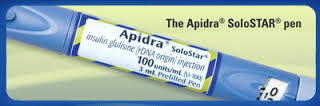
The Apidra pen arrives this year

UnknownApidra SoloStar® Pen

Unknown-1Lantus SoloStar® Pen

Just a bit of news: Apidra, a rapid-acting insulin used before meals like Humalog and Novolog has just won FDA approval to be packaged in a prefilled disposable pen, to be called ” SoloSTAR®.” They’ll be available in pharmacies sometime this year.

Apidra and Lantus are both Sanofi-Aventis products. If you use the Lantus pen SoloSTAR®, (Lantus being long-acting insulin most patients use once or twice a day to cover the fasting state), the two pens will come in different colors to help tell them apart. And trust me, there are endless accounts of patients mixing up their rapid and long-acting insulins because the pens or vials look so much the same. However, I’ll have to reserve judgment as what I saw didn’t look that far afield from the Lantus pen: a grey blue vs. a blue grey? What’s so hard about making it in green or orange? 


I’m an Apidra user after years of using Humalog. For me, Apidra works faster than Humalog which means I need to use less and its quicker action gives you the advantage of injecting during and sometimes after a meal depending on what you’re eating. This takes a lot of the guesswork out making my doses a wee bit more accurate. 

2:10 A.M. to 2: 25 A.M., just another night with a low

I woke up last night at 2:10 AM and just felt off. My first thought of course was low blood sugar, even though my thoughts weren’t rising like scrambled eggs and my heart wasn’t beating out of my chest. I crept out of my bedroom into the kitchen, flicked the light and tested. Darn, a borderline 65 and it was only 2 A.M. I should have known when I was 123 before bed that I wouldn’t make it through the night. 

Typically, when I have some wine with dinner my blood sugar needs to be about 140 before I go to sleep since I’ll drop about 60 points overnight, and there I was 20 points shy. I wore a CGM once for 3 days to see if my blood glucose followed any trends. What was revealed to me was that indeed it did–I drop significantly overnight. When I asked my diabetes educator, “Why?” and, “What can we do about this?” the answer was “We don’t know why, it’s just how your body responds” and “Let’s move your Lantus from before bed to the morning. The drop may be less severe.” And it is. So now I follow a fairly doable system  knowing where my blood sugar needs to be before I go to sleep based on whether or not I’ve had two glasses of wine. I just have to be alert and make the effort even when it’s the last thing I’m in the mood to do at midnight.

Anyway, back to the kitchen. After discovering I was 65 I ate one glucose tablet, a few strawberries and a small bite of an Extend Bar. A few bites before bed help keep my blood sugar more level overnight. Then I tiptoed back into the bedroom. My husband who was now on the verge of wakefulness said, “Are you OK?” I said “Yes.” And I was, and I wasn’t. I don’t often have this thought but I did last night, How unfair and frustrating that this is how I have to live! How amazing that this is my life?! The thought that followed seconds later was a resigned acceptance, Well, if this is how I have to live then this is what I have to do. This is my life.

But there’s a second act to last night’s show. Now back in bed I lay there having a debate with myself whether my 1 glucose tablet, 2 strawberries and bite of Extend Bar was enough to get me through the next five hours. After a good ten minutes debate, because I really didn’t want to get up again, my sleepier side lost and I walked back into the darkened kitchen and retrieved and chomped down another glucose tablet. 

This morning I woke up at a stellar 86. Yet I’ve been mulling all morning about how hard I work at managing my diabetes and the only reward is maybe I’ll get less complications, maybe they’ll be postponed, maybe I will make it to 80 years old and won’t have more than my share of heartache. 

Of course now that the sun is making its way over to my living room window, my thoughts shift along with its brightness. Living side by side with my intermittent anguish is the hopeful expectation that within the next five to ten years there’ll be more advances in diabetes research, tools and procedures that will make managing diabetes almost effortless and ensure us much better control. 

How odd that all that we do to manage diabetes, particularly for type 1s, just becomes mundane in an egregious life, and that we exist in a constant ebb and flow from fear to faith and night to day. 

Making the most of the hand you’ve been dealt

Screen Shot 2015-02-08 at 1.05.19 PM

I was just so moved by this article in the NY Times Sunday Styles section last week, “In a Charmed Life, a Road Less Traveled” by Layng Martine Jr. that I insisted my husband read it. “Anyone who is in love is living a charmed life,” said the author, “especially if you’ve been in love for many years, through good times and bad.” I was moved both because it resonated with how I feel about my partner and because love never left this relationship. Not after the author’s wife lost the use of her legs, as well as other bodily functions. Not after she had to give up so many things she once enjoyed, and they once did together, like hiking in the mountains, strolling on a beach, tending to their garden. 

Martine Jr. continued, “After the doctor left, tears filled her eyes. “It was all too perfect,” she said, “wasn’t it?” And it did seem that way. It always had… Not long after getting home from the hospital, when we were having dinner by candlelight at our kitchen table, she burst into tears. “I don’t know if I can do this for the rest of my life,” she said.

All I could say was, “We’ll do it together.”

And then they began to look for what could be instead of what they had lost. “We began to think of what we could do to replace playing tennis, walking on the beach, working in the garden. 

We take many more drives now, preferably in our convertible… where they bring the food to our car…We know to say “Yes” to nearly everything because there is probably a way to do it. We know there is happiness available every day… A few months after the accident, Linda started driving again. She has rolled three marathons — yes, a full 26-plus miles in a racing wheelchair.” 

And now, so long since that fateful night, looking across the dinner table at my wife, or seeing her across the room at a party, the hopeless crush I have on her is as wonderfully out of control as when I first saw her more than four decades ago.” 

Fifteen years after the accident they have found a way to still roll through Tuscany, in and out of Ireland’s pubs, and watch the sun set holding hands on a country porch.  

“We don’t know what will happen tomorrow, or who will live how long…We are two, but we are one. And I love those numbers.”

This is a story of love and support, of possibility and survivorship, of finding happiness in simple things and adapting to what life hands you. And while it’s easy to say when you’re feeling down look around at the people who have it worse than you, it can still be hard to make your unhappiness smaller. 

But the game really is to find ways to still have happiness and contentment no matter what life has handed you. And the lesson to be learned is it is possible. 

A scare, an unnecessary fright and bad behavior, all over potassium

I had my blood drawn two weeks ago to check out my vitals and all were in target range except my potassium. Potassium?! Who even knew they tested your potassium? But I was told it was out of range, high, a “6” and needed to be retested to see whether the test result was accurate.  How important can it be that it might be a little high? [Normal range is 3.5-5.3 mEq/L.] O.K., no sweat. After all how important can potassium be? Certainly not up there with my A1c, cholesterol, triglycerides, microalbumin and thyroid activity.   

Now is when it gets interesting. First, I had to instruct my endocrinologist’s office to send the test results to my general practitioner. Isn’t that what an HMO is all about? Your GP sends you out to specialists who report back? Apparently not. When my GP got the results a day later his assistant called me to say, and I might add sounded a little worried, “Riva, do you know your potassium is high?! The doctor wants you to get it tested again.” “No problem,” I said nonchalantly. I already have an appointment next week to have it retested. I hung up the phone wondering what’s all the fuss about my potassium? 

I suppose my comfort came mostly from the fact that this very thing happened to me once before several years ago, and I’m basically healthy: I eat a Mediterranean-like diet, high in healthy fats, whole grains, low in fats and sugars, plenty of veggies, my weight is in range, I walk every day…But the idea that something might be wrong began to pray on me so I looked up on the internet foods high in potassium to see if that could have caused the spike. If so, I’ll cut down on those foods I decided. In my search naturally I started reading about potassium. The Mayo Clinic site reports, the most common cause of high potassium is impaired kidney function, such as due to acute or chronic kidney failure. High potassium is a life-threatening disorder that can cause muscle fatigue, paralysis, abnormal heart rhythms, nausea and require kidney dialysis.

Whoa, stop the train! Now I’m a little freaked out to be honest. I still believe my number must be wrong but….what if it was right? What if my potassium is now a problem and I’m headed for kidney failure or am already in the early stages? How I will fare with such a fate? Of course I also did read sometimes a report of high blood potassium isn’t accurate. It may be caused by the rupture of red blood cells in the blood sample during or shortly after drawing the sample. The ruptured cells leak their potassium into the serum. This falsely elevates the amount of potassium in the blood sample, even though the potassium level in your body is actually normal. But, achem, I wasn’t quite so confident anymore.

The conclusion to my retest is the first test result was an error and I’m in range. But here’s my real beef. I was retested on a Wednesday, first thing in the morning and called my endo Friday morning to get the results. His assistant told me he wasn’t in but would be in in the afternoon and yes she had the results. I was very clear that I wanted to know the results that day as I didn’t want to go the whole weekend fearing the worst. He didn’t call me back.

I called again Monday morning. I was told my endo was busy all day with patients and the assistant said fleetingly as a throw-away, “He doesn’t call you if your test result is O.K.” But I had no assurance of this. I repeated to her that it wasn’t O.K. before and I’d like to know for sure if that was a mistake. Please ask him to call me.” She said she would leave him the message. He didn’t call.

I called Tuesday morning and she told me, “I gave him the message yesterday. I’ll tell him that you called again.” No return phone call. I called again at 5 PM to find the office closed and so I left this message, more or less. “I can’t understand why after having an abnormal value for my potassium and getting it retested and not knowing whether or not it’s still abnormal and calling Friday, Monday and today, no one has bothered to call me back and let me know if I’m O.K!” It took five days to get me to that point. My husband was already there the first day.

My doctor called the following morning. “What can I do for you,” he said. No apology, very matter of fact, and he told me my potassium is in range. As he was about to get off the phone he said, “I don’t call patients when the results are normal.” I said, “After getting an initial result that wasn’t, it only makes sense I would want to know whether this result was also abnormal or not.” He muttered something that was hard to make out and we hung up.

I began to think about what this policy of only call a patient when there’s a problem creates. It means you don’t even hear from your doctor when there’s a resolution to a problem. Further, don’t you think if your doctor called and said when your test results were all in range, “Your labs are all good, all normal, good work! Keep it up, you’re doing something right and that’s great!” that you’d be more motivated to continue the good work? Yes, it may cost a doctor another half hour a day, or maybe he’d outsource it to his nurse. But right now, without it, it costs patients a lot of mental stress and our healthcare system big bucks. How perverse is our system that hard work and effort go unappreciated and unacknowledged and we’re only told about problems? 

O.K., I’ve ranted, it’s out of my system now, but just between you and me, I’m changing endos.

Do you wear a medic alert bracelet?

womens-medical-id-braceletsMedical alert plaque from Sticky Jewelry

DiabetesHealth ran an article on its web site last week which got to me, “Medical ID Bracelets: The $15 Lifesavers.” Admittedly, I’ve had diabetes for 37 years, been on insulin for 32 (I was misdiagnosed early and put on oral meds the first 5 years) and have never worn a medical alert bracelet. Why? Thirty years ago when I looked at them, there were few available, they were all ugly and screamed, “I’m deathly ill.” Or so they made me feel. Then I just sort of forgot about them over the years. I learned how to recognize and treat a low, never expect to have a time I can’t, and never received any suggestion from either my general practitioner or endocrinologist that it might be a good idea to wear a medic alert bracelet. When I think about that now, that seems a stunning lack of care.

But reading the article about how such a bracelet can and does save lives, I thought how foolish am I not to wear one. I have enough lows and am alone often enough that I could end up in a situation where I pass out and such a bracelet could save my life. Each morning I walk an hour around my local park. I take my SweeTarts, some money and my keys, but nothing that would alert anyone to the fact that I have diabetes. I do carry a wallet card, but often am out and about without my wallet. Thinking back, my last two great lows both occurred in airports when I was traveling by myself. Luckily I had sugar with me and enough brain cells working to stop and treat myself, but what if I did not….?

So, over the past week I’ve conducted an exhaustive online search to see what’s available, and being the finicky Virgo that I am, have only had trouble choosing because quite a few different styles appeal to me. Although I know I’m in for a bracelet; necklaces bother me and something on your knapsack or some other hidden place defeats the purpose. Also, it’s a bit tricky to find one that both is immediately identifiable as a medic alert bracelet and yet looks attractive enough that you’d wear it. But, too fashionable, and I doubt any paramedic would bother looking to see if there’s life-saving information on your dangly, jewel-crusted bracelet. But feeling these two bracelets satisfy that debate, right now I’m  wavering between the beaded bracelet and more sleek stainless steel lynx bracelet, and then my friend who makes jewelry said, “If you buy an engraved plaque, maybe I can make a fashionable bracelet for it.” Well, now I’m just stumped altogether. But, it’s my plan to have one within a month’s time. I also checked my local drugstores and found you can buy a medic alert bracelet there for about $7.00 but don’t expect any style. 

If, like me, you haven’t thought about getting a medic alert piece of jewelry for decades or no one’s ever suggested you wear one, think again. And if you have access to the internet, expect to find enough choices, whether bracelet, necklace, charms etc, to spend a few hours finding just what you like. Well, that’s if you’re like me, I guess. 

Here’s also what I learned as far as the information to have engraved: 1) Diabetes, 2) If you’re insulin dependent which can be summed up in IDDM (Insulin dependent Diabetes Mellitus) 3) Allergies 4) Phone number to call, and what I actually realize was really important, 5) Your name. And that’s because if you do pass out, those working on you will call your name to try and revive you along with other life-saving medical measures. Since space is limited depending upon what item of jewelry you pick and from which manufacturer, choose the info that’s most important for you. Also, some bracelets will let you engrave on both front and back, others just one side. I’m going with:

Type 1 Diabetes IDDM

Riva Greenberg

Mom: Phone number

It will be interesting to see how I actually feel wearing it after being unencumbered all these years. Will it feel like I’m shackled or a “Badge of Honor.” I’m going for the latter. Will let you know.

Win big, help millions

Got an idea for an innovative new diabetes device or web application up your sleeve?  Amy Tenderich, noted blogger of DiabetesMine, is running the DiabetesMine Design Challengewith a Grand Prize of $10,000 for ANYONE with a good idea to help manage diabetes: patients, parents, startup companies, design & medical students, developers, engineers, etc. The challenge is sponsored by theCalifornia HealthCare Foundation.

The contest runs through May 1st and winners will be announced May 18th. in addition to the Grand Prize are smaller cash prizes, consults with design experts and a mini-workshop with health and wellness experts at Ideo, the global design firm. 

Check for submission and judging criteria and contest details and then let your innovation flow.