El ABC para aprender a quererte teniendo diabetes

Screen Shot 2015-02-08 at 11.48.29 AM

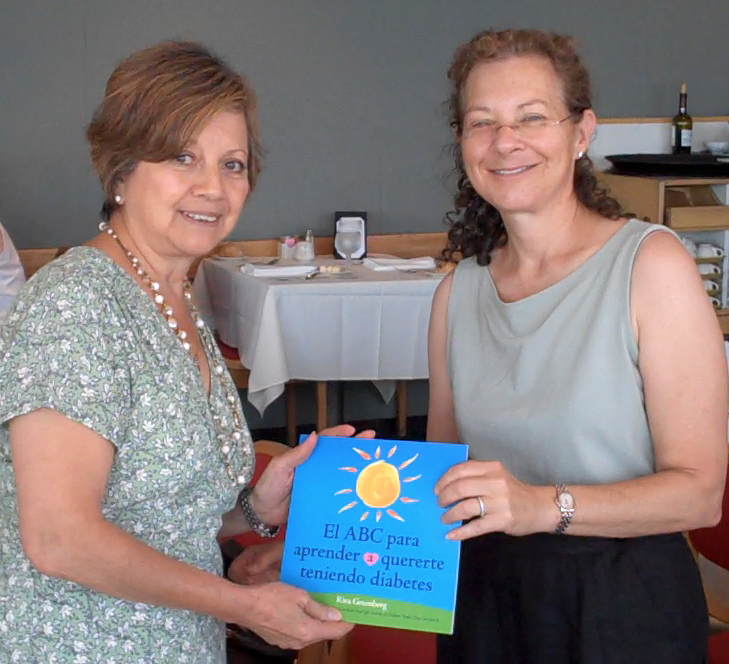
Translation:  “The ABCs of Loving Yourself with Diabetes.” This Spring my ABC book came out in Spanish due to the unprecedented hard work of its two translators: Georgina Baez-Sommer (pictured here) and Amparo Fernandez. How lucky was I to have two translators from the United Nations! In truth, I’m not that special but beside being a dedicated professional, Georgina also happens to be my neighbor’s mother. 

I decided there isn’t enough literature to help Spanish speaking people with diabetes, the Hispanic population being one of the highest risk groups, so voila, a coaching book in Spanish. 

“The ABCs of Loving Yourself with Diabetes” guides readers to use more positive emotions both in life and in living with diabetes, for one enhances the other. For instance, if you appreciate all that you do have in your life – friends, family, work, a hobby you love, you experience life as a happier place. Being happier makes managing diabetes a little easier. If you forgive your mistakes with diabetes and see them as learning opportunities, you build a databank of diabetes knowledge and more resources to do better next time. If you’re struggling with something in your care and can look back to when you’ve managed difficult times before and bring those same qualities and skills to managing your diabetes, you will do better.

Among the emotions you’ll learn to augment are courage, confidence, joy, awe and pride. You deserve to be proud just because living with diabetes is an ongoing job. Pride in a job well done is a powerful source of energy and healing. In truth, all we have power over living with diabetes is how we live with it: graciously, responsibly, lovingly and kindly or angrily, guiltily, sadly, beating ourselves up and everyone around us.

Anyway, just wanted to remind you The ABCs is available in Spanish and share these lovely pictures. Now it’s up to you to do the rest. 


No urgency in Emergency

Lying in bed at 6 A.M. a few weeks ago I felt a sting and when I brushed my hand against my wrist, felt something fuzzy there. I didn’t know it but I had just brushed off a hornet or wasp or bee that had stung me. I jumped out of bed, ran to the kitchen to inspect my throbbing wrist, ran back to the bedroom (mind you these runs are only 10 feet long) to wake my husband. We turned on the light and there was my attacker on the wall near the lamp on my dresser. I began to freak out.


While I expected my husband to nurse me in some way, he sat down with his computer on his lap, his typical early morning work routine. I was flabbergasted until he began reading off a web site what to do for bee stings. As he read the anaphylaxic (allergic reaction) life-threatening symptoms: throat closing, light-headed, dizziness, weakness etc, I was having them all. I was so weak I had to sit on the kitchen floor, my head spinning and my legs falling out from beneath me. Then through my fog I heard my husband’s voice, “Check your blood sugar, check your blood sugar, check your blood sugar.” With shaky hands I did and it was 57, most likely the cause of my weakness and shaky symptoms — along with a good dose of panic.


After I gobbled some glucose bits, my blood sugar returned to normal but my panic was only slightly abated. I’ve never been stung by a bee. How serious is this? My Aunt is allergic, if she gets stung I know she can die. Is there a stinger in my wrist we have to get out? We followed all the steps advised on the web site should there be an embedded stinger and then I said uncharacteristically, “Let’s go to the ER.” It was Saturday and I knew I couldn’t reach my doctor.


We walked the six blocks to the hospital, and as we walked I questioned whether I really needed to go. But I was worried and wanted someone to tell me it was O.K. so we kept walking. 


Entering the ER was nothing like on TV.


We arrived at 7:15 A.M. Only two people were in the waiting room and I thought this is great, I’ll get seen soon. Then the drunk showed up strolling the room and talking aloud to no one and then the woman who’d been sitting there quietly started yelling and every 10 minutes went to the public phone nearby to yell to someone how much pain she was in and no one was paying attention to her. More like she was off her meds. I saw they paid attention to her when security finally came to calm her down. What a freakish scene I found myself in, on an early Saturday morning, in a place I’ve never been, hoping for quick medical attention.


When we had first entered the receptionist asked me a bunch of questions, only one having to do with my bee sting, and typed my answers into her computer barely looking at me. A half hour later I was called up to another desk where the woman asked me the same questions and typed my answers into her computer. As I tried to engage in at least some conversation, we spent more time talking about her failed diet than my bee sting. 


When I finally saw a physician’s assistant, 3.5 hours after arriving, including the one hour wait after being called into the inner sanctum of the E.R. where I was utterly ignored, she told me all looked fine, go home and take some pain reliever. 


In truth, I was relieved to hear a medical person say, don’t worry, it’s O.K. I guess that’s what I came for. And I surely understand that if there were people arriving on stretchers then my bee sting could wait. But having one simple nurse up front could have sent me home in less than a half hour and receiving one simple smile could have ameliorated the cold, fearful wait. 


As I left I thought let me never come back here again unless it’s through the back door on a stretcher. 


Ready to torch my blood sugar log

DSC00587


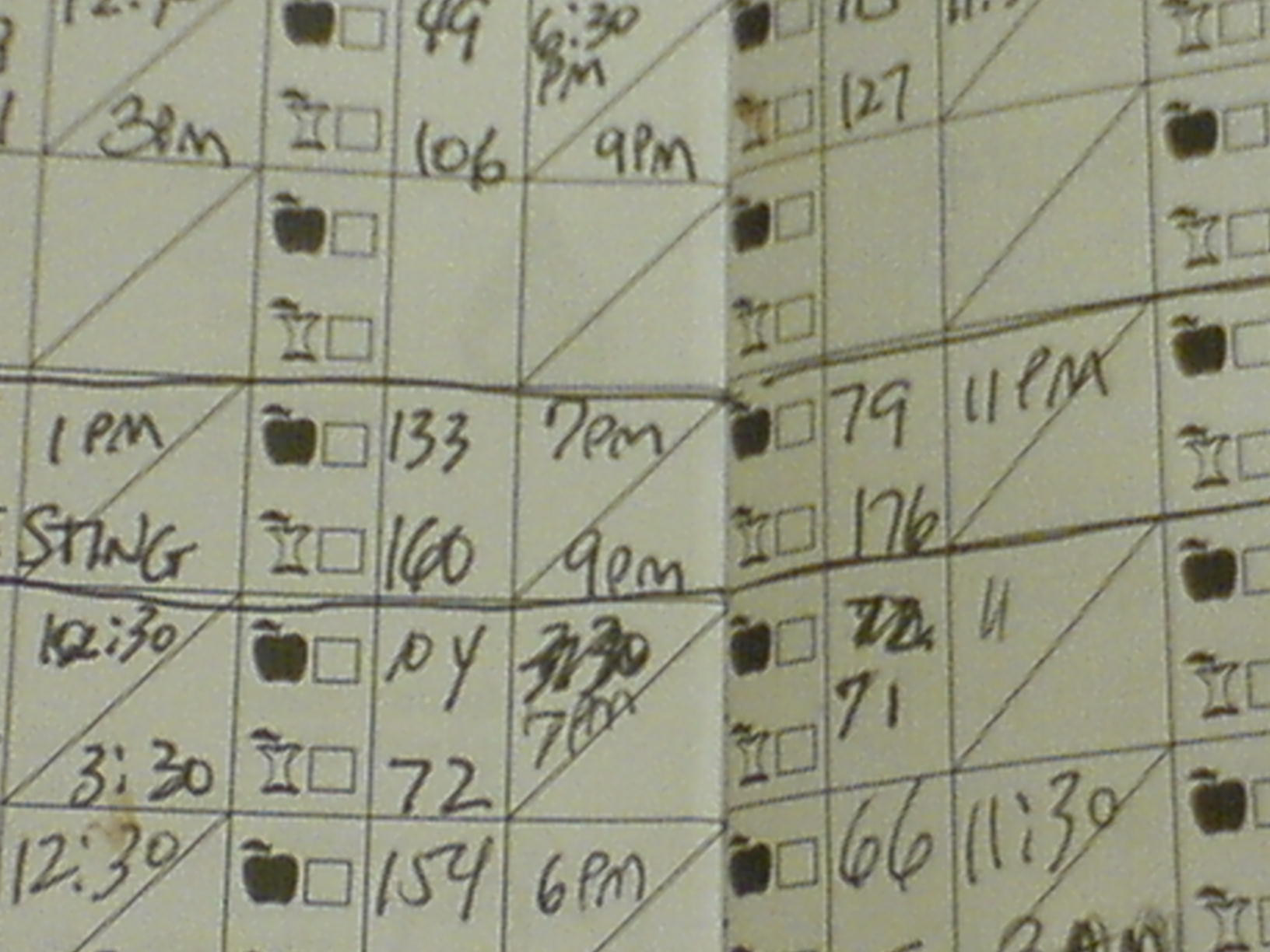
For the first time in I don’t know how long I’m keeping a log of blood sugars. No kidding, it has the blood smears throughout to prove it. 


The reason? Two weeks ago I started with a new endo whose main task has been adjusting my insulin dose and when I take my Lantus so I have less lows. Personally, I wasn’t particularly concerned about my once or twice a week low, and I particularly liked that my A1cs are in the 5’s, but endo said the fluctuations in blood sugar irritates the blood vessels and it would be healthier to be mainlining more around 100 and up to 140 two hours after a meal. 


That meant two changes: 1) Cutting down from 14 of Lantus to 10 units and 2) Switching my Lantus from before breakfast to before bed.  Switching to before bed was to override the morning highs (dawn phenomenon). My sugar was rising so fast in the morning it was thought my Lantus wasn’t lasting 24 hours and by moving it to before bed I’d have better coverage for the morning. I’d been taking a first dose of Apidra by 7 AM to blunt my blood sugar rise and then a second dose for breakfast. The cutting down on the amount of Lantus I was taking was because endo thought I had too much Lantus in my system overall the 20 or so hours it is working, and it may be contributing to my lows. 


But cutting back to 10 units, the immediate result was HIGH blood sugars. I was freaking out. And, I had such unpredictability with my numbers that I  was unexpectedly at a loss how to deal with my rapid-acting mealtime Apidra. I had had my routine sooooo down pat before this all started that this lack of control was, and is, driving me insane. So we upped my Lantus to 12 units which seems to be working a little better except for the 261 I had out of the blue after lunch the other day and the 30 that awoke me at 2 AM with my heart beating out of my chest. 


I’m not liking this new routine much. Can you tell? The unpredictability is driving me nuts, did I say that already? If so, it’s worth repeating. But, I have to commend my endo for checking in with me weekly to discuss my numbers and for listening to my frustration. That can’t be fun. I’m giving endo another half point.


And I’m going to give this new regimen, which now includes dosing my Apidra for dinner higher since those evening hours may be when my Lantus is wearing off now, another week to see if things settle down, which I tell myself daily, hourly they will. And while I wanted to jump ship this morning and go back to my old ways, endo said let’s give it another few days and I know endo is right. I know I am biting at the chomp to cut the process short because I’m so impatient to be back in control. However, this morning endo revealed another reason to try and get my sugars to be more consistent: lows can lead to insulin resistance. Oy!  


One thing I can say from all this stomping around in my sugars is I see a clearer case, personally, for using a pump. To have as I’ve always described it, “more elegant control” – greater flexibility in the moment and to be able to preprogram for more and less insulin as the body needs it at various times of day. Personally, I was waiting for the pump to get small enough that it wouldn’t feel like an intrusion on my body, and it seems to have done just that with the soon-appearing-near-you Solo MicroPump


So while I’m still futzing around with my calculations I can offer you some advice from two diabetes educators I checked in with about what the ratio should be between your Lantus and rapid acting mealtime insulin if you use both. 


How much to dose: “Historically/Mathematically the total daily dose of insulin (both Lantus and Apidra or Novolog or Humalog) would be divided in half, Lantus being half and the prandial (mealtime) insulin being the other half which is then divided further by 3 to give the dose before each meal. This usually coincides with eating a minimum of 30 – 45 carbs/meal. Not everyone’s body, however, matches what can be figured out mathematically. But it’s a place to start and then you tweak it just like you are doing.”


My other educator added that since I eat a low carb diet, maybe 15 grams of carb/meal at most, except for breakfast, that I shouldn’t expect my Lantus/ Apidra ratio to be 1:1 but more like 2:1.


General rule for where your sugars should be: 80-100 before meals, 125-140 post meals and 120-140 before bed. 


My advice: Find the best match between your medicine and your blood sugars even if it takes some doing. Make it a priority – both for your diabetes health and your peace of mind.  


Insulin myths and truths

Screen Shot 2015-02-08 at 11.53.19 AM

I’ve just returned from Worcester, Massachusettes where I spoke to a group of about 100 patients about a lot of confusion around insulin. It was a great group, it was a great talk. The audience, largely type two seniors come from near and far to attend this monthly support group. They were curious and engaged and I always get energized when speaking to such a group. 

Yet, as educated and committed as this group is to their knowledge and care, there were still some myths about insulin and diabetes that they believed. It was great to see light-bulbs go on all around the room as they learned the truth.

Insulin Myths:

Myth: Shots hurt. People envision the big syringes and long painful needles they sometimes get a shot with at their doctor’s office. 

Truth: Shots rarely hurt. Needles are as small as 1/4 of an inch and extremely thin. Also, the needle goes into the skin where there are few nerve endings. 

Myth: If I need insulin, I’ve failed. It’s understandable you might think this as doctors often present and use insulin as a last resort. 

Truth: If your doctor recommends insulin it’s because it’s the best treatment to manage your blood sugar. Increasingly the American Diabetes Association is recommending earlier intervention with insulin to get patients under better control quicker.

Myth: People who use insulin have worse diabetes. After all if you have to take shots it must be really bad.

Truth: People who do not have control of their blood sugar have “worse” diabetes. Unmanaged blood sugar over time leads to diabetes complications and that’s as bad as it gets.

Myth: Only people with type 1 diabetes can wear an insulin pump. 

Truth: Most people who wear a pump have type 1 diabetes because everyone with type 1 is on insulin, but many people with type 2 who take insulin also wear a pump.

After my presentation the questions came fast and furious and I realized once again how much I know having written my recent book, 50 Diabetes Myths That Can Ruin Your Life:  And the 50 Diabetes Truths That Can Save It.” As the title says, myths degrade the quality of our lives and accurate information empowers us to live well. You’d be amazed how much you believe is true about diabetes, isn’t.

Today brings a new score for endo

In my last post I scored my new endocrinologist according to my own devised criteria.  The tally was: 6.75 out of 10. Today, I am raising that score as new information has arrived. 

This morning endo called me at home with my test results from the labs taken the day of my visit last week. First, I’m impressed by the call. My previous endo never called unless there was a problem. Second, I’m impressed endo called on Labor Day weekend. OK, maybe endo is working, but still it’s nice. And I’m a sucker for nice.

Third, endo gave me my results in plain English not medical gobeldigook and while endo expressed concern about one test result endo took a prudent attitude and recommended we revisit this next time we take this test. Efficient, endo also sounded a tad warmer than our first/last meeting. Also, endo is faxing my A1c result to the organization I requested last week. At first I was confused who endo was faxing my test result to because I had forgotten! So endo is on the ball. All tolled, I’m raising endo’s score to a full 7. 

You might think I should raise it to 8, but 8’s pretty special in my book out of only 10. Besides, I’m fairly confident endo may still go up on my score card as we continue to work together and I’m looking forward to see what I discover during more visits over the next few months. 


When the healthy choice is the easy choice, that’s the one people will make

Biking in Finland, easily accessible

 NewImage

New York City trying to create bike lanes

 NewImage

The great gateway to the West, St. Louis

 NewImage

Where our diet is leading us: two thirds of Americans are slowly dying from obesity

 NewImage 

Around the same time that the Diabetes Prevention Program in 1992 proved that losing a moderate amount of weight (7%–about 10 or 15 pounds for many people who are overweight) and getting 30 minutes of physical activity five times a week can possibly prevent diabetes, the Finns ran a similar study and came up with similar results.

But there the similarity ends. The Finns actually did something about it. For the past 15 years they’ve been building parks and bicycle paths, changing foods available in schools and restaurants: they’ve been making healthy choices easier to make. And people have been losing weight, getting fitter and lowering the incidence of type 2 diabetes in Finland. 

As Dr. Pekka Puska, Director General of the National Public Health Institute says in Dr. Francine Kaufman’s documentary, Diabetes Global Epidemic, “You can give people all kinds of information but unless you make the healthy choice the easy choice, it’s not going to be the one people make.” The key is connecting the dots from information to action, so in Finland city planning has changed direction so people can more easily be physically active. The central lesson from Finland’s success is it’s human nature to make the easy choice and when you make the easy choice the healthy choice, people will follow: fitness trails now fill Finland’s cities and people who otherwise would not be, are on them.

I had the opportunity to reflect on this last week when out of my home town of New York City I was in the heartland, attending a conference in St. Louis. The first morning I was abruptly reminded and saddened to see how poor the choices are across much of America to make healthy choices when it comes to eating. Lodged at a very lovely, star-studded hotel, I was frankly appalled at the dismal breakfast buffet. It appeared the best way to make a healthy choice was to get on line for the fresh omelets. So I did. I got a spinach omelet dripping in butter and when I asked for lettuce and tomato instead of potatoes both grill chefs looked at me like I was speaking a foreign language.

Surveying the breakfast buffet, on tap were gummy scrambled eggs, fruits in canned syrup, bacon, sausage, biscuits with coagulated gravy, sweetened, flavored yogurt, frosted cold cereals and only instant oatmeal in only sweetened flavors like Apple and Cinnamon, Maple Syrup and Brown Sugar. 

My whole four days were an enormous effort to work around the unhealthy selection of foods plentifully available and try to find a few nutritious choices. The one evening my colleagues and I went off premises we took a short ride into historic downtown St. Charles for dinner. Having asked our driver for a good restaurant that offered a variety of foods he recommended Lewis & Clark. It appeared to be a typical family restaurant chain like a Fridays or Houstons. Scanning the menu I immediately saw almost everything was fried. We settled on what I thought would be the healthiest choices: guacamole and a spinach-artichoke dip for appetizers. Both came creamed and with a mound of corn chips. Luckily there were two fish entrees which you could order grilled with steamed veggies which I did. If this is how America eats because this is what we’re offered, how can we expect people will not be fat?

The straw that broke my back was breakfast at the St. Louis airport the day I left. In the new concourse there was only one place to sit and eat a meal, at the bar. I ordered scrambled eggs which came with sausage, only white sourdough bread, and when I asked if they could substitute lettuce and tomato for the hash browns, I got my second startled lettuce-and-tomato look. The eggs tasted like they came out of a plastic container not a chicken, the sausage was so salty I’m sure it spiked my blood pressure right then and there, the coffee incidentally was burnt. I felt almost sick after that meal, physically and spiritually. 

Understand, I’m not picking on St. Louis and I’m not saying everyone in this country makes poor health choices; I am saying I experienced how difficult it was to make healthy choices in the course of a day in an ordinary American city, and that it’s shameful to hawk at us on morning news programs and magazines that we have to change our eating habits and then make it almost impossible to do so. 

America, shape up–and I’m not talking to those of you who have pounds to lose–but our agriculturalists, industrialists and politicians who let the food industry and big business get away with murder–because frankly they’re killing us.

My new endo’s score card: 6.75


I went to a new endocrinologist yesterday. If you read this blog you know that when I couldn’t get my last test results from my previous endo(after a high potassium level that turned out to be a mistake when I retook the test) that was the end of the line for we two. 


Since one of my great commitments is to help health care providers better understand the patient experience so that they can partner with and empower patients to perform better self-care, I had my antennae up during this visit


I will say overall my new endo (no gender to preserve anonymity) came up both exemplary, and lacking in something I particularly care about and feel is invaluable. Early into the intake endo determined we should lower my frequency of lows, as the greater the variance between highs and lows the greater irritation to the blood vessels. I was instructed to take less Lantus and likely up my Apidra: The overall goal is to have less up and downs. So I’m to test as I do now and send the results to endo on a weekly basis. Frankly no endo has ever asked me to do this, so kudos here. Endo also listened and respected my firm stance when I said I have no intention of letting my A1c get above 6. Endo said it may during this transition, but if so, then we’ll get it down again. I liked that I felt heard and I know that made me feel greater enthusiasm to make the transition.


Where endo faltered in my book was in creating relationship with me as a person/patient. The focus was almost entirely clinical, scientific and task-oriented; specifically what I needed to do and how we were going to do it. 


Yet, there were so many opportunities when endo could have given me a pat on the back, a sense of partnership, encouragement to continue all the good work I’m doing and commendation for my current results. This would give me even more juice to keep doing well, and I’m already highly motivated –imagine your average patient.


Here were a few missed opportunities:

1. I told endo I intend to be one of those people who gets a medal for 50 years of living successfully with diabetes. Endo made no response: My words just hovered over the desk between us. I felt foolish and unheard.

2. I told endo I don’t want my A1c to go above 6 because the first dozen years my blood sugar was consistently around 200 not having a meter and being on pills for five years (misdiagnosed as a type 2) and so I have some complications. But now that my A1c has been in the 5’s over the past few years due to my diligent diet and daily excericse, endo could have given me a “Good work. You go girl!” But nothing came.

3. When I gave endo a sheet on which to record my A1c result and send to the organization for which I do peer-mentoring work, endo took the sheet, glanced at it, said “I’ll send it” and put the sheet in endo’s in-box. Not a word. Not a, “How nice (great, wonderful, amazing, selfless, well one can dream) you do this work.”


I think it’s imperative when treating diabetes, a chonic illness that relies on behavior change, for health care providers to also be sources of support as well as guidance — primary engines of unleashing patients’ motivation. Wouldn’t it make a difference to you to come out of your doctor’s office having been told you’re doing great, or if not, that you’ll get there? Feeling validated for all the hard work you do? Feeling relieved knowing you have a partner across the desk who sees you? I know these things make a difference: They impact our attitude, resourcefulness and commitment.


Unfortunately, I am not entirely surprised how our session went. Medical training emphasizes illness not patients and does not offer skills training in coaching, sensitivity, getting the context of a patient’s life or deeply listening to patients. Discussing this with a friend who’s a diabetes educator she confirmed this citing the “human-centered” approach of most nurses and the “clinical-centered” approach of most physicians.  


As I left the building, I also thought back to a piece of information I received at the end of the American Association of Diabetes Educators conference the beginning of this month. I had my book, “The ABC of Loving Yourself with Diabetes” in their bookstore. Last year the book flew off the shelves and not one remained. This year not one sold. The bookstore manager told me this:


“It’s the economy, less discretionary personal income and cuts in reimbursing purchases. So this year the bulk of the bookstore purchases were really heavy on clinical and accrediting DSME/T programs.  None of the teaching tools that usually sell out sold as well this year as in the past two years and other titles comparable to your ABCs did not sell well/at all either.”  


So here’s the conundrum: We need patients to change their behavior to better manage diabetes. Yet at the annual conference for diabetes educators what got reimbursed was clinical-related. Why is it so hard to see that without the tools that help motivate, encourage and support patients, behaviors will not change? Further, and studies document this, A1cs will not and are not going down and complications continue that can be avoided. 


The score card for my new endo:

Wait time:               30 minutes

Time spent in visit: 1 hour 

Manner:                   Pleasant and respectful

My Questions:         Listened to and answered

Relationship:           Not fostered. I was not asked: What are your goals?      

                                What’s important to you? What are you successful at 

                                doing? What’s hard for you? 

Close:                      Clinical. I was told to fax my blood sugar numbers every

                                week yet not told if I had any concerns, worries or 

                                questions while changing my regimen to call or email the

                                doctor or office.


Score:   6.75 out of 10.

Pros –   Thorough, respectful, spends time.

Cons –  Almost exclusively disease-based, lacking in relationship-based.
Focus on what you want, not what you don’t want

Unknown

It’s a proven principle, when you focus on what you want there’s a greater  likelihood that it will happen. It’s the same principle as “thoughts held in mind produce their kind” and “like attracts like.” Hold onto something energetically in your mind and your attitude and behaviors will fall in line behind it. Poof! What you will see in your life will follow your thoughts.

Unfortunately, most of us focus on what we don’t want. It’s a sort of safeguard from failing or maybe a holdover from what you were programmed to believe about yourself in childhood. But the principle remains the same, like attracts like. If you focus on what you don’t want (most of us do so unconsciously, yet vigorously), it will tend to show up in your life. Then you say, “See, I never succeed, the deck is stacked against me” Or, “Why bother, I never get what I want.” You reinforce that you were right about your wrongly held intention. 

With diabetes you can either focus on what you don’t want like complications: blindness, kidney disease, heart attack, amputation and a shorter lifespan or you can focus on what you do want: a healthy weight, feeling vigorous, showing up as the healthiest person in your doctor’s office; your actions in both cases will be in alignment with what you focus on. 

So this morning I heard in a segment of Good Morning America with Dr. Oz, noted heart surgeon and health guru, on Keys to Long Life a new study came out that shows these keys can reduce chronic illness by 80%, add seven years of life and cut our health care costs in half. 

But what intrigued me was what Diane Sawyer quoted as the new mantra, “Eat what you need to eat first instead of worrying about what you don’t eat. Hmmm…focus on what you want not what you don’t want. So shop, cook and savor the flavor of the recommended daily 7 servings of whole grains, 4 servings of fruit, 5 servings of veggies, 2 servings of lean meat and a handful of nuts and let go of the worrisome thoughts around what you’re trying to avoid. Every time you go there you take a step off the road to what you want.  

To the garden state and back

One of the most surprising elements in the book, “How Doctors Think” by Jerome Groopman, M.D. is right at the start when Groopman says most doctors interrupt their patients within the first 18 seconds. 


A few days ago I went to New Jersey to present diabetes materials at a minor league baseball stadium that was also featuring a small health fair. Funny to see our little table against a backdrop of every unhealthy fast food available, but let’s not go there.


While I talked with a number of people I remember one particular woman who stopped by the table. She was hesitant at first, tentatively looking over what was on the table. Her hesitation and Pacific Islander look immediately made me think she probably wasn’t that educated about diabetes. Yet when I began to ask her about her blood sugar and A1c, wow, she knew her stuff. She told me about her 6.4% A1c and how she want’s to get it a little lower, she told me what she eats and where she can do better and she told me about her last conversation with her doctor, turning her shy smile downward. Hearing her A1c, without thinking I stuck out my arm and shook her hand saying, “Congratulations! You’re doing a wonderful job!” She grinned, she glowed, her smile lifted and spread from ear to ear going right up into her eyes. “Keep up the good work!” I said as she walked away waving and smiling, smiling and waving and thanking me. 


Right before my eyes I saw the affect of congratulating a patient on her hard work. Something I fear not nearly enough doctors do. And I know damn well she’s going to work even harder to get that A1c where she wants it because someone acknowledged her and her efforts. More and more I am convinced patients will do better if we acknowledge and praise, congratulate, encourage and inspire them.


In a Wall Street Journal article, “The Importance of Trying to Be a Good Patient” by Laura Landro, Landro cites medical educator and physician groups that are training doctors to conduct more sensitive interviews, recommending doctors find ways to praise patients for their competencies and express sympathy with how frustrated patients may feel. John Prescott, chief academic officer at the Association of American Medical Colleges, reports more and more communication training programs are trying to get doctors to step back and say, “What’s going wrong with this discussion and how can I change that?” And, the authors of “Breaking the Cycle”recommend doctors let patients speak uninterrupted for three minutes and ask open-ended questions. We hark back to where I began.


As my sojourn out to New Jersey came to an end, the driver of my ride turned to me as we approached my neighborhood saying, “I heard you talking about diabetes…” (I had been on the phone in the car). I explained to him what I do and he began to tell me about his father who died of diabetes and his brother who is having a terrible time with it. And how he and his wife are concerned because they’re both overweight. 


I listened, answered his questions, encouraged him and spent an extra five minutes in the car in front of my building to give him information and a soft place to speak. When I reached for the car door handle to let myself out he reached for my hand, shook it and thanked me, wishing me the best day anyone ever has. I feel now as though it was kismet that I met the two people whom I know I impacted. I imagine they feel the same about meeting me.