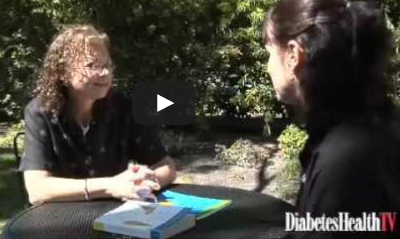
The discovery of insulin and how it effects one family

Screen Shot 2015-02-07 at 5.04.27 PMInteresting read

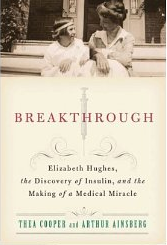
The first few patients to actually receive insulin back in 1922 make an interesting story in, Breakthrough: Elizabeth Hughes, the Discovery of Insulin and the Making of a Medical Miracle.

It all began at the University of Toronto with the discovery of insulin after two years of scientific research and experiments conducted on dogs.

The back story is really the story: the personal and professional struggles of the lead scientist, Dr. Frederick Banting, whose birthday has been taken as World Diabetes Day, November 14th. Banting did not have an easy slog through the myriad of academic regulations and competing researchers’ jealousies. 

Elizabeth Hughes, the daughter of an American diplomat, was one of Banting’s first patients after she managed to live for four years on a starvation diet – the treatment before insulin was discovered. Amazingly, perhaps she lived to be a ripe 77 years old.

While the authors, Thea Cooper and Arthur Ainsberg, guess at times at actual occurrences, the overall arc of the book conveys a true look at the drama of living with diabetes before insulin was discovered and shortly afterward.

Type 1 vs type 2 diabetes debate continues

Which is worse t1 or t2? Keeping another myth alive.

 NewImage

Wow, I am late to this discussion, but felt it worthwhile to join because it appears the debate continues…

Last month Diabetes Health published “What People with Type 1 Diabetes can Learn from Type 2s” by Clay Wirestone  It set off a firestorm of comments, mostly from type 1s, about how dare you tell us we can learn something from those lazy, fat type 2s!

David Spero, blogger over at Diabetes Self Management then wrote this post, “Type 1s Vs. Type 2s?” calling for type 1s and type 2s to come together for the sake of our health and that both sides are not fully aware of what the other side lives with. Interestingly, the comments posted on Spero’s site were almost unanimously empathetic.

It seems to me, Wirestone’s biggest goof was his argument (that t1s can learn from t2s) and his tone. If he’d approached the topic from the point of view that t1s and t2s share some commonalities and we can each learn something from each other, the war may have never ensued. But it is a fascinating study in how we all emotionally hold diabetes.

You should go read the stories and comments to both stories. In reading all the comments to Wirestone’s post, I found Allison Blass nailed it for me:

“The problem with this article isn’t so much that it’s saying people with type 1 can learn something from type 2, but assuming that people with type 1 aren’t already learning these lessons for themselves. Plenty of PWDs with type 1 exercise regularly, take their medication faithfully, and make small changes to get healthy. These aren’t genius concepts divined by the type 2 community. 


I will say that the amount of misinformation and misconceptions about type 2 diabetes in the comments are disgusting. Type 2 diabetes is not CAUSED by obesity – it’s a contributing factor. Type 2 is not cured through diet and exercise – it is managed, just like insulin. Type 2 diabetes does not have the same flexibility as type 1 – blood sugars have to be dropped through extra exercise or changes in diet, not just a simple bolus. People with type 2 diabetes can go years without being diagnosed, which means that many people with type 2 are diagnosed at the same time they find out they have complications. 


Type 2 diabetes is a bitch, same as type 1 diabetes. And yes, they are different. But we both have to do things that are different, we both have a health issues and learning tactics and strategies for handling certain situations could help. 


In any event, if you don’t like people spreading misconceptions about your disease, you should probably be damn sure you’re not spreading misinformation about someone else’s. It’s not nice.” 


-Allison Blass 
www.lemonade-life.com

And then, as I said, even tho I came late to the game, I felt compelled to add my own 2 cents worth and so I posted this today on Spero’s blog:

“As a type 1 for 38 years I understand the cry of type 1s that no one understands how hard and intense it is to live with this disease, and that we are grouped under the same umbrella of those lazy, fat type 2s who did it to themselves.

Yes, many type 2s engaged in poor health habits that may have led to their diagnosis, but not all. One in five are slim actually. For some the genetic component is so strong they would have gotten it regardless of their actions. And there must certainly be type 2s who are annoyed with the bad press their own brothers and sisters bring them.

But one diabetes being worse than the other? It’s all a matter of perspective. I wrote a book recently, “50 Diabetes Myths That Can Ruin Your Life and the 50 Diabetes Truths That Can Save It”  and the myth I always quote is, “Type 2 diabetes is not as serious as type 1.”

It is one of my favorites, because the emotion runs so high and because the answer seems so obvious, but is not. Both are extremely serious because they can both lead to the same devastating complications. While type 1s will never get off their insulin, and endure more intense management, type 2s are asked to undertake preventive behavior, which anyone can tell you, is a bitch.

Since most type 2s are diagnosed years after they have the illness, many already have complications by time they’re diagnosed. And while most type 1s will live with their illness longer than type 2s, many will also live more healthfully with it because they developed healthy habits earlier and they see more directly the positive result of healthy habits.

When “What People with Type 1 Diabetes Can Learn from Type 2s,” appeared on Diabetes Health what incensed most readers was the cavalier notion that type 1s aren’t doing good enough, so obviously we could learn a thing or two from type 2s. That reeks of presumption and offends.

We all have something of value to share from our experiences, and it’s up to us as individuals how we manage our diabetes. And, how we choose to see it – some see themselves as victims and only see hardship, others see diabetes as a welcome wake-up call and get healthier, and others see diabetes as a signal that life is precious and go about making the most of it.

Since no one can argue with your experience, it’s foolish to throw rocks at someone else’s. And while personally, I would vote to change the names of type 1 and type 2 diabetes to better reflect the differences and educate the general public about the differences, when it comes to helping each other out, let’s not overlook that living with any chronic disease we share many similarities.”

What’s your take on this?

Don’t let fear and worry steal from you

I want to tell you something it took my mother roughly 70 years to learn: Fear and worry can be giant stalkers and thieves. I grew up with a mom whose two primary emotions were fear and worry. Admittedly, there are times these can save a life. But usually they steal from your life. Fear and worry for decades have colored how my mother sees and interacts with the world, “Take a hat or you’ll get sick!,” “Let’s go now (2 hours early), there’ll be traffic!,” “No, I’m not going. They only invited me because they were being polite.” These are not life-savers, they are life-stealers.

 RettaDavid2007 birthday - 4

My mother’s automatic response to most situations is: “You shouldn’t X, because Y will happen and Y will be terrible!”  Fear and worry affect her decisions and expectations of others and the world. It is a heavy load to bear when fear and worry are what you hold most close, simultaneously creating comfort, distress and so much limitation. 

I’ve pointed this out to my mother for years, since I was a teenager actually. She is wholly aware and agrees, but knowing and doing something to change are two different things. When she imposes her fear and worry on me, I stop her as quickly as I can. Sometimes graciously, sometimes not so much. She has learned at these times to back off. It is self-protection for me: I don’t want to absorb her negativity. I love my mother and I know after years of trying, I will not change her and I don’t want her outlook to change me. Funny thing is if you met my mother you would think she is lovely, warm and personable, and perfectly normal, all of which she is. And she harbors these demons.

I have seen these emotions narrow my mother’s world and opportunities, like the friends not made because “They don’t really want me” and the job offered not taken because, “I won’t do it properly” when hands down she would do it better than anyone. I’ve been ruminating about this because I recently read a quote that captured these thoughts so well and reminded me how easy it is to nurture fear and worry living with diabetes:

“Worry does not empty tomorrow of its sorrow, it empties today of its strength.” Cornelia (Corrie) ten Boom.

So succinct, so profound, so true. I shared this quote with a group of patients I presented to a few weeks ago in Gettysburg, Pennsylvania. If you spend time worrying about the future, complications or premature death, you will not change anything except probably feel worse than you already do. However, if you take that same investment of time and energy to do something productive and useful – like learning how to and eating healthier, being more active, going to the doctor and spending more time doing what you enjoy, you will change everything.


Corrie Boom was an interesting woman – the first licensed female watchmaker in The Netherlands who after WWII became a preacher traveling the world preaching forgiveness. During the war Corrie worked with the Dutch underground recusing Jews, until in 1944 her entire family was arrested and sent to Ravensbruck concentration camp. When released from the camp – due to a clerical error, otherwise she would have died there like her sister – Corrie returned to the Netherlands and opened rehabilitation centers. Soon after she went back to Germany where she began preaching, bringing her Christian beliefs about the power of forgiveness to over 60 countries. In her post-war experience talking with other Nazi victims, she discovered that those who were able to forgive were best able to rebuild their lives.


There is more and more literature coming out about the power of positive emotions, which I believe just as strongly as I believe negative emotions are disempowering. While fear and worry provide the comfort of feeling like you’re doing something, in actuality all you’re doing is using up time and energy that can be put to actually improving something. 


My mother’s turning 80 this January and in many ways she is recapturing much of the life she gave away. While fear and worry are still fond friends, she has found a way to turn her head away a good deal more often now and see them as the thieves that they are. 


The power of blood sugar penning

I’m a type 1 who rarely logs her blood sugar numbers. I test about six times a day ordinarily, more when I eat a meal out and don’t really know how many carbs are in it, or take an unexpected walk and don’t know where its left me, or do a presentation and know the pre-talk jitters are messing with me or my sugar’s rising fast in the morning and I haven’t even had breakfast yet… and on and on and on. You get the idea, I test frequently. 

But I never log my blood sugars. Sure, I hear you say, why bother they’re in my meter. But I never look at them, never download them. And if you’re saying to yourself, they’re in my meter, you may not pay them much mind either. 

A few months ago I had a short spate of  logging my numbers because I started with a new endo and was asked to write them down. For about six weeks I wrote them in a log book. Once a week I sent them to my endo. So I began to look at them and noticed some overarching trends, ’tis true, yet at the same time a certain randomness – and without the additional information like what was I eating and did I walk that morning and had I already taken a unit of Apidra to blunt my early morning rise – they seemed just like floating numbers not attached to any relevant information. So, sure enough when I stopped sending them to my endo I stopped writing them down.

Now I’ll contradict all I just said. If you’re new to blood sugar testing or going through a patch where your numbers seemed to have changed for no apparent reason or you just can’t figure them out, I do think logging can help you spot patterns. It also makes you more aware that you indeed have blood sugar numbers and that they fluctuate throughout the day. 

And, writing them down with paper and pen seems to win in winning your attention over just letting your meter collect them. In this little piece in Diabetes Forecast magazine, “The Value of the Logbook” Laurie Terrio, a cde and type 1, lost her own argument of meter over logbook when she began to write them down and really see the impact of her numbers. 

If you need a little extra help with your blood sugar, try the pen. You might just find something worthwhile peering back at you from a real page.

All aboard: Amtracking through Pennsylvania with diabetes

coloredpullmanportercar

These last two weeks I’ve been “Amtracking” up and down the East Coast: From New York to Cambridge, MA two weeks ago and  last week to Harrisburg, PA and then back from Philadelphia to speak to patients and nurses. This work I do has to my surprise led to seeing a lot of the country.

Not having ridden Amtrack for probably a decade it was a delightful surprise – almost stepping back into a more genteel era. The seats are wide, comfy and provide plenty of leg room, unlike those I’ve grown used to now in airplanes’ economy class. The conductors are pleasant, “Hello, how are you doing today?” While stepping aboard on one leg of my journey, the high steps made it difficult to lift my wheeling case. Not a problem, the conductor had it in tow before I even thought how was I going to manage it.

Amtrack also has a “Quiet Zone.” A car where no cell phone use or loud conversation is allowed. What a delight. Between the gentle rolling of the train and the silence I fell off to sleep for an hour. Moreover, two restrooms in every car, never a line! I am forever changed. Next time I go somewhere Amtrack goes and the trip is not more than a few hours I will opt for the age-old comfort and civility of train-ing over plane-ing. Moreover, it allows you to bypass going through airport security where a hand search reveals syringes and begs questions, an insulin pen raises a red flag and one is supposed to (I rarely do) extricate one’s self from seat, climb over two fellow passengers and scuttle off to the restroom to take a shot. 

I was train-ing to speak to two groups of patients and nurses amid the rolling hills of rural Pennsylvania. My train stop was Harrisburg, where I was picked up by Betsy Wargo, a dedicated diabetes educator who serves the nearby area through Wellspan, and had invited me to be the key speaker for their annual diabetes health fair. The fair was held at Gettysburg Hospital in historic Gettysburg, home of one of the major battles of the Civil War and Abraham Lincoln’s famous address. At the hospital I had the pleasure of addressing about 70 patients as an author and fellow patient. I shared my personal story of getting diabetes at 18 and what it’s been like to live with, dispelled many of the diabetes myths that confuse most people and explained the power of tapping into our positive emotions to better manage diabetes. These of course are the topics of my two books.

Focusing on what we want (happy, healthy life) rather than what we don’t want (complications) and putting more energy into our positive emotions, for instance appreciating what we have, forgiving ourselves when we muck up, patting ourselves on the back for all we do and taking pride in our efforts – helps us do better. Oprah often says, “When you know better, you do better.” What’s also true is, “When you feel better, you do better.” Afterward Betsy and I toasted the successful evening over a drink at the famed bar inside the hotel and talked passionately about how to help patients improve their self management.

The next day I was picked up and driven to Springfield, a town just outside of Philadelphia, where I presented my Taking Control program to another 70 patients. I followed an endocrinologist in the line-up and when I finished my talk numerous people told me how much they got out of what I said. It doesn’t hurt to have a powerful story to share or to follow a doctor who has just pummeled your audience with target numbers, facts and figures.

Then it was back on the train home to the Big Apple where I, for one, was riding on a high. As we approach Thanksgiving, more and more for me it is not an annual event. Throughout the year I give thanks for how fortunate I am to be doing this work and how grateful I am for all who make it possible. 

Revving up for Diabetes Day, November 14

L1030211Learn and Do on Diabetes Day

This is my last post for a few weeks and so I wanted to leave you with some interesting things to check out and do while I’m gone. And, remind you to come back the end of this month to hear about where I’ve been and what I’ve been doing. Meanwhile,  as we rev up to November’s Diabetes Month, here are some great ways to start your learning curve now.


1. Check out World Diabetes Day, the new web site Manny Hernandez, founder of TuDiabetesand David Edelman, co-founder with his wife of Diabetes Daily, have created. The site brings greater awareness to diabetes in general and things you can do to be a part of diabetes day, November 14, and spread the word. You’ll find lots of news and lots to read, including blogsfrom an assortment of bloggers, including three from me that will show up throughout the month. 


2. If you’re new to my blog or come sporadically, you might want to read some past posts. Most are timeless since you may have noticed I tend to write about the emotional experience of living with diabetes and how to reframe diabetes, using it as a catalyst to create more health and happiness. 


3. You can listen to my recent podcast on the Diabetes PowerShow. A lively discussion between me and the show’s four passionate hosts about diabetes myths and the emotional resilience needed to live with diabetes, and how to create it. Also available on iTunes.


4. Do your homework, but I promise I won’t collect it. Pay attention over this next month to what you do well in your diabetes care and appreciate your efforts in some tangible way, whether buying yourself a little something or just giving yourself a pat on the back. Also, pay attention to what you could do better and figure out one simple step you are willing and able to take that will help you do better. Take it, look for improvement and write down your improvement. Then go back and buy yourself a little something or give yourself a pat on the back to commend your efforts. 


I’ll see you in late October after I return from the International Diabetes Federation conference in Montreal. Hopefully I’ll be a little more educated and so will you.

Insulin myths and truths

Screen Shot 2015-02-08 at 11.53.19 AM

I’ve just returned from Worcester, Massachusettes where I spoke to a group of about 100 patients about a lot of confusion around insulin. It was a great group, it was a great talk. The audience, largely type two seniors come from near and far to attend this monthly support group. They were curious and engaged and I always get energized when speaking to such a group. 

Yet, as educated and committed as this group is to their knowledge and care, there were still some myths about insulin and diabetes that they believed. It was great to see light-bulbs go on all around the room as they learned the truth.

Insulin Myths:

Myth: Shots hurt. People envision the big syringes and long painful needles they sometimes get a shot with at their doctor’s office. 

Truth: Shots rarely hurt. Needles are as small as 1/4 of an inch and extremely thin. Also, the needle goes into the skin where there are few nerve endings. 

Myth: If I need insulin, I’ve failed. It’s understandable you might think this as doctors often present and use insulin as a last resort. 

Truth: If your doctor recommends insulin it’s because it’s the best treatment to manage your blood sugar. Increasingly the American Diabetes Association is recommending earlier intervention with insulin to get patients under better control quicker.

Myth: People who use insulin have worse diabetes. After all if you have to take shots it must be really bad.

Truth: People who do not have control of their blood sugar have “worse” diabetes. Unmanaged blood sugar over time leads to diabetes complications and that’s as bad as it gets.

Myth: Only people with type 1 diabetes can wear an insulin pump. 

Truth: Most people who wear a pump have type 1 diabetes because everyone with type 1 is on insulin, but many people with type 2 who take insulin also wear a pump.

After my presentation the questions came fast and furious and I realized once again how much I know having written my recent book, 50 Diabetes Myths That Can Ruin Your Life:  And the 50 Diabetes Truths That Can Save It.” As the title says, myths degrade the quality of our lives and accurate information empowers us to live well. You’d be amazed how much you believe is true about diabetes, isn’t.

Novo Nordisk – Changing Diabetes Bus World Tour

Novo’s bus touring the world

 NewImage

As part of the festivities for Diabetes Month – November for those of you who don’t know – this Tuesday, November 13, Novo Nordisk will have a bus packed with diabetes information, Changing Diabetes® Bus World Tour, on the North side of Union Square, from 11 –  7 PM. Visitors will be welcomed aboard the 59-foot mobile showroom that has been traveling the globe to raise awareness about diabetes prevention and control.  The Changing Diabetes® Bus has visited five continents – Europe, Africa, Asia, Australia, and now North America.  On the bus are interactive, multimedia exhibits about diabetes and you can help support the UN Resolution on diabetes by signing a petition. 

Outside the bus, visitors can get free health screenings and meet some of the crew from Divabetic’s ‘Makeover Your Diabetes’ team including: best-selling author/motivational speaker, Mother Love, style advisor, Catherine Schuller, celebrity makeup artist, Jeff Jones, fitness & food expert, Jessica Issler, celebrity photographer, Winston Kerr, Divabetic founder, Max Szadek, life coach, Dana Hariton, fitness expert, Rochelle Rice, Divabetic spokes person, Seveda Williams and a dazzling array of DIVA volunteers and motivators will be on hand to help you makeover your diabetes. Diabetes isn’t fun, but they’ll almost make you think it is, while you get educated and in touch with your inner ‘diva.’