Taking a CGM vacation

I’ve often been asked why I don’t wear a pump. I do MDI (multiple daily injections), always have. I’m usually asked the pump question by a pump user, who of course extols the benefits of using a pump. And I am sure there are many and it is a wonderful device for many.

Sometimes my pump wearer then tells me they also take pump vacations. It is what it sounds like it is. They take a break from wearing their pump and do injections instead for a while. Wearing a pump, as most (all) devices, has its drawbacks as well as its virtues. In the case of a pump, although if you wear one you’ll know better than me, drawbacks include changing sites, occluded tubing or any other pump failure, carrying tons of supplies, where to wear it for the beach.

Yet, in all the years I’ve heard people talk about taking a pump vacation, I’d never heard, or thought about myself, taking a CGM vacation. Yes, I wear a CGM. Currently Libre 3 Plus. I’d never thought of taking a break until I had reason to do so a week ago.

How’s it going? Remarkably, actually. I’m back to checking my glucose on a meter about 7 days a day. Do I like the finger sticks? Nope, no more than before. But, I’m surprised (amazed) that when I do a check, my numbers are great (I avoid saying ‘good’ as numbers aren’t “good” or “bad”). They are nearly always in range and numbers I like: 83, 101, 98. Huh? How could it be?

I have to guess it’s because of two values I hold. The first is routine. I eat and exercise pretty similarly day to day so I’ve learned my patterns, how my blood sugar reacts. It’s pretty similar day to day. That was the second value by the way, learning my patterns. Which of course came from years of wearing a CGM.

I don’t know how long I’m going to wait before I start up my next sensor. I’m enjoying this vacation. If you’ve never done it, you might like to try. My mind no longer obsesses about my numbers (although it surely did the first day I was CGM-free). That means there’s more space up there and a certain carefreeness. I feel a little more ‘normal,’ and a little less like a person with diabetes. Trust me, I didn’t expect this. But, hey, interesting. (Caveat: I’m no doctor, you need to be comfortable with this decision).

I gave up my CGM last week because I’m experimenting with photobiomodulation (red light therapy). I was going to do a red light therapy treatment on a bed of lights called the Novothor and I didn’t want to risk that the sensor would be affected or shut off. Simple as that.

I’ll write more about photobiomodulation soon. It’s a healing modality that uses certain wavelengths of light with really no side effects. In the short run, it can help heal injuries, lower inflammation, aid blood flow and charge up mitochondria for more energy. In the long run, it may even help people with diabetes avoid what’s come to be called Type 3, brain conditions like dementia and Alzheimers. People with diabetes are at higher risk of such conditions due to the damaging effect of high and low blood sugars on the brain. More to come.

So just a suggestion – next time you feel overwhelmed by your diabetes you might want to take a CGM vacation. See how you feel and what happens.

That said, I know I’ll be putting my sensor on again fairly soon. It’s still an amazing tool and likely, in the long run, I trust it will keep me healthier than without it.
The highest blood sugar I’ve ever had

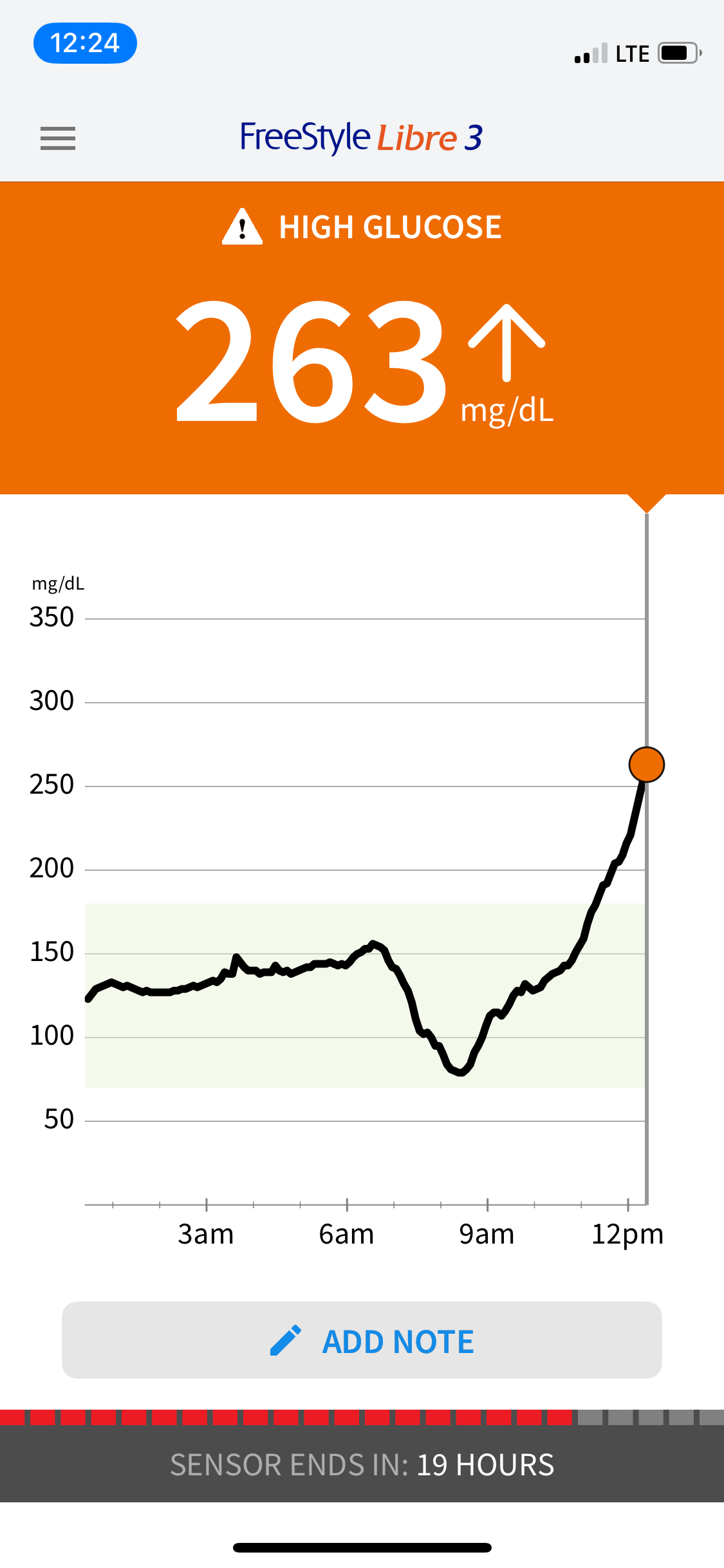
I think this is the highest blood sugar I’ve ever had, or at least since I could see my blood sugars. I sent this to a fellow type 1 friend in an email with the heading: ‘Don’t ask!?’ She wrote back: ‘I’m asking!!! Something you ate for breakfast?, sugar got in your coffee, bad news/stress…. Detectives at work! 

Of course I’d already put on my detective hat and wrote back: ‘Could be any or all of those. I think the sensor was correct. I don’t know if my Fiasp (short acting) or Toujeo had spoiled as both were expired. Or, I didn’t cover breakfast correctly because I was at my friend’s house in NJ and she made oat muffins which I don’t ordinarily eat. Or maybe the heat tampered with my insulins or BS. Or I injected through scar tissue.  Or…or…or…

Because when I realized how my insulin(s) wasn’t covering my breakfast, I was in the car with friends just starting out on our two hour drive from visiting a friend in New Jersey, back to Brooklyn. We made one stop before getting on the highway; we stopped at a supermarket. You know city girls just wanna walk up and down the aisles of a real supermarket. So while my friends shopped I walked up and down every aisle and around the property outside knowing exercise now was the only way to stop my blood sugar from rising and hopefully get it down.  

And it did start to come down, from this high of 263 to 219, but then we got back in the car and it started going up again. By this point I’d likely taken 7 units of Fiasco in 1 or 1.5 unit shots and I was bouncing my feet up and down in the car to keep so blood sugar lowering motion going. Finally I chanced one more unit when I was 175 and half way home. Finally that knocked it down to 110 by time we crossed over to Brooklyn. 

I dumped the Toujeo and started a new one this morning. I watched my blood sugar all evening and the next morning and all seemed fine.

So what did this detective and my friend come up with. We figured the most likely scenario was seriously undershooting for the oat muffin. But truly who knows?! As the song goes, ‘Mama said there’d be days like this, there’d be days like this mama said.’ Luckily we now have the tools, my CGM, to watch what’s happening in real time, and the knowledge to run small experiments like taking 1 unit and seeing what happens. Luckily too, while I was somewhat distressed not to be close to home and able to just grab a fresh bottle of insulin, I was grateful I wasn’t alone.

Blood sugar has a mind of its own

One of the things that has the most value for me managing my blood sugar is routine. Like the Virgo I am, I tend to eat the same type of foods, amount, carbs, often the same foods every day — and no I don’t feel deprived. I also tend to exercise similarly day to day. What you see above was me stepping off my routine track and while gleefully wanting to shout, “look ma, no hands!” I took a giant splat, or spike and spill, spike and spill…

The 150 mg/dl around 7 am was just the damn Dawn Effect, and it started before I even awoke. That sometimes happens, other times it waits for me to at least put a foot on the floor from my bed.

But the afternoon spike and spill was walking to a cafe I wanted to try that gets rave reviews for amazing griddle oatmeal pancakes. Now, I next to never eat pancakes. Yes, my low carb lifestyle is my second most effective agent to manage my blood sugar. But today was a gorgeous near 80F, sunny day, perfect for a long walk and an adventure. So I set off for these boasted pancakes, and to indulge in a treat.

When I arrived at the cafe my sensor reported 59 mg/dl, so I watched it and didn’t bolus until I’d finished my meal. I sat on a bench and noticed it was now at 164 mg/dl. Again, I had a 40 minute walk home, so I took one unit leaning toward small errors, small misfortunes. However, the trickery of how many carbs were in those pancakes? Who knows. What would be the effect of the 40 minute walk home? Who knows. How many units of insulin did I really need having waited to inject until after I ate? Who knows?

You know, and I know you know, there’s no rest for the weary.

So I’m happily ready to get back on my routine horse, until a beautiful day, and an impetuous mood, calls me out, very likely to once again get my free ride on this roller coaster.

What a day.

Sweet, nutritious snacks with small impact on blood sugar

I was sent the four snacks below by Ben’s Natural Health. They all look delicious and won’t spike your blood sugar, so I highly recommend giving them a try. Below them I share my favorite recent slow-rise sandwich.

  1. Grapes with Cheese

Because cheese has a lot of fat and protein, pairing it with any sugary food will slow the rise of your blood sugar. You can use grapes, peaches, cherries, pretty much whatever fruit you like. Remember, dried fruits like prunes and raisins are packed with more sugar than fresh fruit. If you’re using canned fruit, buy it packed in water, or if you can’t, rinse off the sweetened water it comes in.

2. Greek Yogurt with Cacao Nibs, Chia and Berries

“Greek yogurt is a fantastic base for a blood sugar-friendly treat,” says Oscar Scheiner from Ben’s Natural Health, “Adding cacao nibs for antioxidants, chia seeds for fiber, and berries for a natural sweetness creates a perfect combination for stabilizing blood sugar. ” A study published in Diabetes Care found that fiber-rich additions like chia seeds can reduce glucose spikes by up to 39%. Personally, I’d leave out the chocolate nibs and add fiber-rich nuts instead.

A variation of this recipe can be made with coconut and or almond milk instead of Greek yogurt and it’s called chia seed pudding. There are tons of recipes for chia seed pudding online so have a look around.

3. Apple Slices with Peanut Butter and Cinnamon

An oldie but goodie. Fiber and protein-rich peanut butter is filling and apples are the best way to keep doctors away, aren’t they? Just spread some peanut butter, or almond butter if you prefer, on a slice of apple and sprinkle with cinnamon. Altogether this will give you a really satisfying crunch, super smooth mouth sensation and gradual sugar rise.

4. Dark Chocolate with Almond Butter

Lucky for me dark chocolate has been shown to have more antioxidants than milk chocolate so enjoy it. Personally, 92% is my bliss point which I usually get by pairing a square of 85% with a square of 95 or 100%. The almond butter as you know now will slow down the sugar rise due to its protein and fat. The key here is quality chocolate. The flavor sensation is so rich, you don’t need more than a square or two.

Thank you for these ideas Ben’s Natural Health.

5. My new fave sandwich: Peanut butter and banana on multi-grain toast

If you’re my age you might remember this sandwich was enormously popular years ago when hippies ruled the earth. Somehow it seems to have slid out of fashion, but recently I made it for myself and I can’t stop. I rarely eat bread at home, but a friend, and fellow type 1, recommended Dave’s Killer Bread, so I bought the PowerSeed loaf. Several varieties also come in “thin.” I toast the bread and only use half a banana and slice it thinly. I lay it down on one toasted slice of bread and slather the other with peanut butter. It’s mildly sweet, and sensuous in your mouth, and while I do have to take 2.5 units to cover the seedy bread and banana, it’s a slow rise.

World Diabetes Day, again, hmmm and again, and again, and again, and again, and again

I’ve had type 1 diabetes for 52 years. You may know that. Diagnosed at 18. I was told, like almost anyone diagnosed with type 1 diabetes in any year, “We’ll have a cure in five to ten years.” Well, of course we don’t. Nor do I actually expect one in my lifetime.

That’s not to say I’m not grateful for all the advances we have: better insulins, faster insulins, peak less insulins, smart insulin pens, continuous glucose monitors, insulin pumps now cozy with continuous glucose monitors, looping etc. Most of these advances have come in the past decade. Somehow speed begets speed. Advance begets advance.

Yet, still each year we stand up tall and honor a single day in the year when we attempt to bring awareness to this condition that many of us have lived with a very long time. I’m sure that’s better than not doing so, but it feels like it feeds a complacency. It quiets the masses.

I’d rather we were doing more, if that’s possible, I don’t know. What I do know is, in part, these campaigns promoting diabetes day with blue balloons and roses and the sharing of stories are lovely for the newcomers to our ranks, but this old rank and file member feels these efforts carry a whiff of distraction because we’re still so far from that original promise.

In all honesty, I had no idea when I began writing this post that I’d end up here. I expected to share with you the campaign that Breakthrough T1D (formerly JDRF) is running this laudable day and extend the opportunity to participate. So here it is – ‘What do you want T1D breakthroughs for?’ And, yes, that’s nice.

Yet, wouldn’t it be nicer to no longer have a World Diabetes Day because there’s no reason to recognize an illness that no longer exists.

Three weeks away from a (virtual) conference you should be at

I’ve spent the past twenty one years speaking to people with diabetes and health professionals around the world, typically about the emotions that come with living with diabetes – and how to flourish.

November 8th and 9th I’m the closing speaker at the Diabetes + Mental Health Virtual Conference. If your mental health is worth $50 you should be there. Health professionals will earn 7 CEUs for attending. As a caregiver, you’ll gain new insights, and tools, how to support your loved one.

This is the third year world experts are gathering online to help us deal with: eating stresses, general and specific fears, perfectionism, stigma, diagnosis trauma, the burden of tech, anxiety, depression, shame, having tough conversations. This is a mecca in the all-but-desert of our diabetes emotional world.

The on-stage experts are too numerous to name, so take a look and also see the agenda. As the closing speaker for the conference, I will share with you what I’ve shared around the world, that we can, and how to, flourish with diabetes. Like ‘Redraw the Frame’ for instance. And, I’m sharing simple calming exercises to stay safe and clear-thinking when you feel overwhelmed.

I don’t recommend things often or lightly but you deserve to live your life less burdened by the ‘scaries’ of diabetes and more knowledgeable and able to manage them when they come.

The Diabetes + Mental Health Conference, November 8th & 9th, 11am-6pm EST. I hope to see you there. Click here to get tickets.

CGMs’ strength is marking the relative field rather than being 100% accurate

I remember having this conversation years ago with a friend, fellow type 1 and doctor. He said to me, and I didn’t want to hear it, “Your CGM isn’t going to be accurate or precise in the way that you want it to, rather it’s going to tell you about where you are.” Why, I thought, can’t it tell me I’m 106 or 202 or 57 with pinpoint accuracy? Well, I get it now.

Wearing the Freestyle Libre 3, that delivers blood sugar (although it ‘s really interstitial fluid) results every single minute, I can see how it isn’t precise. Not in that machine-like way we think of precision. One minute I’m 104, next minute I’m 108, next minute I might be 105 or 119. And I have learned to take a pause before I determine if I need to do something about where my blood sugar is.

It’s mind-boggling to think what in the world is happening in my body for these moment to moment readings to be ever fluctuating like this. I don’t know. What I do know is you can’t think any one number is perfectly it. So I am learning to slow down a bit, watch the numbers and look at the trend. That’s really what CGMs are all about. Showing you trends. Indicating about where you are and if you’re climbing or bottoming out.

As I was keeping an eye on my CGM today, I just thought this was worth mentioning.

Forgive the rage bolus, so cunning, so calculating, so primed to take us down

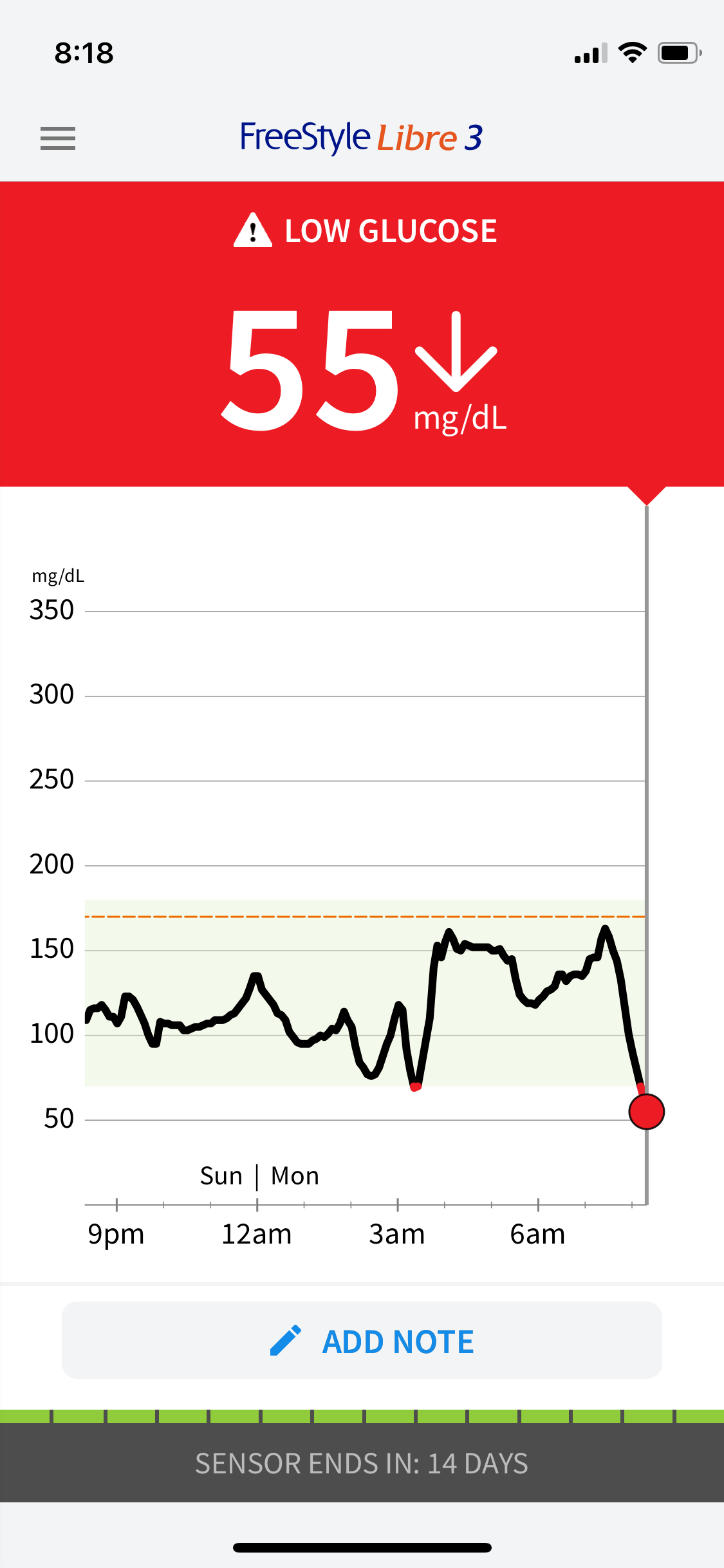
So what the heck is that above? At 4 am I appear to be 170 mg/dl. I was 173 mg/dl when I checked upon waking and 166 mg/dl when I checked on my meter. I checked because this is unusual for me and I just put this sensor on yesterday, and we know they can go wacky in the first 24 hours. Yet, that it was not.

Since I typically need 2 units when I wake up a little high, let’s say 130 mg/dl – one for the Dawn Effect and 1 for my coffee. – my fingers skipped my rationale calculating mind and pushed the plunger down on 3 units. After all, I was 170!

An hour later I paid for my impulsivity. 55 mg/dl (also confirmed on my meter) was the bottom only because I finally ate a teaspoon of honey and 1 jelly bean. FYI I hate to eat for no other reason than I have to, so I usually wait it out like a Tiger Mom watching how far and fast my numbers go up and down.

I think unfortunately the rage bolus is here to stay. It’s just the expression of human emotion. We want to rectify a troubling situation FAST. Even I, who generally follows Dr. Richard Bernstein’s “law of small numbers” (google it for the short explanation) gets sucked in when my emotions override my better thinking; but of course I can blame it on neurobiology saying my perhaps to say it’s really not my fault at all as it’s my amygdala gets hijacked and I just go along.

Then, the only thing you can do, the only route back to sanity is self-forgiveness. Luckily today I had the fortitude to bestow that gift upon myself. I wish you the same.

Diabetes Sisters brings outstanding peer & professional support to women with diabetes

Diabetes Sisters has a new look – and a forward looking agenda. They are working to be THE support organization for women and their health, and they’re well on their way.

The photo above documents their offerings. Among them are weekly virtual meet-ups. While a few years ago the groups were run locally face to face, the pandemic brought the groups online where they have stayed. The advantage is now you can attend any group, anywhere, and as many as you like.

I’ve been doing a lot of work with the leads of Diabetes Sisters, Donna Rice, Michele Polz, Shelby Kinnaird and Kristy Farnoly since last November when I wrote an article in their December newsletter that we can’t control blood sugar. I can vouch that these women’s concern is you. To bring you everything in their power to help you thrive.

I can also vouch that flourishing with diabetes lies very much at the foundation of Diabetes Sisters’ new platform. There are regular expert talks on issues that affect women’s health. Some are given by medical experts, others by patient experts. And I kicked off the Expert Series last month with a webinar on flourishing with diabetes.

May 29th I’ll be showcasing live guest Amy Jordan and her amazing triumphal story. Amy lives with type 1 diabetes, blindness, a damaged leg due to being hit by a New York City bus. Yet, she still leads a dance company, her lifelong passion, and has never stopped taking giant-sized bites out of life, with a sense of humor. You can watch Amy’s documentary, Amy’s Victory Dance, and I strongly suggest that you do. Then join us on the 29th for the conversation.

While the organization has put on a new face, much hasn’t changed. Founded by Brandy Barnes in 2008, and then run by her successor, Anna Norton, and including the women who have run the meet-up groups over the past years, everyone has held the same desire – to help women with diabetes not feel alone, not be alone and live their best life.

There’s a lot going on and there’s a warm community waiting for you with open arms.

10 nutrition myths debunked by experts

This article ran in today’s New York Times, “10 Nutrition Myths Experts Wish Would Die.” If you have access to the Times, you can see the full article. For those who don’t I thought I’d do a brief summary.

Myth No. 1: Fresh fruits and vegetables are always healthier than canned, frozen or dried varieties.

Non fresh can be just as nutritious, sometimes better if fresh isn’t so fresh. One caveat: they can contain added sugars, saturated fats and sodium so read the label.

Myth No. 2: All fat is bad.

This myth was published in the 1940s when experts found a correlation between high fat diets and high cholesterol. In the 1980s everyone reported a low fat diet could benefit everyone even though there was no solid evidence. Food manufacturers replaced fat with sugar, remember SnackWell’s? (I do!). Now the experts say while saturated and trans fats (red meat, cheese) can increase your risk for heart disease, monounsaturated fats (nuts, fish, flaxseed, avocados) can decrease it. Don’t assume “fat free” means healthy.

Myth No. 3: ‘Calories in, calories out’ is the most important factor for long-term weight gain.

Yes and no. Follow the above and you will lose weight for the short term, but not the long term. Stay away from refined carbs (cereal, starchy snacks, crackers, baked goods, soda) they digest quickly, raise your blood sugar and turn into fat in the body. Eat healthy overall, quality over quantity.

Myth No. 4: People with Type 2 diabetes shouldn’t eat fruit.

Everyone benefits from the nutrients in fruit — fiber, vitamins, antioxidants. Even people with diabetes. Always choose fruit over fruit juice.

Myth No. 5: Plant milk is healthier than dairy milk.

Not true. Cow’s milk has more protein. (Still, personally, while I do put light cream or half n’ half in my coffee, I drink almond milk for the lesser carbs.)

Myth No. 6: White potatoes are bad for you.

Yes, they can spike your blood sugar, but they are rick in vitamin C, potassium and fiber, especially consumed with the skin.

Myth No. 7: You should never feed peanut products to your children within their first few years of life.

Surprise! Experts say it’s best to introduce kids to peanut products early on – unless your baby has eczema. Also feed baby a diverse diet the first year to prevent food allergies.

Myth No. 8: The protein in plants is incomplete.

All plants contain all the amino acids necessary for building protein. But to a greater or lesser degree. So eat a variety of plant based foods every day. Most Americans get more protein than they realize or need.

Myth No. 9: Eating soy-based foods can increase the risk of breast cancer.

While isoflavones found in soy stimulate breast cancer in animal studies, it’s not been verified in humans. So for now, scientists are not linking the two. Instead, soy products may be protective toward breast cancer.

Myth No. 10: Fundamental nutrition advice keeps changing — a lot.

Dr. Marion Nestle, food guru and professor of nutrition, points out that in the 1950s people were advised to stay away from saturated fat, high sugar and salt products, and that hasn’t changed. Author Michael Pollan says in his book Food Rules (which I loved) “Eat food. Not too much. Mostly plants” and Nestle agrees.