Life is diabetes and diabetes is life

P-U Bring the Stars Out to PlayThe answers are inside you

A lifetime ago, well literally half my life ago when I was in my twenties, I quit my advertising copywriting job to design and write inspirational greeting cards. I was taking some personal growth trainings at the time and wanted to share my newfound key insights with the world. I actually did create the cards, get them printed, get them sold and four years later, still a starving artist, get a “real” job. 

But what I wanted to teach others has never gone away. What I learned during that time of training and years of reading are life principles that affect the quality of our lives, and as Oprah says, “When we know better we do better.” So, here is what I know for sure:

1. There’s a pay-off to everything we do. You may not think so when you’re miserable but whatever you’re doing, crying in your beer, moaning on someone’s shoulder, letting guilt fill your day, playing the victim with diabetes, it’s comforting to you in some way. 

2. You will tend to get what you expect. If you want more, raise your expectations. If fear of failure is paralyzing you, lower your expectations.

3. “Act as if.” When you don’t feel it, act as if you do: happy, confident, strong, whatever. Who’s to know that’s not really you? Certainly you’ve been these things at various times before. By pretending you feel a certain way, you will begin to. The world then responds to you in kind, as it does all the time, actually.

4. What is, is. You may not like what is, but it’s what you’ve got in your deck to play with. All you can control is how you play your cards. You can always add to your deck of course.

I am coaching a young woman in her early twenties who has type 1 diabetes. She has had diabetes for about 10 years and is going through an emotional storm:  a bad break up with her boyfriend, a death in the family, financial strife and more. The immediate ramifications for her have been a loss of interest in her studies and future, which she was so enthusiastic about previously and out of control blood sugars. Due to months of stress her blood sugars have been consistently high causing her to lose 20 pounds with no effort – her body is not absorbing the calories she eats. Her emotional storm has unmoored her from her good diabetes habits – she is eating erratically, missing meals and not covering her snacks or correcting her high blood sugars, all of which she used to do.

During our coaching session my job is to ask her questions to spark her thinking in a way other than she has been thinking. When we are stuck in a problem it’s very hard to think outside our usual box. And, as much as I want to give her the answers I think I see for her, they are not her answers. She needs to delve down and come up with what will work for her. Trust me, this is hard work. Both for her and for me. Real thinking takes time and effort. Much of her thinking will actually happen after she leaves me because I have stimulated it and it will continue. Holding my tongue while she searches for her own answers is hard work for me. But I know that she must remember what she already knows, reflect back on what she’s done in the past that’s worked and determine what she truly believes she’s capable of doing and willing to do. In short, only she knows what will work for her in her life. In this scenario she is the expert, I am only a tool.  

At the end of our time, however, I do, with her permission, share a few of my own thoughts and suggestions. And as I look back now on what I told her, I see it is very much based on the four principles above. 

I pointed out to her that while it’s hard to see it, there’s a pay-off for this unbearable sadness she is nursing. Maybe it reinforces her sense of herself as not being a very good person and it is always comforting to be right about what we believe. As for expectations, she is already talking about likely failing this semester as she is not paying attention in class. I reminded her that the expectations she plants she will likely create. Alternatively, I suggested she “Act as if” she is fine, her old self, confident, an interested student, for instance, while in class. At least for the periods of time she can sustain it. They will grow longer.   

I suggested she spend up to 30-60 minutes a day obsessing about her worries. And when blue thoughts roll in, in as they will, save them for that period when she will indulge them. Sometimes you just have to cut off non-constructive behavior. The rest of the time I suggested she be as fully present as possible wherever she is and employ the “act as if” principle. Lastly, I reinforced that she move forward with the small steps she identified that she could take to move in the direction of the life she once dreamed of and still wants. Covering her emotional eating with insulin is a step she identified that she can and will take. The results of this will likely be a little better blood sugars, a little less stress, a little more ease and a little light streaming into her world that now looks so dark. Each step we take creates a ripple effect: one positive step puts you in a more positive upward spiral.

It’s not rocket science, but when the world is on tilt it’s hard to see where you stand. I learn a lot when I coach someone. I learn to listen harder and more openly. I learn myself to be more present in the moment and not finish someone else’s sentences, not even in my mind. I learn we each see the world differently, operate in the world differently and prioritize differently. And, her emotional storm has reminded me just how dependent good diabetes care is on how the rest of our life is going. So along with the four principles I’d like to add this one specific to diabetes: Don’t just tend to your diabetes, also tend to your life. And don’t just tend to your life, also tend to your diabetes. They are intertwined. 

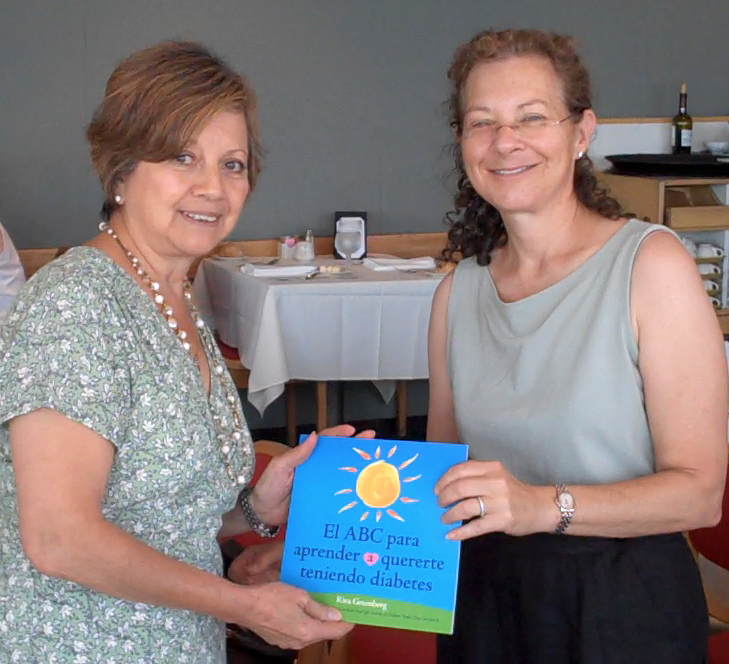
El ABC para aprender a quererte teniendo diabetes

Screen Shot 2015-02-08 at 11.48.29 AM

Translation:  “The ABCs of Loving Yourself with Diabetes.” This Spring my ABC book came out in Spanish due to the unprecedented hard work of its two translators: Georgina Baez-Sommer (pictured here) and Amparo Fernandez. How lucky was I to have two translators from the United Nations! In truth, I’m not that special but beside being a dedicated professional, Georgina also happens to be my neighbor’s mother. 

I decided there isn’t enough literature to help Spanish speaking people with diabetes, the Hispanic population being one of the highest risk groups, so voila, a coaching book in Spanish. 

“The ABCs of Loving Yourself with Diabetes” guides readers to use more positive emotions both in life and in living with diabetes, for one enhances the other. For instance, if you appreciate all that you do have in your life – friends, family, work, a hobby you love, you experience life as a happier place. Being happier makes managing diabetes a little easier. If you forgive your mistakes with diabetes and see them as learning opportunities, you build a databank of diabetes knowledge and more resources to do better next time. If you’re struggling with something in your care and can look back to when you’ve managed difficult times before and bring those same qualities and skills to managing your diabetes, you will do better.

Among the emotions you’ll learn to augment are courage, confidence, joy, awe and pride. You deserve to be proud just because living with diabetes is an ongoing job. Pride in a job well done is a powerful source of energy and healing. In truth, all we have power over living with diabetes is how we live with it: graciously, responsibly, lovingly and kindly or angrily, guiltily, sadly, beating ourselves up and everyone around us.

Anyway, just wanted to remind you The ABCs is available in Spanish and share these lovely pictures. Now it’s up to you to do the rest. 


Focus on what you want, not what you don’t want

Unknown

It’s a proven principle, when you focus on what you want there’s a greater  likelihood that it will happen. It’s the same principle as “thoughts held in mind produce their kind” and “like attracts like.” Hold onto something energetically in your mind and your attitude and behaviors will fall in line behind it. Poof! What you will see in your life will follow your thoughts.

Unfortunately, most of us focus on what we don’t want. It’s a sort of safeguard from failing or maybe a holdover from what you were programmed to believe about yourself in childhood. But the principle remains the same, like attracts like. If you focus on what you don’t want (most of us do so unconsciously, yet vigorously), it will tend to show up in your life. Then you say, “See, I never succeed, the deck is stacked against me” Or, “Why bother, I never get what I want.” You reinforce that you were right about your wrongly held intention. 

With diabetes you can either focus on what you don’t want like complications: blindness, kidney disease, heart attack, amputation and a shorter lifespan or you can focus on what you do want: a healthy weight, feeling vigorous, showing up as the healthiest person in your doctor’s office; your actions in both cases will be in alignment with what you focus on. 

So this morning I heard in a segment of Good Morning America with Dr. Oz, noted heart surgeon and health guru, on Keys to Long Life a new study came out that shows these keys can reduce chronic illness by 80%, add seven years of life and cut our health care costs in half. 

But what intrigued me was what Diane Sawyer quoted as the new mantra, “Eat what you need to eat first instead of worrying about what you don’t eat. Hmmm…focus on what you want not what you don’t want. So shop, cook and savor the flavor of the recommended daily 7 servings of whole grains, 4 servings of fruit, 5 servings of veggies, 2 servings of lean meat and a handful of nuts and let go of the worrisome thoughts around what you’re trying to avoid. Every time you go there you take a step off the road to what you want.  

To the garden state and back

One of the most surprising elements in the book, “How Doctors Think” by Jerome Groopman, M.D. is right at the start when Groopman says most doctors interrupt their patients within the first 18 seconds. 


A few days ago I went to New Jersey to present diabetes materials at a minor league baseball stadium that was also featuring a small health fair. Funny to see our little table against a backdrop of every unhealthy fast food available, but let’s not go there.


While I talked with a number of people I remember one particular woman who stopped by the table. She was hesitant at first, tentatively looking over what was on the table. Her hesitation and Pacific Islander look immediately made me think she probably wasn’t that educated about diabetes. Yet when I began to ask her about her blood sugar and A1c, wow, she knew her stuff. She told me about her 6.4% A1c and how she want’s to get it a little lower, she told me what she eats and where she can do better and she told me about her last conversation with her doctor, turning her shy smile downward. Hearing her A1c, without thinking I stuck out my arm and shook her hand saying, “Congratulations! You’re doing a wonderful job!” She grinned, she glowed, her smile lifted and spread from ear to ear going right up into her eyes. “Keep up the good work!” I said as she walked away waving and smiling, smiling and waving and thanking me. 


Right before my eyes I saw the affect of congratulating a patient on her hard work. Something I fear not nearly enough doctors do. And I know damn well she’s going to work even harder to get that A1c where she wants it because someone acknowledged her and her efforts. More and more I am convinced patients will do better if we acknowledge and praise, congratulate, encourage and inspire them.


In a Wall Street Journal article, “The Importance of Trying to Be a Good Patient” by Laura Landro, Landro cites medical educator and physician groups that are training doctors to conduct more sensitive interviews, recommending doctors find ways to praise patients for their competencies and express sympathy with how frustrated patients may feel. John Prescott, chief academic officer at the Association of American Medical Colleges, reports more and more communication training programs are trying to get doctors to step back and say, “What’s going wrong with this discussion and how can I change that?” And, the authors of “Breaking the Cycle”recommend doctors let patients speak uninterrupted for three minutes and ask open-ended questions. We hark back to where I began.


As my sojourn out to New Jersey came to an end, the driver of my ride turned to me as we approached my neighborhood saying, “I heard you talking about diabetes…” (I had been on the phone in the car). I explained to him what I do and he began to tell me about his father who died of diabetes and his brother who is having a terrible time with it. And how he and his wife are concerned because they’re both overweight. 


I listened, answered his questions, encouraged him and spent an extra five minutes in the car in front of my building to give him information and a soft place to speak. When I reached for the car door handle to let myself out he reached for my hand, shook it and thanked me, wishing me the best day anyone ever has. I feel now as though it was kismet that I met the two people whom I know I impacted. I imagine they feel the same about meeting me.

Can You Be In This Moment?

IMG_2105

I am trying to be more conscious to “be in the moment.” Sitting on the subway yesterday, staring out the window (there are a rare few moments where the subway is overground) I was thinking that what happened yesterday, last week, a moment ago is over and what will happen in the next moment isn’t here yet. So let me see if I can just be present now, in my body, looking at what I’m looking at, smelling what I’m smelling…well, maybe not on a New York City subway, but you get the idea. Of course the exercise was not in the analysis, but what followed, to “just be.” 

In all honesty, I’m not sure I completely believe that there is only this moment. Part of me thinks whatever has already occurred still exists energetically in the minds, memory and maybe even cells of our body. But I do believe that if I can be more present in this moment, that my moments will be fuller, richer, calmer, more content, and that like threading a necklace of beads, if each bead is high quality the end product will be beautiful. For I do unequivocally believe that the quality of each moment creates the quality of our lives. 

So today I’m going to try to be more present when washing the dishes – to feel the soap suds slime over my hands, enjoy how clean the dishes are becoming (and not worry about the next post I have to write). And I will truly listen to whomever is speaking to me and quiet my own thoughts racing to and fro in the background. And I will attempt to do this throughout the day.

So now I’m going off to the Motor Vehicles office to renew my license. Yes, I’m going to spend my precious moments marveling at the ancient, dilapidated room I’m sitting in, chuckling at the 3,000 people in energetic discourse with the ten civil servants behind protective glass, savor the sweetness of the peach I’ll be biting into to bring my blood sugar back up, and smile when I emerge five hours later into the predicted rainstorm for this afternoon that my license is good for another eight years.


Everybody’s got a story: here’s mine


thoughtful riva

I always wonder how people get to where they are in their lives. Best I can figure my curiosity began when I was nine. At the diner my family went to for the occasional dinner out, I would scan the room and notice others laughing, animated in conversation, or a couple with not even a word passing between them.  Who are these people, I wondered? What do they really think and feel? 


It’s not surprising that as I grew up I wanted to write the human interest features column for a newspaper, or that over the past few years I’ve interviewed more than 135 people with diabetes: I am fascinated by people’s “stories.” So here I share mine over the last several years since moving into this work. I hope it may offer you some clarity, or inspiration.


Warning: It’s lengthy. Perhaps think of it as a chapter in a book if it helps, definitely not a tweet. We know I’m not much good at that. 


Modified from a contest entry for “Second Acts,” that More magazine was running about changing one’s life after forty. 


My Second Act


I was 48 years old, planning my wedding, (my first thank you) and going into the hospital for diabetic frozen shoulder surgery. As if that wasn’t enough excitement, I fretted whether I’d still have my health insurance coverage for the surgery. This was seven years ago and the dot.com I worked for was bankrupt; every month scores of people were being laid off. I was to be one of them—luckily it would happen two weeks after my surgery. 


On the cusp of fifty, I had lost my job, was going to physical therapy three times a week and the rehabilitation chair that moved into my small apartment, which I had to use to raise and lower my arm an hour a day, gave me a time-out: What did I really want to do with my life? I was in what my friend Pat refers to as “The Void.” I didn’t know what I wanted to do for a living anymore. In my heart I didn’t want to continue in marketing communications, I’d always wanted to be in a helping profession. Yet, I didn’t want to go back to school for four or six years to earn a degree for the profession I’d toyed with – psychologist. While I wanted to help people, I wasn’t convinced that listening to their problems was an effective means for helping them change their lives.


At this same time something else happened that set me along the path that would become my new work– this work. I went to a diabetes educator. I have had type 1 diabetes since the age of 18, thirty years at the time, yet never had I been to a diabetes educator before, someone trained specifically to help people with diabetes manage their illness. After my first visit with the educator, I contemplated becoming a diabetes educator myself. I assumed it would be a six-month course. But this was not the case. I needed to first have a Master’s degree in pharmacology, nursing or social work. Then it was a two-year program and I’d have to practice 1,000 hours before I could become certified. So, I began looking for a copywriter job again. It was what I knew. Trouble was I also knew I didn’t want to do it anymore.


A year later in the midst of doing some freelance work, going on exploratory interviews and reading the famed career book, “What Color Is Your Parachute?” for the third time, my husband said, “You’re a writer and you’d like to help others who have diabetes, why don’t you write about what it’s like to live with diabetes?” I looked at him sweetly, rolled my eyes and said, “Honey, who’s going to buy a book about what I think about living with diabetes?!?” But five years later that’s exactly what’s about to happen. This July, my book, “50 Diabetes Myths That Can Ruin Your Life: And the 50 Diabetes Truths That Can Save It”will be published. And included along with knowledge and advice from diabetes experts and fellow patients is my own.


The road to here began with a roadmap. It wasn’t the first, I’d been drawing them most of my life, but this one was more specific. After I lost my job my husband and I sat on a bench one balmy afternoon and wrote down my vision: To help educate and motivate others with diabetes to better manage their condition. That vision sat in the center of a large blank, daunting white sheet of paper. Then we drew colored lines coming out going in all directions: these were to be the steps to my dream: 1) Write a column for a diabetes magazine, which I do now. One day after reviewing the four major diabetes magazines, I called the editor of Diabetes Health, the magazine that felt like it best matched my voice. I told her I wanted to write a column and led her to my web site to see the work I was doing. Presto—she called me back and said, “Looks great, what would you like to write about?” If it hadn’t happened, I would have told you, not possible. 2) Write and illustrate a bookthat would help people with the emotional management of diabetes. I did that in 2007 and self-published it. It was in the bookstore at the annual conference of the American Association of Diabetes Educators last year. This year it will be there again along with its Spanish translation. 3) Give talks to patients, and medical staff. I do that now across the country through an organization called Patient Mentor Institute (PMI). When I first heard about PMI, I immediately called but they told me they hadn’t yet scheduled their next training. Six calls, one every month, put me in the next training session six months later. Having my roadmap in place, and my heart, mind and body in sync with what I wanted to do, created the foundation I needed to keep putting one foot in front of the other. 


At the beginning of this road, when my husband first suggested that I write a book (and I felt that cold fear like a steel blade pierce my heart!) it didn’t hurt that a week later we met with my friend who worked as a copywriter at an advertising agency. She told us how miserable she was there. The next morning my husband said, “I couldn’t sleep all night thinking about you going back to that kind of work. Why don’t you interview other people with diabetes and write a book that shares many peoples’ experiences.” So that became my first real step: To interview others was so right it reverberated in my bones. I could capture a myriad of stories that would create a shared community and lessons learned. 


For two years I interviewed people. I still interview people. It’s usually a phone call, sometimes a coffee in their house or a coffee shop. I bring a little tape recorder and they bring their story. All I have to do is ask, “How did you discover you had diabetes?” and a lifetime pours out of them. My very first interview I practiced with a good friend. My first “real” interview was with a couple who discovered that their three year old son had diabetes, and they will never forget the date, September 10, 2001. While in the hospital the following day experiencing their personal world collapsing, the World Trade Center towers were doing the same a few short miles downtown, the smoke visible from the hospital hallway windows. The gravity of this interview was a sign to me to keep going. I branched out to interview acquaintances I knew who had diabetes and asked them who they knew. My circle of fellow patients grew quickly as did a community of diabetes educators, nurses and psychologists. In capturing peoples’ stories I have amassed a research library of sorts, collected a wealth of learning and understanding, and also a network of people I now know with diabetes, and in diabetes. 


But this book of interviews was not the book I would end up getting published, for I learned a lesson about publishing two years after beginning the interviews. While you may have what you think is a great idea, a publisher may not. I couldn’t sell the interview book. But the woman who was to become my book agent (whom I was introduced to having met her friend while on a train going to my brother’s house in Connecticut for Thanksgiving—trust me, that’s a whole ‘nother story) said let’s look for an idea you can sell. I shelved the interviews for the time being and we spent three months writing a new book proposal for my diabetes myths book and after shopping it to twenty publishers we had a deal—and I began all over again. As it would turn out, numerous nuggets from my interviews are featured in the book–so while we may hit detours in life, I know nothing is a waste. It’s been seven years now since I lost my job and embarked on this journey and five of those I’ve been avidly working in diabetes. I stopped freelancing two years into this venture because I knew if I didn’t jump in fully, I might never jump in at all. 


If you’ve been on this web site before, you may be acquainted with what I’ve been doing, if not, this blog began about two years ago and all my posts are archived here. I contribute regularly to Diabetes Healthmagazine. I’ve just been featured in Diabetic Living magazine. I’ve been invited to speak at the Mayo Clinic this September both about diabetes, and about my books. “Patient-expert” is a title I wear proudly now and I have earned it by putting one foot in front of the other and following my heart. I could not have told you with assurance that I would end up here, only that when I began I felt trying was worth the effort.


One of my messages has become that you can create an exceptional life–notdespite having diabetes–but because of it. That it can be a catalyst to greater health, happiness, meaning and purpose. What’s required is knowing how to medically take care of yourself and having the emotional resilience to weather the ups and downs. I don’t mean that you become a “Pollyanna,” but once you deal with the stages of shock and grieving, (and mind you they will re-visit you from time to time) that you will reach a crossroads that invites you to answer the question, “How am I going to live from here?” You will be better served if you can recognize that “What is, is,” and choose to honor your life by managing this sometimes-beast as best you can, and embracing more spiritual qualities like appreciation, joy and giving back. This is where, after decades, I have arrived. It wasn’t a quick trip, but I hope I can now shorten the passage for others.  


I knew in my late forties, as sure as I breathe, that it was time for me to finally nosedive into my dream of making a difference and create my singular road that would lead me there. With my husband’s financial support I could take a break from earning a living. With his emotional support I was loved and encouraged to keep going. The biggest challenge looking back was social: I missed having people to go to lunch with, and, admittedly, deadlines someone else gave me. What helped, however, and still helps, is having a routine: Taking a yoga class, my daily walk around the park and meeting my interviewees face-to-face as often as possible. And now seeing the early fruits of my labor. 


I say all the time now, “The universe keeps dropping gifts at my feet.” My husband says, “Don’t discount all the hard work you’ve done.” And I don’t. Yet I’m convinced that being on the right track, leading with your heart and following with your feet opens more doors than you can possibly imagine. Don’t be discouraged if you can only pry the door ajar slightly now. Keep tugging at it. One day it will open.


Today I associate most closely with something Mahatma Gandhi said: “Happiness is when what you think, what you say, and what you do are in harmony.” From the very first bench meeting my husband and I had to when he recently told me enthusiastically, “We’re only two degrees of separation from Oprah!” it amazes me where I’ve arrived. We joke that one day I’ll be sitting on the Oprah show and she’ll be holding up my book saying, “And everyone is going home with a copy of Riva’s book today!” 


You may laugh, most days I do too, but dreams have a way of turning into reality when you hold them fast and keep putting one foot in front of the other. 
A new friend and a shared view of being inspired by diabetes

Unknown

These days I know many people who live with diabetes unlike the first three decades of my life when I couldn’t drum up any such acquaintance. Over the past few years I have looked into numerous patients’ eyes at health fairs and support groups and I work with colleagues with whom I share a professional bond. 

I also now have real and true friends with diabetes with whom I do fun friend-things like riding around Mississippi for a week, and the more everyday activities of lunching, and on the weekends, spend free minutes trading intimate details of our dealings with this beast. I am awash with endorphins during those calls, secure in the knowledge that I need not explain anything; they understand the wacky ups and downs of blood sugar, the need to chew while on the phone, the positioning of our call after my walk but before lunch, the foolish thing we heard so and so say the other day and the hopeful sharing of some new research that may ease our burden one day.  

Then, every once in a while I meet a fellow traveler who is so much a mirror of myself I have to glance twice, and then again. That happened last week when I interviewedHeather Clute. Heather lives on the West Coast so it was a scheduled phone call and a last minute confirmation. She told me once we were on the call that she had wondered where in the world she was going to fit our one hour interview into her day. Yet, she decided to nontheless.

Fifteen minutes into our talk, I was chatting with a new, old friend. We had so much in common — grown women with type 1 working in wellness, our search for meaning and purpose through diabetes, our constant exercise to keep a positive outlook and a shared practice of mindfulness. I said that we’d be twins “if” not for her three children. OK, I admit it, three children is a big “if.” And so we laughed. 

I had googled Heather before I spoke to her and skimmed a few posts she had blogged. During our interview I read a few lines to her that she had written, “…we are all either choosing to be conscious or “unconscious” to the possibilities and opportunities around us. For me, diabetes has brought a deeper level of awareness to ALL of life, to every moment’s potential and every moment’s grace.” She laughed and thanked me for reminding her, it was just what she needed to hear that day.

After our talk I went back to read her posts. There are only four as Heather’s busy life, kids, school, work, staying physical, caught up with her, but I think you’ll like them. They are beautifully written and share a view of diabetes from the inside-out. 

It’s always a joy to meet someone with whom you immediately connect. It’s all the more when much as you may not want to, you share diabetes.


The new face of chronic illness

Screen Shot 2015-02-08 at 12.58.32 PMMichael J. Fox’s new book

I just watched Michael J. Fox in his appearance on the Oprah Winfrey show this week. Yes, working for myself gives me the liberty to take a break at 4 P.M. and recharge my batteries. 


Fox is an emblem of living gracefully with chronic illness. If you don’t know, he’s had Parkinson’s disease for the past 18 years, and looks just as youthful and boyish as he always has. Just now he shakes–a lot. Oddly, he said, the shaking is not from the illness, but rather the medication for Parkinson’s. If not for the medicine, his muscles would freeze. But there’s certainly nothing frozen about his mind, his enormous optimism, or his activism. 


Fox has gone to Washington repeatedly to seek funding for stem cell research and Obama has just passed legislation to make that possible. Of course where was Fox? Not in Washington, but climbing the Himalayas in Bhutan. He joked, it’s not so easy to get out of the Himalayas at a moment’s notice. He also told us that while there his disease affected him less. He could breathe more easily, odd because such altitude usually hampers breathing, and his muscles moved more fluidly. We also saw a demonstration in a segment of him playing ice hockey: he looked little different than his younger self who was an amateur player growing up in Canada.


Part of Fox’s appearance was also to promote his new book, Always Looking Up: The Adventure of an Incurable Optimist. And that was the face of illness that we saw: someone who is accepting, living fully and treasuring each small moment with his wife and children, someone who even savors the turn his life has taken saying if this hadn’t happened, he wouldn’t have met the amazing people he’s met and done the amazing things he’s done.” And, we got that he feels his life has been enriched. 


Some days he has more trouble tying his shoelaces than others or his medicine kicks in too slowly to avoid an incident he would not have asked for, but he said that vanity was the first thing to fly out the window once his symptoms began to show. And that he is not afraid, but eating life. 


As Fox says, “Parkinson’s doesn’t define me, it’s just one part of my life.” He also tells his children when they ask about his shaking, “My brain doesn’t work the way yours does.” How simple those few words are. So simple, a child can understand, and it leaves judgment out the door. It’s we adults who have to struggle to see past the jerky movements and our assessments based on outer appearances. 


Well, my pancreas doesn’t work the way yours may, so I’m a little different, not damaged or less than. That thought gave me a new window from which to see my diabetes. I think Fox truly is inspirational and an example of how to live with a chronic illness. He wears it well and so can we.

Making the most of the hand you’ve been dealt

Screen Shot 2015-02-08 at 1.05.19 PM

I was just so moved by this article in the NY Times Sunday Styles section last week, “In a Charmed Life, a Road Less Traveled” by Layng Martine Jr. that I insisted my husband read it. “Anyone who is in love is living a charmed life,” said the author, “especially if you’ve been in love for many years, through good times and bad.” I was moved both because it resonated with how I feel about my partner and because love never left this relationship. Not after the author’s wife lost the use of her legs, as well as other bodily functions. Not after she had to give up so many things she once enjoyed, and they once did together, like hiking in the mountains, strolling on a beach, tending to their garden. 

Martine Jr. continued, “After the doctor left, tears filled her eyes. “It was all too perfect,” she said, “wasn’t it?” And it did seem that way. It always had… Not long after getting home from the hospital, when we were having dinner by candlelight at our kitchen table, she burst into tears. “I don’t know if I can do this for the rest of my life,” she said.

All I could say was, “We’ll do it together.”

And then they began to look for what could be instead of what they had lost. “We began to think of what we could do to replace playing tennis, walking on the beach, working in the garden. 

We take many more drives now, preferably in our convertible… where they bring the food to our car…We know to say “Yes” to nearly everything because there is probably a way to do it. We know there is happiness available every day… A few months after the accident, Linda started driving again. She has rolled three marathons — yes, a full 26-plus miles in a racing wheelchair.” 

And now, so long since that fateful night, looking across the dinner table at my wife, or seeing her across the room at a party, the hopeless crush I have on her is as wonderfully out of control as when I first saw her more than four decades ago.” 

Fifteen years after the accident they have found a way to still roll through Tuscany, in and out of Ireland’s pubs, and watch the sun set holding hands on a country porch.  

“We don’t know what will happen tomorrow, or who will live how long…We are two, but we are one. And I love those numbers.”

This is a story of love and support, of possibility and survivorship, of finding happiness in simple things and adapting to what life hands you. And while it’s easy to say when you’re feeling down look around at the people who have it worse than you, it can still be hard to make your unhappiness smaller. 

But the game really is to find ways to still have happiness and contentment no matter what life has handed you. And the lesson to be learned is it is possible. 

The Secret – we create what we expect

Staring out the staff lounge window at the Cumberland Hospital in Fort Greene Brooklyn, just outside the auditorium where I am going to speak, I watch the traffic move along the Brooklyn Queens Expressway. Manhattan’s skyscrapers sit just beyond. I look up at the sky and whisper, “Thank you for where you have brought me.” This is my second presentation in my native Brooklyn. I’m not being so literal as to be citing Brooklyn in my thanks, but on the larger canvas of my life, to be doing this work.

I am critically aware in this moment that you never know what life has in store. Where you might be a year from now, five years from now. Surely, I never could have guessed I’d be standing in a hospital staff lounge about to speak to a group of fellow diabetics to motivate them toward better diabetes management. Not much more than five years ago I gave my diabetes management little thought. 

I always wanted to teach people that our lives are the projection of our thoughts,  and so we should plant the ones we truly want to reap, and accept our gifts and believe in our dreams. I just never knew sharing these ideas would have anything to do with diabetes. Honest, never.

When I speak to audiences I stress shifting their focus from the burden of diabetes to the rewards of doing the work — whether it’s to spend time with the grandkids, have more energy, pursue a beloved hobby or second career, or give back to the community. Most of diabetes education is about numbers, but the fabric of our life is mostly our thoughts and feelings.

Now at Cumberland Hospital I have finished my hour presentation and a woman raises her hand. After apologizing for coming late she says, “Maybe I missed this but how do you do it? How do you manage your diabetes so well?” The side conversations stop and the room quiets. Everyone is fixed on me. I begin listing all my tricks: my daily one hour power walk, using smaller plates, choosing more veggies and fiberous foods, sweeping most of the carbs out of my diet, and as the preacher in me takes over, the knowledge that my care is entirely up to me and that I don’t harbor a single doubt that I am committed to my best health.

18 pairs of eyes hold mine seeking answers from my passionate pontification. I wind down realizing how revved up I am. This rag-tag group of African American type 2 diabetics, one in a wheelchair, one with a cane, who when I began my talk seemed to only half listen, now applaud this slim white woman. I smile shyly almost shooing away their gratefulness out of embarrassment, yet I know they have been moved and the greatest gift I can give them is to accept their gratitude. 

This is what they don’t get from their doctor or their CDE — the understanding and insight of someone who lives where they live and has conquered the demons diabetes throws at them — at least most of the time. Moreover, many people I speak to are weighted down and held fearful by the loss of family members who have died from diabetes or those currently struggling with its complications. I try to bring them to a place where they can see that the possibility for their life is of their own making, not the legacy of their family members.  

Last year I learned something about my own family legacy. I interviewed my parents to get their take on what it was like for them when I got diabetes at 18. My mother told me something I never knew. “When you were diagnosed,” she said, “my heart broke.” Your father’s mother died in her fifties of a heart attack from diabetes and just before it happened they were going to cut off her leg. All I could think was this would be your future.” I was shocked to hear her say this, both because it was a revelation and by the information itself. But now that I’ve addressed enough audiences where diabetes is rampant in their families, I am grateful I didn’t know. 

Maybe if I had known what happened to my grandmother, who died before I was born, I would not have believed I could be as healthy as I am. Maybe I would have believed my grandmother’s fate would be my own, as so many people with diabetes similarly believe. Maybe not knowing allowed me to manage my diabetes and expect that if I did it well I’d be well. In fact, I believe diabetes can be a great stimulus to creating a healthier and happier life rather than falling victim to it and all the negative messages around diabetes. But maybe I would have been derailed on my way to these thoughts if I’d known what happened to my grandmother. 

I am pretty healthy after 35 years living with type 1 diabetes and I am resolute that I will continue to control what I can to have the best health that I can. It’s never been a secret to me that we create what we expect. Truth be told, that’s the good news and the bad. If you catch your thoughts more often and plant the ones you want to sow, I believe you can weight your fate for the better. Ah, see, I am teaching people just what I thought I would so many years ago.