Just another day in Diabetesville

My friend with type 1, who’s had it over 30 years, emailed me this morning:

“I skipped Avra’s class (qigong) and went to the gym since I had a doctor’s appointment yesterday and missed the gym. But… I had changed my Dex G7 in the morning and it had me going high and my control IQ gave me insulin I didn’t want… so I went low during weights class, ate glucose and went high … repeat… went low again and then low during the yoga class I took after the weights class. UGH. Frustrating because this hasn’t happened before recently at the gym. Also, I put collagen powder in my coffee this morning and did not dose… so i think that is what made me high in the first place. DARN.”

My friend wears a pump and a CGM. She is diabetes-educated and experienced. She is a health coach and former peer leader. Even so, she went to Diabetesville.

You know it, you’ve been there. That place where all of a sudden you notice things aren’t going the way they should. Nothing you do seems to make sense. No correction you make seems to work… until…finally…all your efforts return you home from Diabetesville.

What caused the initial hiccup? Who knows? What contributed to the ensuing chaos? No clue can be confirmed. What can you learn from this? Nothing. Nothing more than it’s just another day in Diabetesville. Things don’t go according to plan and you don’t know why. You couldn’t have stopped it because you didn’t know it was happening until it was too late.

53 years with type 1 diabetes and the train still drops me off there. Once a week…once a month…Always when I least expect it. It has to be that way, of course. For me, it was just a week ago while visiting a friend in New Jersey.

Don’t worry, if there’s anything you missed seeing or doing while in Diabetesville, you’ll be back.

Sweet, nutritious snacks with small impact on blood sugar

I was sent the four snacks below by Ben’s Natural Health. They all look delicious and won’t spike your blood sugar, so I highly recommend giving them a try. Below them I share my favorite recent slow-rise sandwich.

  1. Grapes with Cheese

Because cheese has a lot of fat and protein, pairing it with any sugary food will slow the rise of your blood sugar. You can use grapes, peaches, cherries, pretty much whatever fruit you like. Remember, dried fruits like prunes and raisins are packed with more sugar than fresh fruit. If you’re using canned fruit, buy it packed in water, or if you can’t, rinse off the sweetened water it comes in.

2. Greek Yogurt with Cacao Nibs, Chia and Berries

“Greek yogurt is a fantastic base for a blood sugar-friendly treat,” says Oscar Scheiner from Ben’s Natural Health, “Adding cacao nibs for antioxidants, chia seeds for fiber, and berries for a natural sweetness creates a perfect combination for stabilizing blood sugar. ” A study published in Diabetes Care found that fiber-rich additions like chia seeds can reduce glucose spikes by up to 39%. Personally, I’d leave out the chocolate nibs and add fiber-rich nuts instead.

A variation of this recipe can be made with coconut and or almond milk instead of Greek yogurt and it’s called chia seed pudding. There are tons of recipes for chia seed pudding online so have a look around.

3. Apple Slices with Peanut Butter and Cinnamon

An oldie but goodie. Fiber and protein-rich peanut butter is filling and apples are the best way to keep doctors away, aren’t they? Just spread some peanut butter, or almond butter if you prefer, on a slice of apple and sprinkle with cinnamon. Altogether this will give you a really satisfying crunch, super smooth mouth sensation and gradual sugar rise.

4. Dark Chocolate with Almond Butter

Lucky for me dark chocolate has been shown to have more antioxidants than milk chocolate so enjoy it. Personally, 92% is my bliss point which I usually get by pairing a square of 85% with a square of 95 or 100%. The almond butter as you know now will slow down the sugar rise due to its protein and fat. The key here is quality chocolate. The flavor sensation is so rich, you don’t need more than a square or two.

Thank you for these ideas Ben’s Natural Health.

5. My new fave sandwich: Peanut butter and banana on multi-grain toast

If you’re my age you might remember this sandwich was enormously popular years ago when hippies ruled the earth. Somehow it seems to have slid out of fashion, but recently I made it for myself and I can’t stop. I rarely eat bread at home, but a friend, and fellow type 1, recommended Dave’s Killer Bread, so I bought the PowerSeed loaf. Several varieties also come in “thin.” I toast the bread and only use half a banana and slice it thinly. I lay it down on one toasted slice of bread and slather the other with peanut butter. It’s mildly sweet, and sensuous in your mouth, and while I do have to take 2.5 units to cover the seedy bread and banana, it’s a slow rise.

10 nutrition myths debunked by experts

This article ran in today’s New York Times, “10 Nutrition Myths Experts Wish Would Die.” If you have access to the Times, you can see the full article. For those who don’t I thought I’d do a brief summary.

Myth No. 1: Fresh fruits and vegetables are always healthier than canned, frozen or dried varieties.

Non fresh can be just as nutritious, sometimes better if fresh isn’t so fresh. One caveat: they can contain added sugars, saturated fats and sodium so read the label.

Myth No. 2: All fat is bad.

This myth was published in the 1940s when experts found a correlation between high fat diets and high cholesterol. In the 1980s everyone reported a low fat diet could benefit everyone even though there was no solid evidence. Food manufacturers replaced fat with sugar, remember SnackWell’s? (I do!). Now the experts say while saturated and trans fats (red meat, cheese) can increase your risk for heart disease, monounsaturated fats (nuts, fish, flaxseed, avocados) can decrease it. Don’t assume “fat free” means healthy.

Myth No. 3: ‘Calories in, calories out’ is the most important factor for long-term weight gain.

Yes and no. Follow the above and you will lose weight for the short term, but not the long term. Stay away from refined carbs (cereal, starchy snacks, crackers, baked goods, soda) they digest quickly, raise your blood sugar and turn into fat in the body. Eat healthy overall, quality over quantity.

Myth No. 4: People with Type 2 diabetes shouldn’t eat fruit.

Everyone benefits from the nutrients in fruit — fiber, vitamins, antioxidants. Even people with diabetes. Always choose fruit over fruit juice.

Myth No. 5: Plant milk is healthier than dairy milk.

Not true. Cow’s milk has more protein. (Still, personally, while I do put light cream or half n’ half in my coffee, I drink almond milk for the lesser carbs.)

Myth No. 6: White potatoes are bad for you.

Yes, they can spike your blood sugar, but they are rick in vitamin C, potassium and fiber, especially consumed with the skin.

Myth No. 7: You should never feed peanut products to your children within their first few years of life.

Surprise! Experts say it’s best to introduce kids to peanut products early on – unless your baby has eczema. Also feed baby a diverse diet the first year to prevent food allergies.

Myth No. 8: The protein in plants is incomplete.

All plants contain all the amino acids necessary for building protein. But to a greater or lesser degree. So eat a variety of plant based foods every day. Most Americans get more protein than they realize or need.

Myth No. 9: Eating soy-based foods can increase the risk of breast cancer.

While isoflavones found in soy stimulate breast cancer in animal studies, it’s not been verified in humans. So for now, scientists are not linking the two. Instead, soy products may be protective toward breast cancer.

Myth No. 10: Fundamental nutrition advice keeps changing — a lot.

Dr. Marion Nestle, food guru and professor of nutrition, points out that in the 1950s people were advised to stay away from saturated fat, high sugar and salt products, and that hasn’t changed. Author Michael Pollan says in his book Food Rules (which I loved) “Eat food. Not too much. Mostly plants” and Nestle agrees.

Tech doesn’t allow you to control blood sugar or diabetes

I was a very happy user of the Dexcom G5 and G6 CGM. If you read anything here you likely know I’m not a fan of the G7 – too many lost signals and that atrocious overpatch. So several weeks ago I switched to Abbott’s Libre 3 and frankly it’s working pretty great so far. Yes, there’s an occasional lost signal, but far, far, far fewer, it’s just as accurate for me as Dexcom, so tiny that I forget I’m wearing it, and it uses the smallest amount of adhesive that’s also the strongest. It stays on throughout the entire 14 day wear.

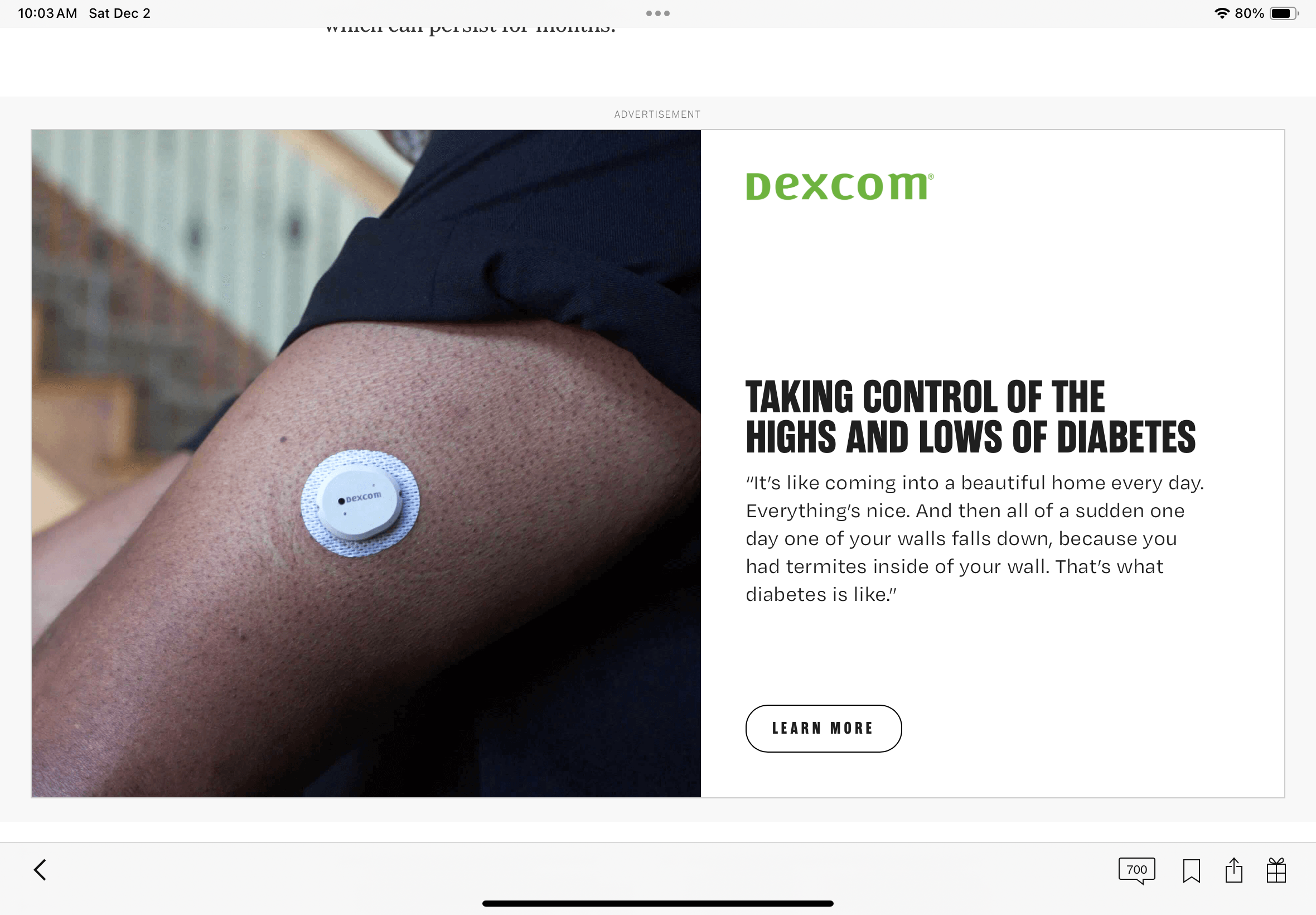
However, while I think the CGM is the best thing to have happened to diabetes after the discovery of insulin, it does not, in any way, shape or form, control it. Or allow you to control it as the ad above indicates. What it does do is expand your ability to influence and navigate, aka manage, your blood sugar: nothing “controls” blood sugar or diabetes because it cannot be controlled.

Thinking we can control blood sugar and our diabetes takes the view that the human body – you – are a machine. As in you can do this and that will happen, precisely. As if I could get a blood sugar of 168 mg/dl down to 100 mg/dl exactly and in a certain time period. As if I could prevent toppling over 140 mg/dl by eating low carb and exercising, which I do, yet I’ve seen my fair share of highs and will continue to.

As a human, with multiple metabolic functions interacting and influencing blood sugar, and as I, and you, daily interact with our often unpredictable world, control is just not possible. So why do we keep telling people to take control as Dexcom assures us you can do with their CGM? I’ve recently written about this in further detail and will post the article here when published.

Meanwhile I’m glad to know “control” has been singled out for phasing out in the #languagematters movement. It’s time we get earnest about it and not continue to set people up for failure giving them the impossible goal of control.