The highest blood sugar I’ve ever had

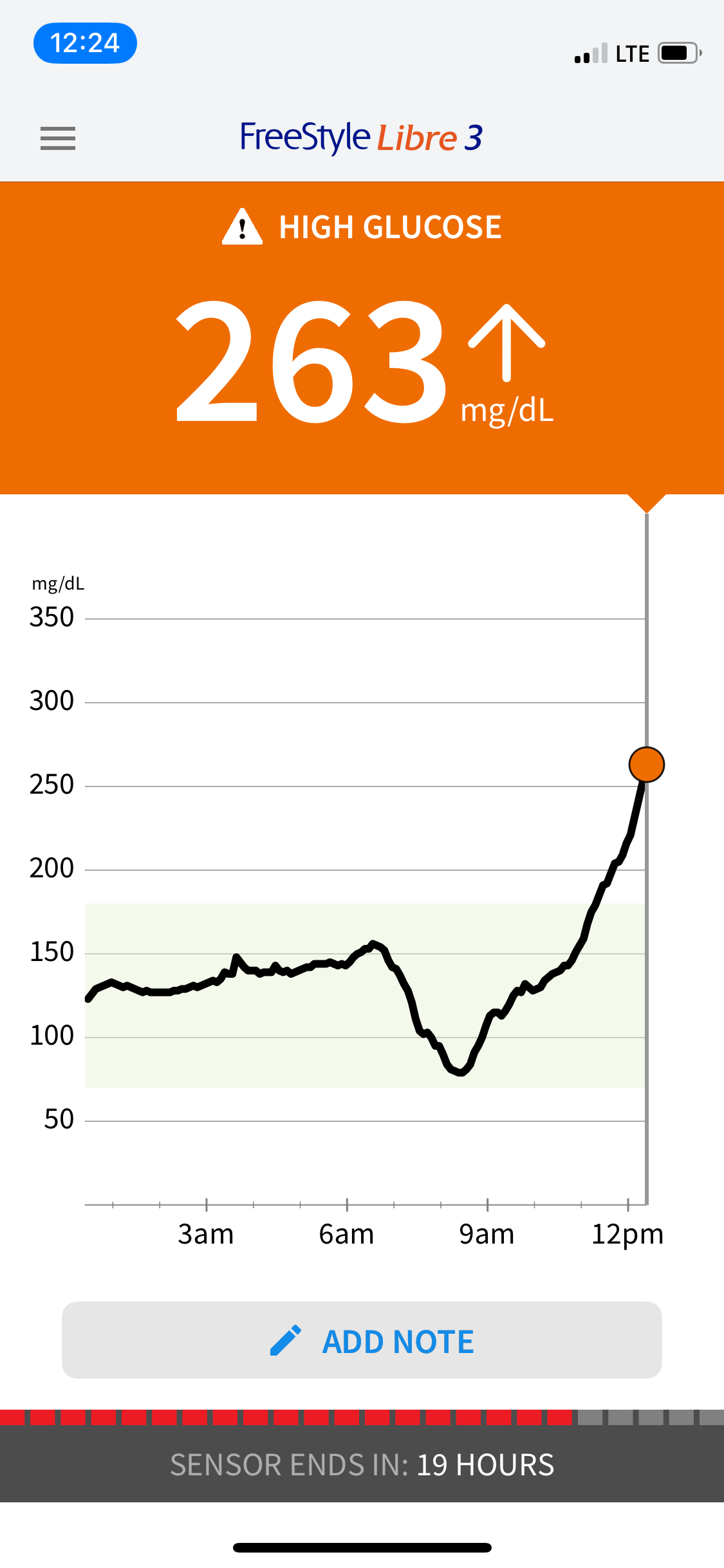
I think this is the highest blood sugar I’ve ever had, or at least since I could see my blood sugars. I sent this to a fellow type 1 friend in an email with the heading: ‘Don’t ask!?’ She wrote back: ‘I’m asking!!! Something you ate for breakfast?, sugar got in your coffee, bad news/stress…. Detectives at work! 

Of course I’d already put on my detective hat and wrote back: ‘Could be any or all of those. I think the sensor was correct. I don’t know if my Fiasp (short acting) or Toujeo had spoiled as both were expired. Or, I didn’t cover breakfast correctly because I was at my friend’s house in NJ and she made oat muffins which I don’t ordinarily eat. Or maybe the heat tampered with my insulins or BS. Or I injected through scar tissue.  Or…or…or…

Because when I realized how my insulin(s) wasn’t covering my breakfast, I was in the car with friends just starting out on our two hour drive from visiting a friend in New Jersey, back to Brooklyn. We made one stop before getting on the highway; we stopped at a supermarket. You know city girls just wanna walk up and down the aisles of a real supermarket. So while my friends shopped I walked up and down every aisle and around the property outside knowing exercise now was the only way to stop my blood sugar from rising and hopefully get it down.  

And it did start to come down, from this high of 263 to 219, but then we got back in the car and it started going up again. By this point I’d likely taken 7 units of Fiasco in 1 or 1.5 unit shots and I was bouncing my feet up and down in the car to keep so blood sugar lowering motion going. Finally I chanced one more unit when I was 175 and half way home. Finally that knocked it down to 110 by time we crossed over to Brooklyn. 

I dumped the Toujeo and started a new one this morning. I watched my blood sugar all evening and the next morning and all seemed fine.

So what did this detective and my friend come up with. We figured the most likely scenario was seriously undershooting for the oat muffin. But truly who knows?! As the song goes, ‘Mama said there’d be days like this, there’d be days like this mama said.’ Luckily we now have the tools, my CGM, to watch what’s happening in real time, and the knowledge to run small experiments like taking 1 unit and seeing what happens. Luckily too, while I was somewhat distressed not to be close to home and able to just grab a fresh bottle of insulin, I was grateful I wasn’t alone.

Blood sugar has a mind of its own

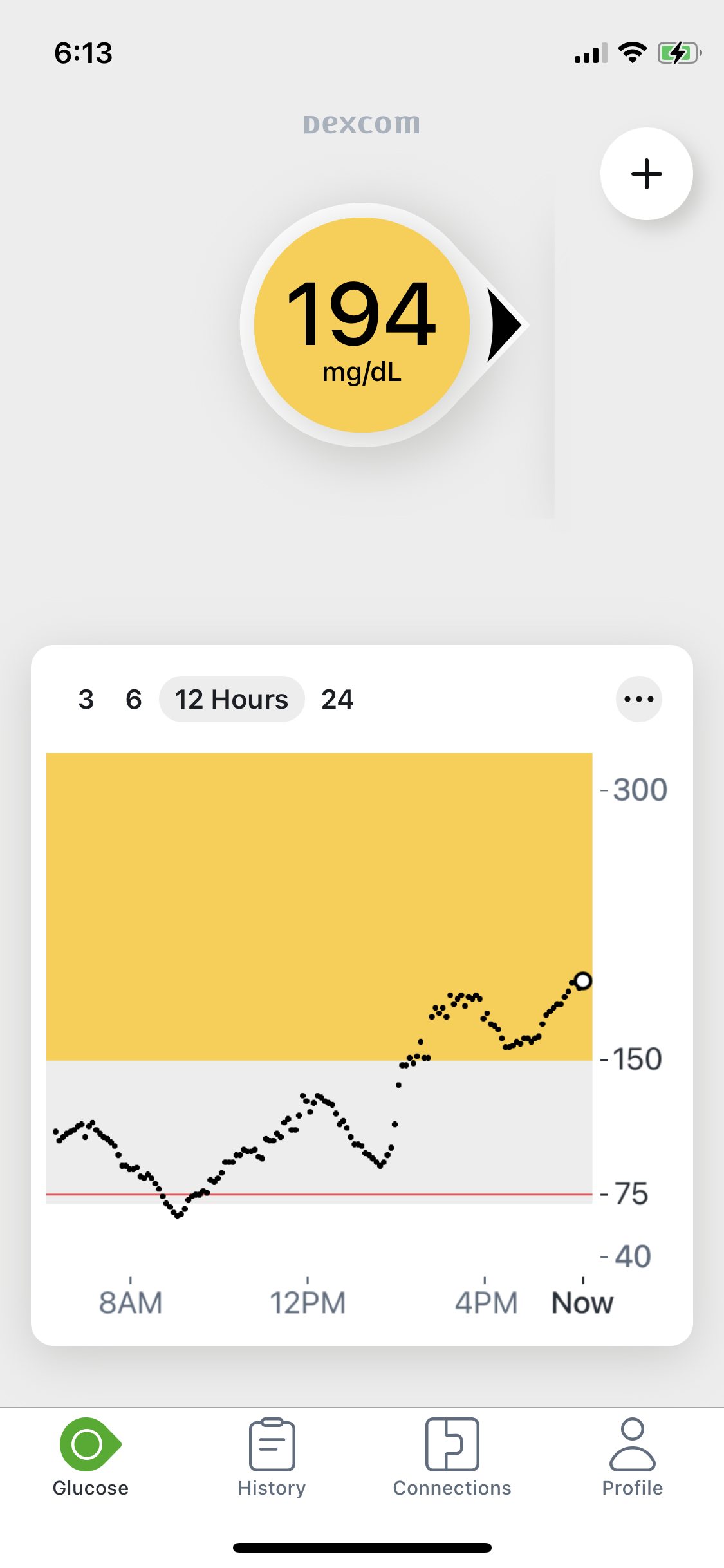
One of the things that has the most value for me managing my blood sugar is routine. Like the Virgo I am, I tend to eat the same type of foods, amount, carbs, often the same foods every day — and no I don’t feel deprived. I also tend to exercise similarly day to day. What you see above was me stepping off my routine track and while gleefully wanting to shout, “look ma, no hands!” I took a giant splat, or spike and spill, spike and spill…

The 150 mg/dl around 7 am was just the damn Dawn Effect, and it started before I even awoke. That sometimes happens, other times it waits for me to at least put a foot on the floor from my bed.

But the afternoon spike and spill was walking to a cafe I wanted to try that gets rave reviews for amazing griddle oatmeal pancakes. Now, I next to never eat pancakes. Yes, my low carb lifestyle is my second most effective agent to manage my blood sugar. But today was a gorgeous near 80F, sunny day, perfect for a long walk and an adventure. So I set off for these boasted pancakes, and to indulge in a treat.

When I arrived at the cafe my sensor reported 59 mg/dl, so I watched it and didn’t bolus until I’d finished my meal. I sat on a bench and noticed it was now at 164 mg/dl. Again, I had a 40 minute walk home, so I took one unit leaning toward small errors, small misfortunes. However, the trickery of how many carbs were in those pancakes? Who knows. What would be the effect of the 40 minute walk home? Who knows. How many units of insulin did I really need having waited to inject until after I ate? Who knows?

You know, and I know you know, there’s no rest for the weary.

So I’m happily ready to get back on my routine horse, until a beautiful day, and an impetuous mood, calls me out, very likely to once again get my free ride on this roller coaster.

What a day.

10 nutrition myths debunked by experts

This article ran in today’s New York Times, “10 Nutrition Myths Experts Wish Would Die.” If you have access to the Times, you can see the full article. For those who don’t I thought I’d do a brief summary.

Myth No. 1: Fresh fruits and vegetables are always healthier than canned, frozen or dried varieties.

Non fresh can be just as nutritious, sometimes better if fresh isn’t so fresh. One caveat: they can contain added sugars, saturated fats and sodium so read the label.

Myth No. 2: All fat is bad.

This myth was published in the 1940s when experts found a correlation between high fat diets and high cholesterol. In the 1980s everyone reported a low fat diet could benefit everyone even though there was no solid evidence. Food manufacturers replaced fat with sugar, remember SnackWell’s? (I do!). Now the experts say while saturated and trans fats (red meat, cheese) can increase your risk for heart disease, monounsaturated fats (nuts, fish, flaxseed, avocados) can decrease it. Don’t assume “fat free” means healthy.

Myth No. 3: ‘Calories in, calories out’ is the most important factor for long-term weight gain.

Yes and no. Follow the above and you will lose weight for the short term, but not the long term. Stay away from refined carbs (cereal, starchy snacks, crackers, baked goods, soda) they digest quickly, raise your blood sugar and turn into fat in the body. Eat healthy overall, quality over quantity.

Myth No. 4: People with Type 2 diabetes shouldn’t eat fruit.

Everyone benefits from the nutrients in fruit — fiber, vitamins, antioxidants. Even people with diabetes. Always choose fruit over fruit juice.

Myth No. 5: Plant milk is healthier than dairy milk.

Not true. Cow’s milk has more protein. (Still, personally, while I do put light cream or half n’ half in my coffee, I drink almond milk for the lesser carbs.)

Myth No. 6: White potatoes are bad for you.

Yes, they can spike your blood sugar, but they are rick in vitamin C, potassium and fiber, especially consumed with the skin.

Myth No. 7: You should never feed peanut products to your children within their first few years of life.

Surprise! Experts say it’s best to introduce kids to peanut products early on – unless your baby has eczema. Also feed baby a diverse diet the first year to prevent food allergies.

Myth No. 8: The protein in plants is incomplete.

All plants contain all the amino acids necessary for building protein. But to a greater or lesser degree. So eat a variety of plant based foods every day. Most Americans get more protein than they realize or need.

Myth No. 9: Eating soy-based foods can increase the risk of breast cancer.

While isoflavones found in soy stimulate breast cancer in animal studies, it’s not been verified in humans. So for now, scientists are not linking the two. Instead, soy products may be protective toward breast cancer.

Myth No. 10: Fundamental nutrition advice keeps changing — a lot.

Dr. Marion Nestle, food guru and professor of nutrition, points out that in the 1950s people were advised to stay away from saturated fat, high sugar and salt products, and that hasn’t changed. Author Michael Pollan says in his book Food Rules (which I loved) “Eat food. Not too much. Mostly plants” and Nestle agrees.

A Christmas Gift from me to you: You Can’t Control Blood Sugar

I’ve been saying this for quite a while, now I’m writing about it: You cannot control blood sugar or diabetes. Yes, you can manage it, influence it, navigate it, wrangle with it, bolus rage it, but you cannot “control” it. You cannot do x, y and z and get the precise number you want. There are a multitude of interacting factors why. If you’ve had diabetes long enough for the shock to wear off, I will go out on a limb and say you agree, as everyone does once I explain this. Surely you’d think after having type 1 for 51 years I’d know every trick to control it – geez, hasn’t happened yet.

So here’s my Christmas present to you – you’ll learn why you can’t control it and what to do instead : “The Myth of Controlling Blood Sugar, And a Better Way to Manage It.” It’s in DiabetesSisters’ newsletter this month.

It’s truly amazing that this falsehood has been told to us for decades, by our health professionals, the media, and now device companies. Is it wishful thinking? Our love of speaking in sound bites? Medical training for acute conditions that fails miserably for chronic conditions.

Whatever it is that causes us to repeat this myth, without scientific or anecdotal evidence, or much thought at all, causes people with diabetes to expect the impossible from themselves, and then feel bad, sad, frustrated, disappointed, angry, shamed, burned out you name it when they don’t ace it.

So steal away sometime today and have a read. The reward is immediate. And need I say, will be a gift that just keeps giving each and every day.

The Big Fat Surprise uncovers a big fat lie: fat is not the enemy

Screen Shot 2015-02-06 at 3.01.50 PM

I’ve long thought our reverence for a low and no fat diet has failed us. Just look around. Ever since the US government began pushing more carbs and less fat, and food manufacturers all but wiped full fat products off the shelf, as a nation we’ve grown fatter than ever.

Now, The Big Fat Surprise uncovers 9 years worth of investigation by its journalist author, Nina Teicholz, tracing how one man – Ancel Keys – convinced food experts, scientists, researchers the government and the American public that saturated fat was the devil – and changed our diet. 

Keys massaged much of his research to fit his notion that fat and red meat was our downfall. Study after study was faulty and wrongfully reported. Keys also liked being the persuasive savior and his charisma filled a room until all were convinced.  

I am two-thirds of the way through the book so I can’t tell you if we will find at the end the Big Truth, but I do believe sugar and carbs have increased our waistline, not fat, and the sooner we drop those containers of skim milk and no fat fruit yogurt and add some eggs, red meat and cheese back into our diet, the better off we’ll be. 

Unfortunately as pointed out in the book, the studies that contradict the merit of low-fat eating, you don’t read or hear about. Because they fly in the face of 30 years of our adopted “wisdom” they never get published. And, I know from marketing, if you hear something often enough you think it’s true whether it is or not.  

Here are a few snippets from the Wall Street Journal review:

In the great morality play of modern diet, the angels, we have been told by a host of experts, favor egg-white omelets and skimmed milk, while the devil gorges on red meat cooked in butter. For 50 years we have been warned to fight the good fight on dietary fats if we want to stay healthy. In “The Big Fat Surprise,” as one might guess from the title, Nina Teicholz plays the devil’s advocate—convincingly.

when skeptics, including the National Academies of Science, weighed in on Keys’s impoverished data, and on related claims that multiplied over the succeeding years, the media attacked the skeptics, heedless of statistical reasoning. Meanwhile, the food industry—apart from the protesting cattle and dairy lobbies—happily ministered to the new dietary wisdom. Government agencies weighed in with dietary guidelines that emphasized carbs and vegetables and warned that red meat was something one could only risk eating a few times a month. And when this miserable diet, shorn of taste, wearied its adherents, as it so often did, the pharmaceutical industry stepped in, offering drugs to lower cholesterol.

Read the book and judge for yourself.