 I landed back on New York soil Friday night from almost two weeks traveling in Singapore and Tokyo. I was invited to speak to medical and diabetes professionals at two major hospitals in Singapore – National University Hospital of Singapore and the ground-breaking Khoo Teck Puat Hospital, the manifestation of innovative CEO, Teng Liak, who believes a hospital should be a place of healing in all respects.
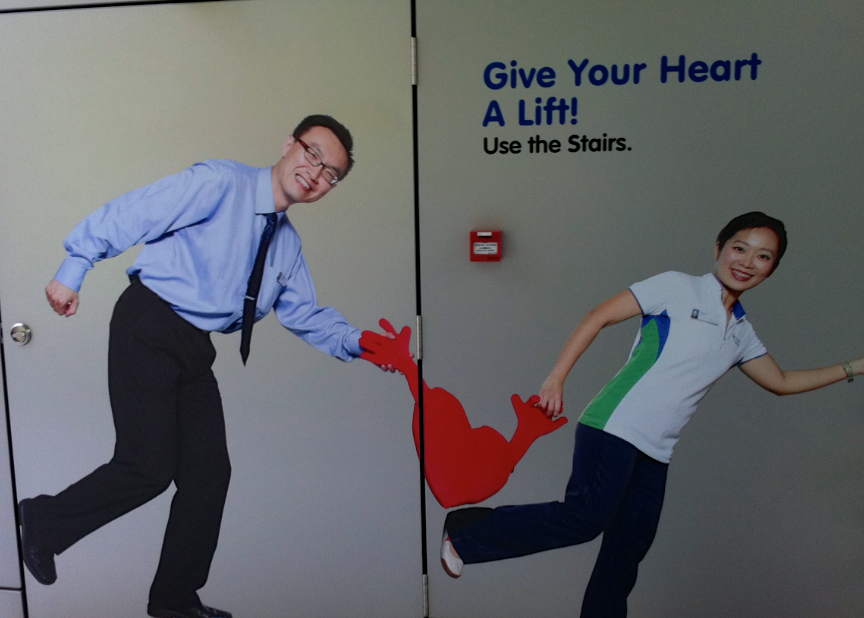
I was given a personal tour of the hospital by Mr. Liak and include pictures here. Throughout the hospital are bright bold colors to find wards easily and lift your spirit. Each building contains learning centers where I consistently saw staff in workshops. Learning displays are mounted in almost every hallway.
Each patient room has an intentional view of greenery for its calming effect. And each patient has a remote control to open and close the blinds in their room, increasing their overall sense of control. Rooms are equipped with coffee and tea service for family and visitors.
The hospital was built in the north of Singapore because that is where the population is growing – bring the hospital to the people. Clinics contain no more than 5 doctors to keep the feeling personal and collaborative. Patients’ information is captured, not only in electronic records, but in a way that promotes health and healing. It is organized around: 1) Know Me 2) Identify Me 3) Direct Me 4) Track Me 5) Clear the Way For Me 6) Close the Encounter With Me and 7) Stay in Touch With Me.
Singapore’s technological achievements are not widely known in the U.S., but they are on display everywhere: waiting times are posted, computers are front and center in each clinic for patient feedback and patient facial recognition is becoming standard.
Wards are clearly marked from both inside the hospital and out and names are clearly displayed for all staff. The hospital grounds contain several restaurants that not only serve healthy food, but it is priced lower than unhealthy food.
On the rooftops are organic farms where volunteers from the surrounding communities come to work together growing food for the hospital and socialize. Mr. Liak husked an ear of corn which we ate right off the tree, sweet to the taste.
The hospital also serves Singapore by helping to maintain its eco system and rain forest. 29 species of butterflies exist on the hospital grounds, as well as a sanctuary for exotic birds, indigenous plants and ponds for thousands of fish.
The mission of Khoo Tech Puat Hospital is to, “Provide good quality affordable and hassle-free healthcare with science, love and wisdom.” In the words of Mr. Liak, “We are trying to build a village.” To say I was duly impressed is an understatement.
I was also impressed that 200 doctors, educators, students and staff came to hear me speak. I shared with them what it’s like to live with diabetes; that they lead patients on a journey and their expectations are critical to that journey; that hope is a powerful force and that it is possible for us to not just cope with diabetes but flourish with it.
I was rewarded with their deep appreciation, respect for my knowledge and wisdom, and I learned that these clinicians face the same growing epidemic of diabetes that we do and the same struggles to help patients change behavior.
After my four whirlwind days in Singapore, I dropped down to Tokyo to visit friends. I lived and worked in Tokyo from 1986 to 1992 and every few years take a trip back to see friends and get my dose of a place that has become a second home.
This time I saw small signs of the recent earthquake – Ginza, usually lit like Times Square, was not nearly as bright, less busses and elevators were running and less air conditioning, all in an effort to conserve energy. Also my hotel had some cracks that ran through the walls, but I was told no major damage.
Otherwise the only sign in the city that a major quake had occurred was the scarcity of foreigners. “Gaijin,” the name for foreigners in Japan, has been newly expanded to “Flyjin” and “Byejin” commemorating how many foreigners have left. But if you’re planning a trip, there’s no reason not to go.
So I return fresh with professional and personal satisfaction, and the hope that my next trip to Tokyo might just be for the Japanese launch of my book, “The ABC’s Of Loving Yourself With Diabetes.” A friend of mine is translating it into Japanese 😉


 Diabetes Stories