Taking a CGM vacation

I’ve often been asked why I don’t wear a pump. I do MDI (multiple daily injections), always have. I’m usually asked the pump question by a pump user, who of course extols the benefits of using a pump. And I am sure there are many and it is a wonderful device for many.

Sometimes my pump wearer then tells me they also take pump vacations. It is what it sounds like it is. They take a break from wearing their pump and do injections instead for a while. Wearing a pump, as most (all) devices, has its drawbacks as well as its virtues. In the case of a pump, although if you wear one you’ll know better than me, drawbacks include changing sites, occluded tubing or any other pump failure, carrying tons of supplies, where to wear it for the beach.

Yet, in all the years I’ve heard people talk about taking a pump vacation, I’d never heard, or thought about myself, taking a CGM vacation. Yes, I wear a CGM. Currently Libre 3 Plus. I’d never thought of taking a break until I had reason to do so a week ago.

How’s it going? Remarkably, actually. I’m back to checking my glucose on a meter about 7 days a day. Do I like the finger sticks? Nope, no more than before. But, I’m surprised (amazed) that when I do a check, my numbers are great (I avoid saying ‘good’ as numbers aren’t “good” or “bad”). They are nearly always in range and numbers I like: 83, 101, 98. Huh? How could it be?

I have to guess it’s because of two values I hold. The first is routine. I eat and exercise pretty similarly day to day so I’ve learned my patterns, how my blood sugar reacts. It’s pretty similar day to day. That was the second value by the way, learning my patterns. Which of course came from years of wearing a CGM.

I don’t know how long I’m going to wait before I start up my next sensor. I’m enjoying this vacation. If you’ve never done it, you might like to try. My mind no longer obsesses about my numbers (although it surely did the first day I was CGM-free). That means there’s more space up there and a certain carefreeness. I feel a little more ‘normal,’ and a little less like a person with diabetes. Trust me, I didn’t expect this. But, hey, interesting. (Caveat: I’m no doctor, you need to be comfortable with this decision).

I gave up my CGM last week because I’m experimenting with photobiomodulation (red light therapy). I was going to do a red light therapy treatment on a bed of lights called the Novothor and I didn’t want to risk that the sensor would be affected or shut off. Simple as that.

I’ll write more about photobiomodulation soon. It’s a healing modality that uses certain wavelengths of light with really no side effects. In the short run, it can help heal injuries, lower inflammation, aid blood flow and charge up mitochondria for more energy. In the long run, it may even help people with diabetes avoid what’s come to be called Type 3, brain conditions like dementia and Alzheimers. People with diabetes are at higher risk of such conditions due to the damaging effect of high and low blood sugars on the brain. More to come.

So just a suggestion – next time you feel overwhelmed by your diabetes you might want to take a CGM vacation. See how you feel and what happens.

That said, I know I’ll be putting my sensor on again fairly soon. It’s still an amazing tool and likely, in the long run, I trust it will keep me healthier than without it.
The highest blood sugar I’ve ever had

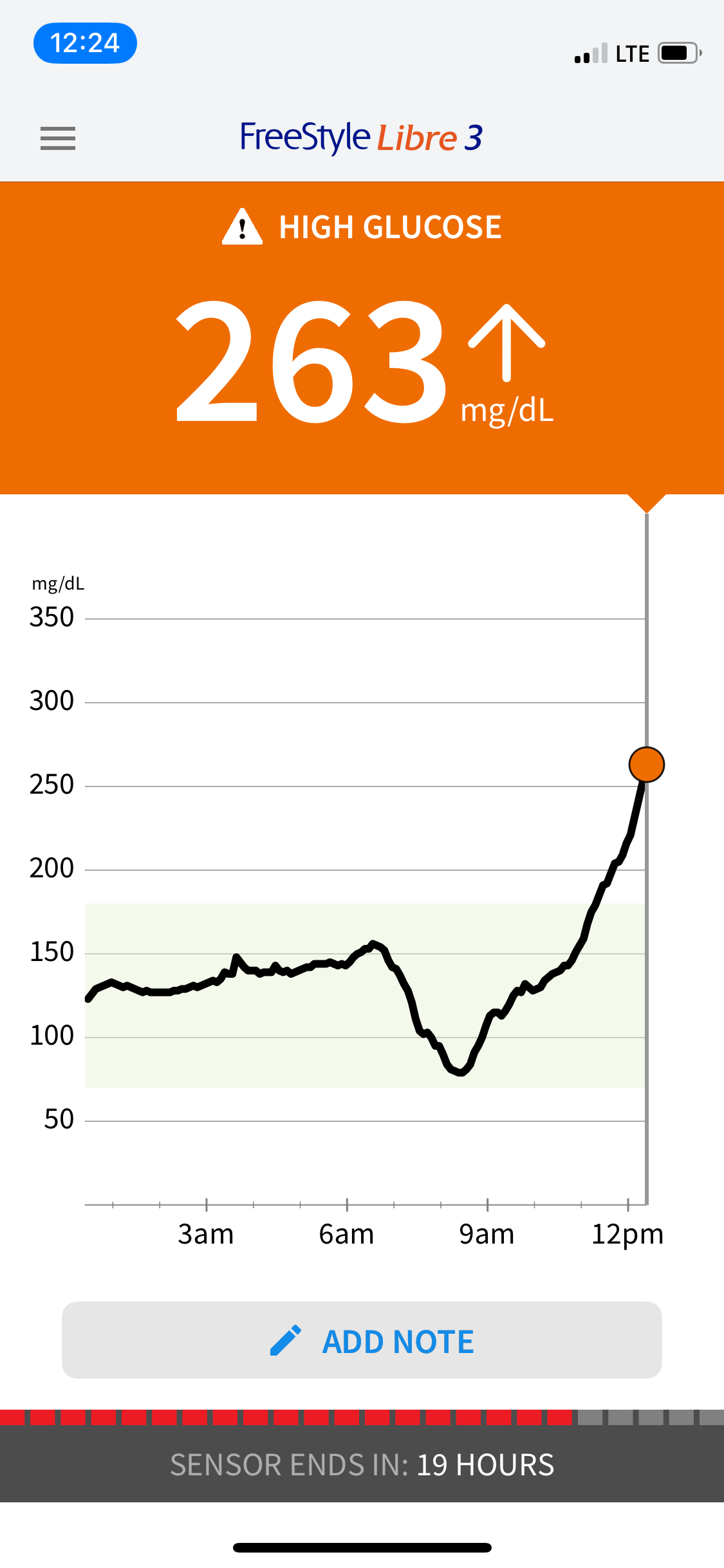
I think this is the highest blood sugar I’ve ever had, or at least since I could see my blood sugars. I sent this to a fellow type 1 friend in an email with the heading: ‘Don’t ask!?’ She wrote back: ‘I’m asking!!! Something you ate for breakfast?, sugar got in your coffee, bad news/stress…. Detectives at work! 

Of course I’d already put on my detective hat and wrote back: ‘Could be any or all of those. I think the sensor was correct. I don’t know if my Fiasp (short acting) or Toujeo had spoiled as both were expired. Or, I didn’t cover breakfast correctly because I was at my friend’s house in NJ and she made oat muffins which I don’t ordinarily eat. Or maybe the heat tampered with my insulins or BS. Or I injected through scar tissue.  Or…or…or…

Because when I realized how my insulin(s) wasn’t covering my breakfast, I was in the car with friends just starting out on our two hour drive from visiting a friend in New Jersey, back to Brooklyn. We made one stop before getting on the highway; we stopped at a supermarket. You know city girls just wanna walk up and down the aisles of a real supermarket. So while my friends shopped I walked up and down every aisle and around the property outside knowing exercise now was the only way to stop my blood sugar from rising and hopefully get it down.  

And it did start to come down, from this high of 263 to 219, but then we got back in the car and it started going up again. By this point I’d likely taken 7 units of Fiasco in 1 or 1.5 unit shots and I was bouncing my feet up and down in the car to keep so blood sugar lowering motion going. Finally I chanced one more unit when I was 175 and half way home. Finally that knocked it down to 110 by time we crossed over to Brooklyn. 

I dumped the Toujeo and started a new one this morning. I watched my blood sugar all evening and the next morning and all seemed fine.

So what did this detective and my friend come up with. We figured the most likely scenario was seriously undershooting for the oat muffin. But truly who knows?! As the song goes, ‘Mama said there’d be days like this, there’d be days like this mama said.’ Luckily we now have the tools, my CGM, to watch what’s happening in real time, and the knowledge to run small experiments like taking 1 unit and seeing what happens. Luckily too, while I was somewhat distressed not to be close to home and able to just grab a fresh bottle of insulin, I was grateful I wasn’t alone.

New Barbie doll has type 1 diabetes, and pretty-in-pink medical devices

I’m not quite sure how I feel about this…probably shocked while giggling. Mattel has just launched its latest Barbie doll and she has type 1 diabetes — and very pink medical devices! Her showing up on planet Earth was the result of a collaboration between the toy company and Breakthrough T1D (formerly JDRF), much spearheading by Breakthrough CEO Aaron Kowalski.

Senior VP and head of dolls, Krista Berger says, “”Introducing a Barbie doll with type 1 diabetes marks an important step in our commitment to inclusivity and representation. Barbie helps shape children’s early perceptions of the world, and by reflecting medical conditions like [Type 1 diabetes], we ensure more kids can see themselves in the stories they imagine and the dolls they love.”

Sure, although she doesn’t have any bruising from cannula insertions and how’s she going to manage a day of up and down blood sugars with that constant smile. If it gives little girls comfort that’s fantastic, albeit the Barbie prototype — all legs and no waist — has always been concerning. However, diabetes-wise, the fact that a doll can’t be emotive makes me wonder if perennial optimism feels dismissive of the real frustration, disappointment, and anger when it comes.

Two other dolls of T1D advocates are also being launched. They represent Peloton fitness instructor Robin Arzon and model Lila Moss. Arzon says, “It’s an absolute honor to receive a Barbie doll as a part of the brand’s efforts to grow awareness and representation surrounding type 1 diabetes, so that we can help show kids that all types of challenges give us all the more reason to push forward and achieve our dreams.” Yes there’s a place for pushing forward and achieving your dreams, but Barbie depicts only that, frozen in happy, happy.

Maybe Moss has hit on what I’m really feeling, “To be able to now see Barbie dolls with [Type 1 diabetes], and to receive a Barbie doll that visibly looks like me even wearing her patches, is both surreal and special.” Amen.

The Barbie doll with Type 1 diabetes is available on Mattel Shop and stores across the country.

Blood sugar has a mind of its own

One of the things that has the most value for me managing my blood sugar is routine. Like the Virgo I am, I tend to eat the same type of foods, amount, carbs, often the same foods every day — and no I don’t feel deprived. I also tend to exercise similarly day to day. What you see above was me stepping off my routine track and while gleefully wanting to shout, “look ma, no hands!” I took a giant splat, or spike and spill, spike and spill…

The 150 mg/dl around 7 am was just the damn Dawn Effect, and it started before I even awoke. That sometimes happens, other times it waits for me to at least put a foot on the floor from my bed.

But the afternoon spike and spill was walking to a cafe I wanted to try that gets rave reviews for amazing griddle oatmeal pancakes. Now, I next to never eat pancakes. Yes, my low carb lifestyle is my second most effective agent to manage my blood sugar. But today was a gorgeous near 80F, sunny day, perfect for a long walk and an adventure. So I set off for these boasted pancakes, and to indulge in a treat.

When I arrived at the cafe my sensor reported 59 mg/dl, so I watched it and didn’t bolus until I’d finished my meal. I sat on a bench and noticed it was now at 164 mg/dl. Again, I had a 40 minute walk home, so I took one unit leaning toward small errors, small misfortunes. However, the trickery of how many carbs were in those pancakes? Who knows. What would be the effect of the 40 minute walk home? Who knows. How many units of insulin did I really need having waited to inject until after I ate? Who knows?

You know, and I know you know, there’s no rest for the weary.

So I’m happily ready to get back on my routine horse, until a beautiful day, and an impetuous mood, calls me out, very likely to once again get my free ride on this roller coaster.

What a day.

World Adherence Day says you are a machine

I’m late to this apparently new day we have now every year, March 27th, called World Adherence Day. And I’m fuming. Started by the World Heart Foundation and supported by the International Diabetes Federation, I find it malicious that healthcare executives from these organizations support adherence – push over pull, hierarchy over collaboration, and medical language over lay language. This poster’s headline announces not just an oxymoron, but these two organizations’ ignorance.

How can ‘adherence’ be a partnership? When I looked up the definition of adherence this is what I got – “In healthcare, “adherence” refers to a patient’s willingness and ability to follow a prescribed treatment plan, including taking medications, attending appointments, and making lifestyle changes as recommended by their healthcare provider.” How can ‘following’ and ‘as recommended by’ be a partnership?

Adherence, for a “patient”, means following a treatment plan created by a clinician. It is absent of partnership, collaboration, choice, context, the complexity of what life throws at us, the complexity of our condition, and our own human foibles managing everyday life and our condition.

Similarly the IDF’s campaign states, “The campaign aims to highlight the importance of following prescribed healthcare plans to manage chronic conditions like diabetes and cardiovascular diseases.” Yes, the bold and underlining is my doing.

Not only is ignorance highlighted in this campaign, but arrogance. Long has the diabetes #languagematters movement shared the words, concepts and behavior offensive and detrimental to people with diabetes’ management. “The Use of Language in Diabetes Care and Education” published in Diabetes Care in December 2017 is explanatory and comprehensive. Have we learned nothing? Yes, we have learned nothing. Below an excerpt from the article:

When will we learn that machine, left-brain hemispheric thinking that values – push, grab, overpower, precision, perfection, narrow focus, heart-less – does not inspire people, emotive beings, to do their best? When will we understand that with all our medicine, treatment plans and glorious devices at our fingertips – hardware and software – it is “heartware,” – connection, compassion, support and safety – always that inspires people to do their best?

Today’s state of industrialized healthcare cannot help but follow its own heavily laden, structured and systemic paradigms and procedures. Such structures are part of the reason the world is in the state it is in today: a narrow focus on getting, grabbing, dehumanizing, power, dominance over.

But things will not change until people reclaim what it means to be human. In healthcare, until health professionals work with their patients with respect, dignity, collaboration and understanding that words like ‘adherence’ imply mechanistic cause and effect, and that anything less than desired is the patient’s fault. And the world will change only when we all treat each other similarly and understand the same.


Please, please Santa won’t you take this diabetes away?!

I posted this letter for the first time many years ago, and then a few more times in subsequent years. In truth, given what we endured this year, 2024, there are many more things I’d ask Santa for, but I’m going to keep my request as simple as it always was. 

Dear Santa,

All I’d like this Christmas is for you to take this diabetes away. I’m so tired of it already. All these injections that sometimes leave me black and blue and decisions I have to make. Now that I’m in menopause I can barely tell if I’m sweating because I’m losing estrogen or my blood sugar’s crashing at 50! And, can we talk…I mean the constant figuring out how many carbs are in a ravioli or bread stick or that fried calamari that will be at the company Christmas party. Some days I just want to lay down and shoot myself. Please, please Santa, would you take this diabetes away?

Sincerely,

riva

Dear Riva,

I’m very sorry you’re having a tough time during my favorite season. I only want people to be singing carols and drinking eggnog and feeling good cheer. Unfortunately, it says in my contract, that I’m not allowed to interfere with life’s natural occurrences. So here’s my suggestion, after you open your holiday gifts, look under your Hanukah bush for the gift in having diabetes. You may have to spend a few days looking so why don’t you schedule it for the week between Christmas and New Years while you have some down time? Then you can start the new year fresh.

Best wishes,

Santa and the gang

Dear Santa,

A gift in my diabetes? What are you crazy? Meshuggah? Thanks, but no thanks!

riva

Dear Rabbi,

I seek your wise counsel. I wrote to Santa to take away my diabetes but he wasn’t helpful at all. Surely you who have studied so much and represent our people who have suffered throughout history can help me with this awful diabetes. It’s such a strain, Rabbi. I have to test my blood sugar when I really want to be lighting the sabbath candles. I forgot all about the High Holy days this year because I was so busy counting carbs in the Challah, bagels and honey cake. Rabbi, please, what solace can you offer me? What words of wisdom? Surely you would tell me to just forget about this diabetes thing and study the Torah, right?

Please write soon,

riva

Dear riva,

Santa and I just returned from the Caribbean and he told me about your difficulty. He said he told you you should look for the gift in your diabetes. I concur with Santa, there are many gifts to be found in diabetes if you look. For one, my child, you won’t have to drink the traditional Manishewitz holiday wine anymore. The Counsel all agree it is much too sweet. Bring out the Chardonnay!

When Santa asks you to look for a gift in your diabetes, he is not saying this because you are not Catholic and he is not bringing you anything, although this is true. He is speaking like our brothers the Buddhists, who profess there is a gift in everything if you look for something positive it can bring into your life.

Let me tell you a story my child. My own Aunt Sheila had diabetes and after she stopped kvetching, she went to a spa and learned how to eat healthy. She shopped along Rodeo Drive and bought a cute little jogging outfit and started running. On her jog along the ocean she met her fourth husband, Marvin, and they’re very happy. They just moved into a $6,000,000 mansion in Jupiter, Florida — right next to Burt Reynolds! Everyone’s plotzing! Darling girl, find a gift in your diabetes, because to be honest, since you’re not orthodox, and all I have are these great wigs I got on sale from my cousin Schlomo, I’m not bringing you anything either. And really, it’s not very pleasant to whine.

Shabbat Shalom

Rabbi, Local Union 107

Dear Rabbi,

I thought about what you and Santa said and have decided to become a Buddhist. I picked up the Dalai Lama’s book, The Art of Happiness. He says, “Happiness is a butterfly, which when pursued, is always just beyond your grasp, but which, if you will sit down quietly, may alight upon you.” I told my friend, Joe, I like butterflies and I like the robe, so these aren’t bad gifts. Joe said the quotation meant that we are the source of our happiness, that happiness can only come from inside us regardless of what happens in our lives. Hmmm, I said, maybe I need to learn more. So I booked a flight to Tibet. Now if only I didn’t have to drag all this damn diabetes stuff with me….ohm…ohm…oy. riva

World Diabetes Day, again, hmmm and again, and again, and again, and again, and again

I’ve had type 1 diabetes for 52 years. You may know that. Diagnosed at 18. I was told, like almost anyone diagnosed with type 1 diabetes in any year, “We’ll have a cure in five to ten years.” Well, of course we don’t. Nor do I actually expect one in my lifetime.

That’s not to say I’m not grateful for all the advances we have: better insulins, faster insulins, peak less insulins, smart insulin pens, continuous glucose monitors, insulin pumps now cozy with continuous glucose monitors, looping etc. Most of these advances have come in the past decade. Somehow speed begets speed. Advance begets advance.

Yet, still each year we stand up tall and honor a single day in the year when we attempt to bring awareness to this condition that many of us have lived with a very long time. I’m sure that’s better than not doing so, but it feels like it feeds a complacency. It quiets the masses.

I’d rather we were doing more, if that’s possible, I don’t know. What I do know is, in part, these campaigns promoting diabetes day with blue balloons and roses and the sharing of stories are lovely for the newcomers to our ranks, but this old rank and file member feels these efforts carry a whiff of distraction because we’re still so far from that original promise.

In all honesty, I had no idea when I began writing this post that I’d end up here. I expected to share with you the campaign that Breakthrough T1D (formerly JDRF) is running this laudable day and extend the opportunity to participate. So here it is – ‘What do you want T1D breakthroughs for?’ And, yes, that’s nice.

Yet, wouldn’t it be nicer to no longer have a World Diabetes Day because there’s no reason to recognize an illness that no longer exists.

Three weeks away from a (virtual) conference you should be at

I’ve spent the past twenty one years speaking to people with diabetes and health professionals around the world, typically about the emotions that come with living with diabetes – and how to flourish.

November 8th and 9th I’m the closing speaker at the Diabetes + Mental Health Virtual Conference. If your mental health is worth $50 you should be there. Health professionals will earn 7 CEUs for attending. As a caregiver, you’ll gain new insights, and tools, how to support your loved one.

This is the third year world experts are gathering online to help us deal with: eating stresses, general and specific fears, perfectionism, stigma, diagnosis trauma, the burden of tech, anxiety, depression, shame, having tough conversations. This is a mecca in the all-but-desert of our diabetes emotional world.

The on-stage experts are too numerous to name, so take a look and also see the agenda. As the closing speaker for the conference, I will share with you what I’ve shared around the world, that we can, and how to, flourish with diabetes. Like ‘Redraw the Frame’ for instance. And, I’m sharing simple calming exercises to stay safe and clear-thinking when you feel overwhelmed.

I don’t recommend things often or lightly but you deserve to live your life less burdened by the ‘scaries’ of diabetes and more knowledgeable and able to manage them when they come.

The Diabetes + Mental Health Conference, November 8th & 9th, 11am-6pm EST. I hope to see you there. Click here to get tickets.

CGMs’ strength is marking the relative field rather than being 100% accurate

I remember having this conversation years ago with a friend, fellow type 1 and doctor. He said to me, and I didn’t want to hear it, “Your CGM isn’t going to be accurate or precise in the way that you want it to, rather it’s going to tell you about where you are.” Why, I thought, can’t it tell me I’m 106 or 202 or 57 with pinpoint accuracy? Well, I get it now.

Wearing the Freestyle Libre 3, that delivers blood sugar (although it ‘s really interstitial fluid) results every single minute, I can see how it isn’t precise. Not in that machine-like way we think of precision. One minute I’m 104, next minute I’m 108, next minute I might be 105 or 119. And I have learned to take a pause before I determine if I need to do something about where my blood sugar is.

It’s mind-boggling to think what in the world is happening in my body for these moment to moment readings to be ever fluctuating like this. I don’t know. What I do know is you can’t think any one number is perfectly it. So I am learning to slow down a bit, watch the numbers and look at the trend. That’s really what CGMs are all about. Showing you trends. Indicating about where you are and if you’re climbing or bottoming out.

As I was keeping an eye on my CGM today, I just thought this was worth mentioning.

JDRF has a new name, Breakthrough T1D

I just got the announcement in my email this morning although it was announced on June 4th. The long-standing, original, research and advocacy organization, Juvenile Diabetes (Research) Foundation, has renamed and rebranded itself into Breakthrough T1D. The organization originally began as ‘Juvenile Diabetes Foundation,’ then moved to ‘Juvenile Diabetes Research Foundation’ to highlight its research activities, and then ‘JDRF,’ to recognize that not everyone who has, or gets, T1D is a child.

Medscape has some interesting statistics about people living with type 1 diabetes, for instance the median age worldwide is 37 years old.

This year’s rebranding is to bring more attention to the fact that the organization works on behalf of all people with T1D, regardless of age, and that their broader portfolio of work includes trials and projects that are under the radar like funding devices and biological cures, including stem cell trials and research.

It’s worth a look around their new website to see they hope to accomplish for the future, and where they’ve traveled from to get here. That’s just what I intend to do later today.