Bastian Hauck above, founder of #dedoc who sponsored my trip to EASD last week.
While at the EASD conference (European Association for the study of diabetes) last week in Hamburg, Germany, diabetes stigma was a large topic of conversation. Not in the scientific programs, of course, but for those of us there as #dedoc voices and several health professional who also realize the damaging consequences of stigma: shame, burden, burnout, guilt, giving up one’s self-management.
Chantel Mathieu, President of EASD, whom I didn’t know before but now so admire, also gave a committed passionate talk why this has to end.
If you would like to contribute to the effort to end diabetes stigma, you can read more about it and sign the petition here. This is a well thought out movement, not just an idea. I was proud to add my name to the list.
Almost weekly my cousin, a psychiatric nurse, sends me another spoof of United Healthcare by Dr. Glaucomflecken on Youtube. While I watch healthcare disintegrate into for profit, assembly line, tests-are-more-important than looking at patients, ophthalmologist and comedian William Flanary, the man behind the Glaucomflecken mask, gives me something worth watching.
I am delighted to be among approximately 25 people with diabetes who will be traveling from all over the world to attend the EASD conference in Hamburg, Germany beginning October 2.
The organization that is sponsoring my, and everyone’s travel expenses, is #dedoc° founded by the amazing Bastian Hauck, who has single-handedly built diabetes social media presence in Europe. I first met Bastian at an International Diabetes Federation conference in 2015 in Vancouver, but only this year did I add myself to his remarkable group of Voices.
Bastian’s insight was that diabetes patient advocates were a sorely missing piece of global scientific conferences and so he set out to change that. Today the Voices can be found at ADA, EASD, ISPAD and ATTD sharing their stories with health professionals, researchers and industry, and bringing back their wealth of gained knowledge to their communities, local and social.
I am proud to take my place among them and be a part of this movement. Below diabetes advocates at IDF’s World Congress in Lisbon last year where Bastian and I caught up. You might guess he’s the tall guy behind me, and you’d be right.
I got the text at 8:57 pm last night. “We have an emergency with a family from Panama on holiday in NYC and I thought of you! They’re vacationing until Tuesday and have miscalculated their child’s insulin. They need a pen of rapid and basal insulin. Can you help?” My texter, Pilar Gomez, is the face of type 1 diabetes in Panama, educating, running diabetes camp, being a mom to a daughter with type 1.
So today I spent the morning texting with the family’s mom and we arranged to meet at a diner in Brooklyn for the handover. I, myself, know what it’s like when you think you have no insulin. Several years ago flying from Amsterdam to Copenhagen I thought my insulin had spoiled. I nervously reached out to a fellow type 1, who readily said, “I’ve insulin here for you, don’t worry.” I also have a doctor type 1 friend, who somehow supplies me with vials on a semi-regular basis, as he gets an abundance from his health insurance for free.
There is something magical about being in a situation where you don’t know anyone and you need insulin, and as my new Panamanian mom acquaintance said to me, “an angel appears.” I am fortunate to have angels in my life, and would never want anyone to be in that overwhelming frightening position to not know if their child will have to go without their insulin for days until they get home.
So, I joined my new Panamanian family in the diner booth, answered lots of questions, and shed as much light as I could for them. If Diego, now 12, who got type 1 two years ago, looks after what he eats and stays active, checks his blood sugar and takes his insulin, there’s no reason for him to face what his grandma did too early – death by diabetes. They were all thrilled to hear it.
This was sent to me by my cousin who is a psychiatric nurse. She says it happens every day. While it’s not about diabetes, I think we can all relate to the constantly changing formulary of drugs, sigh…
You really should give these a go. They’re easy enough to make and delicious. I don’t eat a lot of sweets. Mostly a square or two of really dark chocolate in the evening, but I had a yen to try these when I tripped over them online. And I will make them again.
They’re moist, chewy, chocolatey, high fiber, with no flour and not too many carbs. I have no idea the carb count, maybe you can find it somewhere. The carbs will also be affected by any changes you may make to the recipe. For instance, I always use stevia instead of any sugar or honey or molasses in a recipe. Here, I used three packs of Stevia. Truth is, sometimes that becomes a horrible switch and it doesn’t work at all, but it seemed to work just fine here.
I did use the full 1/2 cup of cocoa powder but I probably used 1/3 of a cup of chocolate, not 1 cup. I just took an 85% dark chocolate bar and cut half of it into little pieces to add to the recipe.
This seems like a perfect recipe to make for the holiday weekend, especially if you bring it somewhere. Trust me, I haven’t yet heard of anyone who knows about black bean brownies, and they will be super surprised by your ingenuity and how delicious they are.
You know I’m not in love with the G7. But I did discover one thing that I quite like – you can start a new sensor while the current one is on its last 12 hours. That gives the new sensor 12 hours to get used to your body since sensors activate as soon as you insert them. Since my first 24 hours on a new sensor are mostly inaccurate, most of the time, this is an advantage.
But a word to the wise: When you put on that new sensor don’t throw away the inserter! As I did! Yesterday! And then took the garbage out! Immediately!
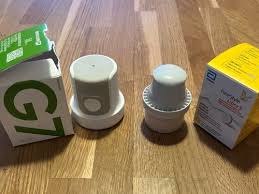
Because this morning, when I went to switch over to the new sensor, it asked me for the sensor code. That’s the 4 digits on the back of the sensor, pictured above on the right. It’s not on the box, I can attest to that having examined it multiple times.
So, lucky me, at 7:15 this morning the husband did a dumpster dive and retrieved the bag with the precious inserter. Shortly thereafter we were up and running.
Dexcom G7, I love you, I hate you. But this morning I love the husband all the more for his sheer gallantry.
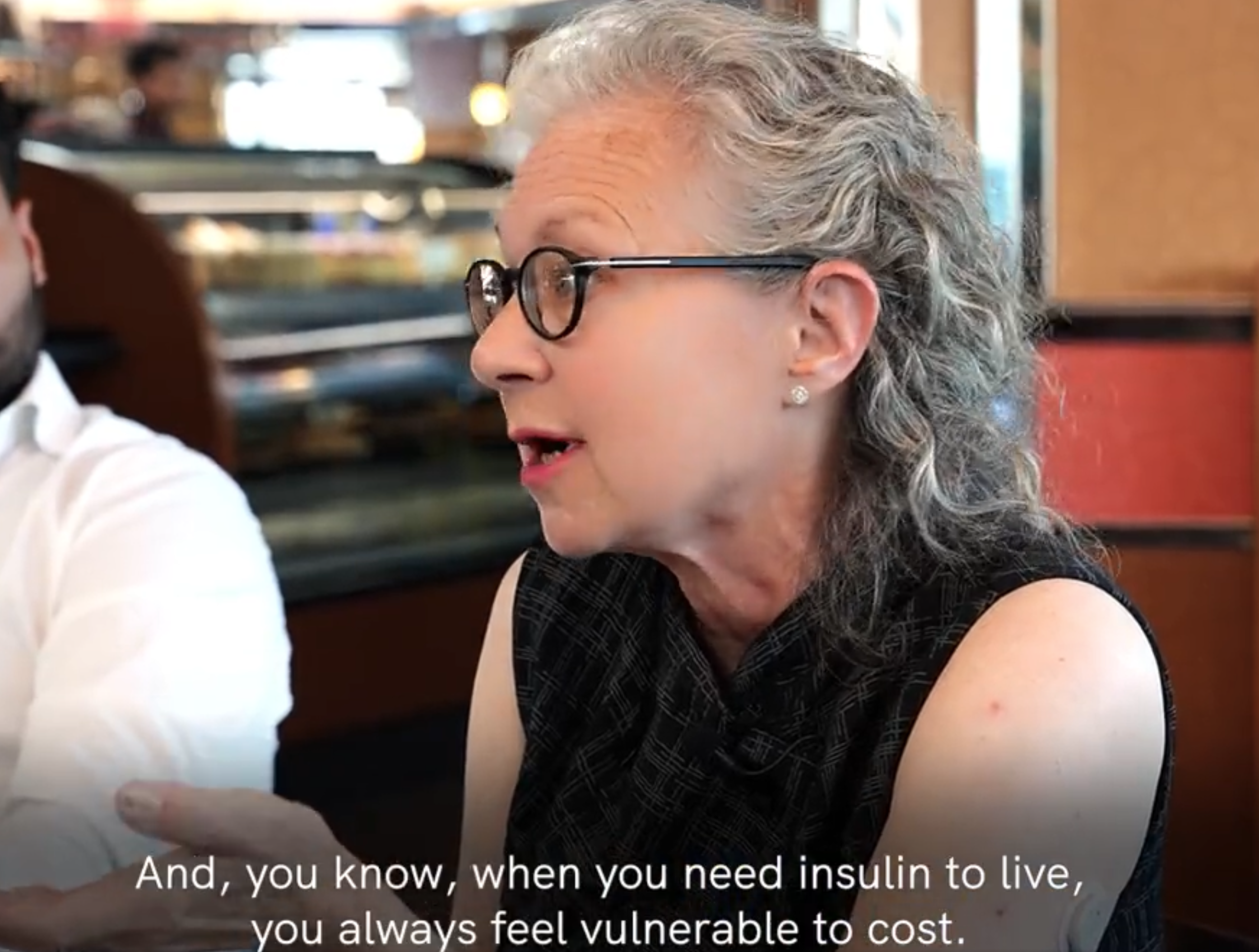
Last week I was sitting opposite Senate Majority Leader, Chuck Schumer, at the iconic Kellogg’s diner in Williamsburg, Brooklyn. I was the face of Medicare recipients, who through the Inflation Reduction Act (IRA) passed a year ago today, can now get their insulin for $35/month.
I was joined by two other Brooklynites who have also benefitted from the IRA. Schumer’s team was great, it was a lot of fun to make the video and I’m all for pointing out what’s working in government and healthcare, as there is so much that does not. Besides, I finally got to see what my hair looks like as normally I can only see it from the front
Enjoy, it’s only 3 minutes long.
FACES OF THE INFLATION REDUCTION ACT:
You’re going to want to see how the Inflation Reduction Act is helping people one year on.
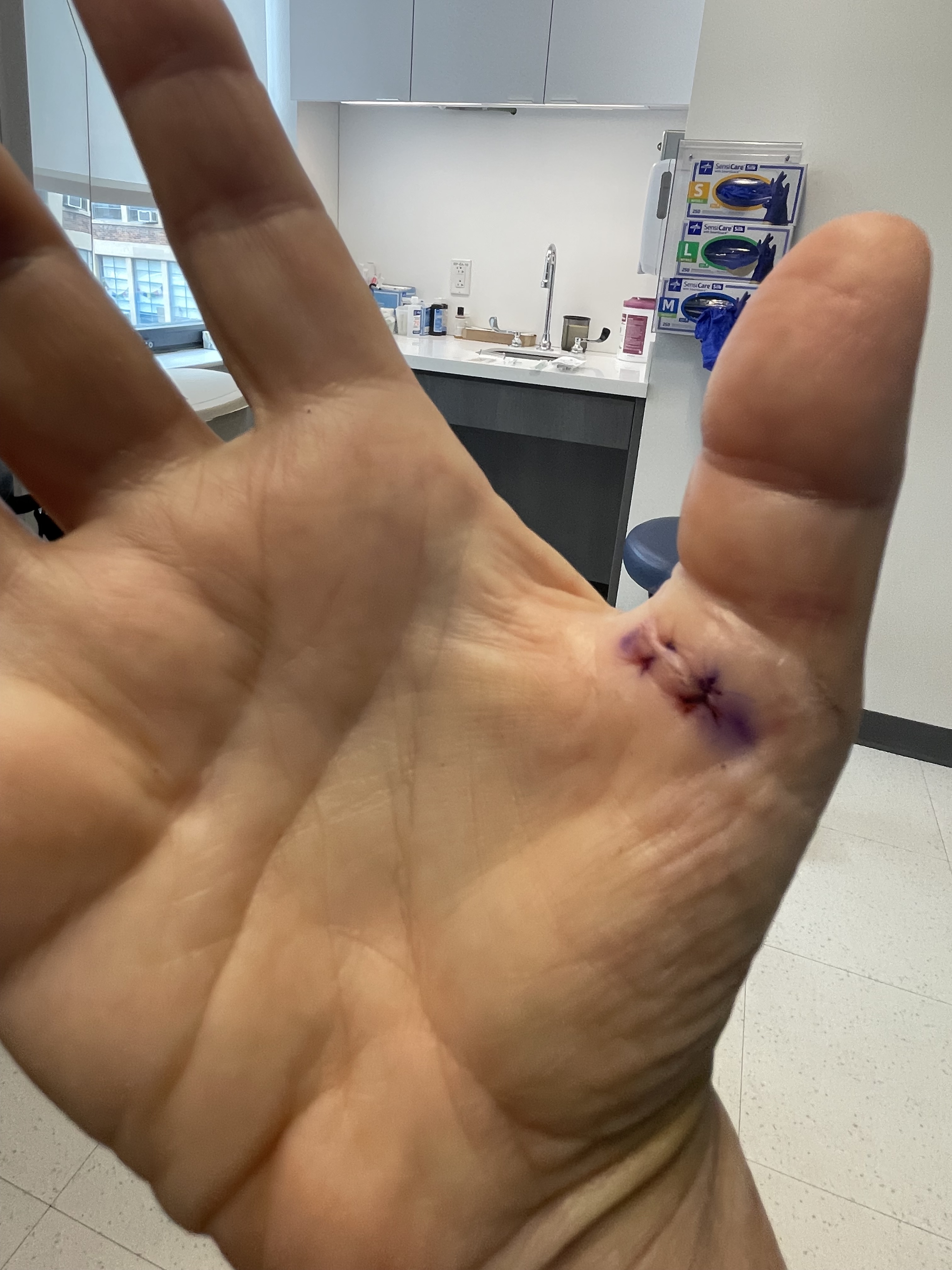
At today’s 10 day follow up I got a clean bill of health. After the surgical dressing the first four days and a band aid the rest of the time, now a tiny piece of 3M Steri-strip covers the small purple area where you can still see a slight slit. Not only is it to keep the area clean but also minimize scarring. To my surprise the surgeon snipped the stitches open and just pulled them out, no local numbing agent needed as I expected.
Now the instruction is to use my thumb normally but wait two weeks before putting significant weight on it, so another two weeks before going back to my gym class where we use weights and resistance bands.
My fellow diabetes friend, who has had five trigger finger procedures, asked, so was it “Easy-peasy?” I wouldn’t say that exactly, as there was some pain the first few days and I did have to be cautious not to get the area wet (that’s where the husband is extra useful, i.e. doing the dishes), but it certainly wasn’t any major hardship.
No physical therapy needed, just flex and straighten my thumb several times a day. Will there be a scar? I assume so, but kinda small.
Only thing I’d offer is if you have this done or any similar surgical procedure, work with a really good surgeon if you’re able. I am lucky to live in New York City on that front and mine is top of the lot. Thank you Dr. Kim.
I didn’t quite get why Abbott, manufacturer of the Freestyle CGM, was trying to get approval from the FDA for its receiver. But now I do. Medicare would not cover the CGM without an accompanying receiver.
The receiver was approved in April, and Medicare has just agreed to cover the cost of Libre, I believe you can get either the Libre 2 or 3. I’m not going to compare them, but diaTribe did. But I have researched comparisons between Libre 3 and Dexcom’s G7, since I’m considering switching.
If you read my post recently, you know G7 and I got off to a bumpy start. It’s still not great, but maybe better. I still get too many ‘lost signal’ windows, including always when I first wake up and retrieve my phone from where I store it overnight. Yes, that’s another story, but mainly I don’t want to wake up throughout the night to alerts from compression lows.
I do appreciate the 12 hour window Dexcom offers at the end of a session so I can pop a new one on and have it start running in the background so by time I switch my session over to the new sensor, I get more like 12 wonky hours on it rather than 24.
In a nutshell these two devices today are not all that different. Both the Dexcom G7 and Libre 3 are small, similarly accurate, insert similarly, have customizable alerts, and while Abbott had to get a receiver approved, you can use both on your phone with their apps.
The major differences are Libre 3 is 14 day wear, Dexcom 10 and a half, Libre 3 has 33 feet of range, Dexcom 20, Libre 3 is cheaper, but Dexcom has more functionality on its app and is actively working toward being operational with Omnipod and Tandem pumps. Truthfully, I think it’s more a matter of personal choice and what features are important to you. And, maybe I buried the lead but you can trial the Libre. See more here.
Here are two comparison reviews. The first from DiabetesDaily and the video from TypeOneTalks:


 Diabetes Stories