Diabetes patient tips sponsored by JDRF


Yesterday I listened to a number of people with type 1 diabetes share their personal tips for managing their diabetes. Above was the last tip recommended, to watch this video from Dr. Steven Edelman, founder ofTCOYD on “diabetes and drinking.” So while writing this, I did. You should too and have a laugh before we go on to more serious stuff. 

The Patient Tips session was part of JDRF’s ONE Expo. A fairly new outreach program trying to bring – education, engagement and empowerment – to the type 1 community in New York City. JDRF is the largest charitable supporter of type 1 diabetes research.

The session was led by Zoe Heineman, who has started her own Ha!(Hypoglycemia Awareness) movement and is training first responders to recognize low blood sugar. 

Here are some of the ‘Tips & Tricks for Daily Type 1 Management’ that were shared by the group including patients, a mom, a sibling and professional athlete:

• Train everyone around you what to do in case of emergency like for instance where you keep your insulin, glucose tabs.

• Give yourself a break. One blood sugar number does not make an A1C.

• A woman who’s had diabetes 53 years shared that she’s always had high A1Cs until she went on a low-fat, high-carb regimen that brought her A1C down from 8% to 6.5%.

• If you’re in school explain diabetes to your teachers and classmates. And tell your friends. They won’t treat you any differently and you’ll feel safer. 

• This loving sister shared that she’s not annoyed to wait for dinner if her brother’s blood sugar is high and she’s more than happy to do speed walking down hotel corridors with him.

• This mom shared how important it is to accept the diagnosis. A family can’t create a positive nurturing environment until you do. 

• If you have an office job, keep your desk as well stocked as a drugstore – with pump and test supplies and reserves of quick acting sugar.

• Diabetes doesn’t define you, it’s something you have. It needn’t stop you from doing almost anything.

• Diabetes is an art, not a science. You can’t always figure it out. You can’t be perfect at this. Try things out and don’t be defeated. It’s all learning. 

• Use exercise to help maintain your blood sugar. No one ever felt worse after exercising – it helps keep weight off, feels good to move your body, have fun and make it social.

• Check your blood sugar, don’t guess. 95 mg/dl may feel different today than it did yesterday. 

• When traveling, keep some supplies on you and some in checked luggage so if you lose some you have back up.

• HelpAround is a community of type 1s. You can register and always find someone nearby who can assist you if you need insulin or a question answered. 

• If you’re drinking, check your blood sugar frequently and make sure your friends know you have diabetes.

• Don’t have your life revolve around your diabetes.

All good ideas. If I add my two cents I’d tell you to appreciate all the work you do managing your diabetes and find one positive thing diabetes has given you and remember it when you feel overwhelmed.
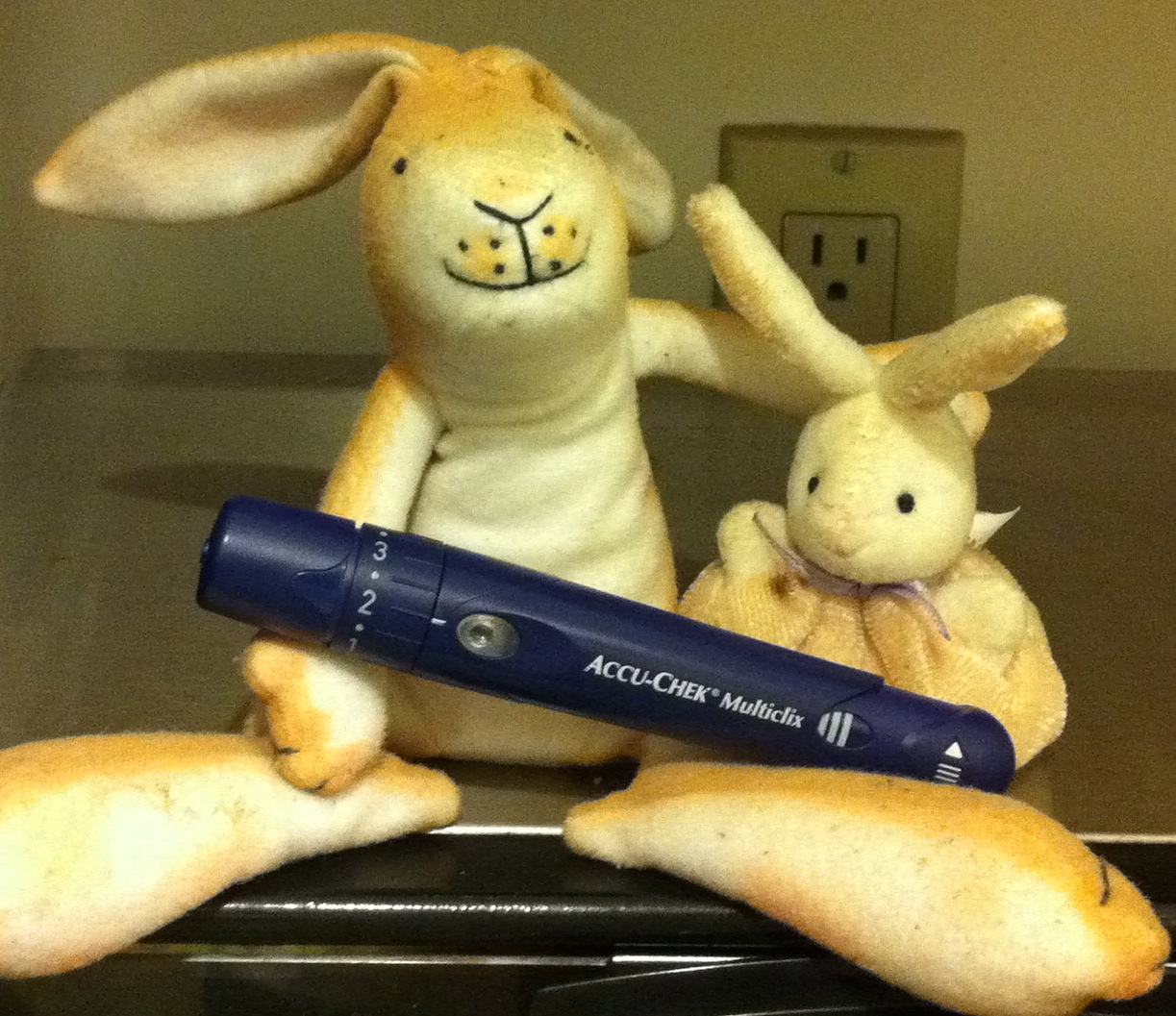
Labor Day means changing my lancet

 IMG_0034

T’was the night before Labor Day

when I decided to change my lancet

How long had it been…

Hmmm, maybe since last I was in transit?


My used syringes cooed all snug in their drawer

Smug were they feeling and absolutely sure

that I wouldn’t come looking to change them too

for they knew my outer thighs had to first turn black and blue


I fumbled around mostly in my brain

Where in heck are those needles I’d seen when last it rained?

Surely I had some, maybe on this shelf maybe that?

Think, you must think, but only gobbledegook was coming back!


My husband approached while I searched, and then forgot

just what I was looking for -b-boom, b-boom – ever-quicker beat my heart!

Then the sweat started pouring down my face onto my chin

My husband panicked yelled, “Forget needles, you need sugar. I’ll bring!”


“No, I need a needle I insisted to thread my lancet

Who needs sugar? Hey, honey, you look so handsome!”

A moment later a jar of honey and a giant spoon

reached up to my mouth, likely not a moment too soon


I hate to admit it, when I fall down on the job

Sixty-one I’ll be tomorrow and still it’s just so hard

Because every day is different and we can only ever guess

How many carbs? Too much insulin? One minute “nailed it!” the next distressed


It’s the nature of the this life to be thankful and frustrated

Another crises over, those pesky lancets finally located

Hmmm…I wonder when this vial of insulin needs to be replaced

A week, maybe three, oh, my, could it actually be today?

Diabetes resources and A1C Champion program information

Screen Shot 2015-02-06 at 3.46.38 PM

More and more patients living well with diabetes are teaching and supporting other patients by sharing their wealth of knowledge and experiences.

Here are lists of trusted diabetes web sites, social media sites, blogs, books and information about the A1C Champions peer-mentor program I participate in.

If you are interested in a free A1C Champion program for your patients, or becoming an A1C Champion peer-mentor yourself, the contact information is below under “The A1C Champion Program.”

Recommended Diabetes Websites  (in alphabetical order)

American Diabetes Association (diabetes.org)

ASweetLife.org

BehavioralDiabetesInstitute.org

ChildrenwithDiabetes.com

DiabetesDad.org

DiabetesMine.com

Diatribe.org

dLife.com

Fit4D.com

Insulindependence.org

JDRF.org

Joslin.org

MayoClinic.com

Mendosa.com

QuantiaMD.com

WebMD.com

Social Communities

#DSMA (Weekly twitter chats)

DiabetesSisters.org (female-specific)

DiabeticConnect.com

DiabetesDaily.com

EstuDiabetes (Spanish)

MyGlu.org (Type 1 diabetes-specific)

Juvenation.org (Type 1 diabetes-specific)

PatientsLikeMe.com (Various disease states)

TypeOneNation.org (Type 1 diabetes-specific)

TuDiabetes.org

A list of those in the infamous Diabetes Online Communityhttp://diabetesadvocates.org/getting-to-know-the-diabetes-online-community-doc-2/

Blogs, communities and more. The most exhaustive list I’ve seen.http://www.diabetesmine.com/blogroll

Several books written by people with diabetes

Balancing Diabetes – by Kerri Sparling

Diabetes Do’s & How-To’s, 50 Diabetes Myths That Can Ruin Your Life and the 50 Diabetes Truths That Can Save It and The ABCs of Loving Yourself With Diabetes – by Riva Greenberg

Emotional Eating with DiabetesYour Diabetes Science ExperimentDealing with Diabetes Burnout – by Ginger Vieira

Kids First, Diabetes Second – by Leighann Calentine

My Sweet Life: Successful Women with Diabetes and My Sweet Life: Successful Men with Diabetes – by Beverly Adler

SHOT – by Amy Ryan

The Book of Better: Life with Diabetes Can’t Be Perfect. Make it Better – by Chuck Eichten

The First Year: Type 2 Diabetes: An Essential Guide for the Newly Diagnosed and Prediabetes: What You Need to Know to Keep Diabetes Away – by Gretchen Becker

The Sisterhood of Diabetes – by Judith Jones Ambrosini

The Smart Woman’s Guide to Diabetes – by Amy Mercer

TypeCast: Amazing people overcoming the chronic disease of type 1 diabetes – by Andrew Deutscher

Books by parents of children with diabetes

Raising Teens with Type 1 – by Moira McCarthy Stanford

Kids First, Diabetes Second – by Leighann Calentine

And now for some books written by patients who are also medical professionals:

Dr. Bernstein’s Diabetes Solution – by Richard Bernstein (Also a doctor)

Taking Control of Your Diabetes – by Steven Edelman (Also a doctor)

Any of Sherri Colberg’s books (Also an exercise physiologist)

Any of Gary Scheiner’s books (Also a CDE)

The A1C Champions Program

If you’re a medical professional and work with people who have diabetes, you can request one of these six free, hour long educational programs for your patients. Each program is presented by someone living successfully with diabetes.

Programs

• Taking Control – Basic educational program

• Managing Diabetes: The Next Step (live and webinar)

• Telling My Story – Adult with type 1 diabetes speaking to type 1 youth

• Our Diabetes Journey – Given by parent and child for parents and kids

• Me-Power – Program from a person with diabetes and CDE

• Diabetes Together – Given by a person with diabetes and his/her care partner

To request a program, please visit www.vprpop.com or call: 816-756-5999.

If you have diabetes and would like to become an A1C Champion, please contact the website or call the number above.

I’ve been an A1C Champion since 2006 and love going out and helping others with diabetes learn, grow and gain the confidence to do better.

Whether I’m speaking to a support group of patients in rural Ohio, or am part of a full day health event in Albuquerque, New Mexico, it’s the cliché in action – “you get when you give.”

Many A1C Champions say being in the program keeps them more committed to their own health. Fellow Champion, Doreen, says, “When I share my story people open up their lives to me, wanting to talk and share their challenges about diabetes. I can’t imagine doing something more rewarding.

81 years young Charles has been with the program almost since it’s beginnings in 2003. “These programs give hope and information that patients often do not receive from their healthcare provider, and, they actually see that people can manage their diabetes.”

Finally, as my new friend, new Champion, William, said, by way of Groucho Marx’ quote, I wouldn’t belong to any club that would have me, “I’m ecstatic beyond words that the A1C Champions program would have me, and allows me to be part of the team, do this work and give back.”

Special dLife webinar to get the action steps in my book

 Screen Shot 2015-02-06 at 3.49.29 PM


Last year I wrote, Diabetes Do’s & How-To’s, to give you very specific action-steps to live your healthiest life with diabetes. The book covers Food, Fitness, Medicine and Attitude. And, has 19 gorgeous cartoons by illustrator Haidee Merritt who’s lived with diabetes since she was two!

Now I’m giving a special webinar with dLife so you can have several important steps to “health-up” regarding what you eat, weight control, checking blood sugar and staying emotionally strong to manage your diabetes day to day.

Tune in next Monday, August 18th, at noon for the webinar. You’ll get great tips, your questions answered and a special one-time discount on the book.

It’ll be a great learning experience and I promise to make it fun. To register for this free event, just go to: https://attendee.gotowebinar.com/register/5200175787112752130

See you there and invite your friends and loved ones!


How’s your carb-counting?

 Screen Shot 2015-02-06 at 3.51.51 PM

The great CDE, founder of Integrated Diabetes Services and author Gary Scheiner, and his fellow CDE and Director of Lifestyle and Nutrition, Jenny Smith, conducted a Carb Quiz in May.

Below is part of the interview they conducted with three outstanding “carb-counters,” that may give you a few ideas to make counting carbs easier.

Of course I no longer call it carb-counting, but carb-guessing. And I’m sure we can all relate to that!

For more carb-guessing advice, click here.

What are some of the tools you’ve used over the years to count carbs?

 Stephanie: I’m using measuring cups and a food scale at home to be as accurate as possible.  At  times I am tempted to just pour a cup of milk without using a measuring cup, but then I think about how well controlled my BG is because I do measure and this helps me continue to use tools.

Lisa: I started by using measuring cups and a food scale.  After a few years I learned about “carb factors” and this has been most helpful for more precise counting for the portions I want to eat.  I use carb factors a lot for fruits and vegetables.   I find when I use measuring tools at home it trains my eye to be aware of what a particular portion looks like and how much carb it may contain – it’s so helpful when I don’t have a label to read.  When I’m eating out at a restaurant I look up information online or I use my Calorie King book as a reference.

Stephen:  There was a learning curve –some foods don’t “look” like they would have sugar!  I had to remember there was carb in milk!  I downloaded Gary’s book – Think Like a Pancreas and read it in one night and realized I needed help.  I use Calorie King and I look up glycemic index as well as information when I’m going to go out to eat.  I do use measuring cups and labels, as well as the estimation tricks I’ve learned from working with Integrated Diabetes Services.  I’m the primary cook at home so it’s easier to count when you know what has gone into a dish you’ve prepared.

What has worked the best for you to ensure accuracy?

S: Measuring is my best tool.  I feel measuring at home has helped me count carbs more accurately when I don’t have a label or the measuring tools to use – such as in the College dining hall.  I have learned to eyeball a portion of carb when eating out by weighing fruits and other carbs at home. I also tend to look info up before going out so I have a more specific count than a simple guess, especially if it is a restaurant that I’ve never been to before.

L: I use eyeball portions when I have to “guess”. I often refer to the size of a tennis ball because I know about how much this is as a measured portion and then I can more accurately account for the carbs when I have to guess.  My best time saving trick at home is to use a measured ladle for soups/casseroles (½ cup per ladle), and I use drinking glasses with a line that equates to a specific portion (pouring up to this line on the glass is equal to 1 cup).

Stephen: I feel the best trick is to trust my gut feeling. Calorie King may say “this is 15g carb”, but then I’ll consider my past experience with the food and what the response was on my CGM. I may adjust up or down by 2-5g based on previous experience.  The use of measuring cups and labels are also major players in ensuring I learn how to count – it helps when I have to guess something that may not have a label.

Do you take into account fiber/glycemic index/glycemic load?

S: I do consider fiber – I subtract it all off the carb count. If it is a lower glycemic index food, I may deduct a bit off the suggested bolus.

L: I don’t use anything scientific, but I keep these things in mind when meal planning and counting carbs to evaluate the effect after meals.

Stephen:  I do consider fiber – I subtract all of it off of the carb count. But, I also take into account the kind of food it is or the glycemic index of the food– sometimes I only subtract ½ the fiber count (I use this for things like granola bars because of all the added sugar, I’ve found that I really can’t subtract all the fiber noted).

Do you feel the use of “smart” pump features helps you cover your meals better?

S: I haven’t been using square/dual bolus (no one has really taught me what to use them for) – but I do use the temporary basal feature for my lacrosse practice as well as running.  I feel it’s the accuracy in counting carbs that makes the major difference in post meal control.

L:  I like to use these when grazing or when eating out at a buffet – I don’t think I use this often enough and when I look back at my pump records, I see I could probably use it for more foods/meals. It’s a question I should ask my nurse educator about so I can use this more effectively.  Since I do a good job with precise carb counting already, I assume proper use of the combo bolus would improve my BGs even more!

Stephen: I have no experience with the smart features on the pump, but I would assume that it’s accuracy in counting as well as portion estimation that makes the most difference.

Do you have any words of wisdom to help everyone become a king or queen of carb counting?

S:  “When you are home and you have access to scales/measuring cups – use them frequently. This will help you with more precise guess-timation when you are out and don’t have your tools or a label available.”

L: “Take classes or ask to take them. You might think you are good at counting carbs and there isn’t anything new you’ll learn, but there is always something new. Every class seems to teach me something I didn’t know before, even as good as I think I am at counting!”

Stephen: “Measure your portions when you have the tools available, and learn how to estimate these when you are away from your measuring tools”

My best advice – routine. If you eat the same basic foods most of the time, you’ll get to know how they affect your blood sugar.

And, if you can, eat a low carb diet. Then, for the most part, your blood sugars won’t be bouncing all over the place! Or as they say, “riding the roller coaster.”

A message from diaTribe’s editor Kelly Close

Screen Shot 2015-02-06 at 3.43.53 PM

Kelly Close if you don’t know is a tireless diabetes advocate and on the front lines of diabetes information and its dissemination. A highly respected financial analyst, as well as someone who’s lived with type 1 diabetes for more than 25 years, Kelly runs Close Concerns and keeps an eagle eye on research, product development, pharma and the FDA.diaTribe is her free every other month e-newsletter. 

The July issue had a message from Kelly I wanted to pass along. Given the FDA’s risk-averse policy to new drugs and devices, many products that could help the many linger and languish. Kelly’s inviting any and all of us to chime in to the FDA at their public hearing August 11th. Here’s the article below and here’s the plea: please email us on what you would like the FDA to know at: 

We want our diabetes treatments to be effective, but we also want them to be safe, and it is up to the FDA to decide if the benefits of a given medication outweigh the risks. Our concern, is that the pendulum has swung too far in favor of caution and safety at the expense of innovation. Much-needed new products are being delayed or even shelved entirely. the good news is theta FDA will be considering these risk-benefit tradeoffs at a meeting in August, and you have a chance to make your voice heard.

Determining whether a new diabetes drug should be approved has never been easy, but the turning point in this debate occurred in 2007, when Avandia was implicated for apparently increasing the risk of heart attacks. The FDA revised its guidelines so that drug companies would need to demonstrate cardiovascular safety before approval, adding huge costs to the process ($100 – $300 million). The FDA tried to ease this burden by allowing the companies to submit so-called interim data, or data midway through the cardiovascular (CV) trial that demonstrated safety, and the companies could complete the trial after the d rug was approved.

Unfortunately, that hasn’t worked out too well. Once the drug has been approved, participants want that drug and are motivated to abandon the trial. It’s logical behavior, but it negates the very costly study.

The result? Companies are giving up on diabetes. Bristol-Myers Squibb left diabetes entirely in 2013, and Genentech is out too. The cardio trials can delay drugs (like degludec) and follow up drugs (IDegLira) for years. Takeda said it won’t develop its once-weekly DPP-4 inhibitor in the US because trials are too expensive, while delays with Sanofi’s GLP-1 agonist Lyxumia slowed development of entire new classes of diabetes drugs.

In sum, there are benefits to the trials, but we believe we are sacrificing innovation at the altar of safety. (And by the way, Avandia was ultimately found to be safe).

The FDA is holding a public hearing on August 11 to discuss how to address interim data in trials. This is a real opportunity for our community to make our voices heard. Registration to attend is open until July 28; those who can’t make it to Silver Spring, Maryland, can submit a comment right here at Kelly@diaTribe.org. Every comment submitted before July 28 will be considered, but you can submit all the way up to October 10. We would love to thank the FDA for giving patients and families and healthcare providers the option to comment. 

When our response is ready, we’ll tweet it and make it widely available – we’re working on it now! This issue is complex, and it’s only part of a much larger question about how we should handle drug development and approval. But for now, let’s tell the FDA that the status quo isn’t working. We also look so forward to following up November 3 in a conversation with FDA – read our new now next for more on this!

very best,

Kelly

Patients learn something invaluable from each other

Screen Shot 2015-02-06 at 3.55.59 PM

I am not medically trained, yet there’s a lot I can give another person with diabetes that a health provider can’t. From 42 years of living with diabetes I know a lot more about medication and food and blood sugar than most.

One thing I am however is a peer-mentor with the A1C Championprogram, and I am among 80 people living with diabetes who speak across the country to other people who have diabetes.

When someone with diabetes, either recently diagnosed or having had it for years, hears from their doctor what they have to do to manage it, they’re usually looking back in the face of someone who doesn’t have it. Someone who thinks what’s the big deal about changing how you eat, taking up an exercise program, taking pills with every meal or six injections a day? Just get on with it.

But when we talk as fellow patients those we talk to look back in the face of someone who gets it. Who knows how frustrating it is when even though you’ve been “good”- eaten the right foods and walked around the mall – your blood sugar is “bad” – not in your target range.

The hour-long programs we present as peer-mentors provide information and education, but largely provide inspiration through our own personal stories of struggle and success.

Patients learning from patients is a very different kind of education than patients learning from medical professionals. And it’s happening more and more. Patients go online, follow diabetes bloggers and volley what they know back and forth. Patients learning from patients is about a shared bond and experiences.

This led me to reflect on an early A1C Champion presentation I gave in Buffalo, New York. It was the first time I was double billed with a diabetes educator. Her talk preceded mine, so I leaned back and listened. What I heard was forty-five minutes of numbers: A1Cs, blood pressures, weight and weight control, exercise, portion control, and carb-counting.

While all this is important information, I also heard what she left out. That these goals are not easy. That we have to find a way to fit it all into our day. That a small step in the right direction is to be applauded. That we should pat ourselves on the back for every good effort.

The purpose of my talk I quickly saw would be to say what she did not: to talk about how we hold diabetes in our lives and if necessary how holding it differently can help. Taking the stage I shared my own shock and fear upon diagnosis, my subsequent denial, and my early complications from that denial.

The room quieted. I was they saw like them. I see the same landscape they see. I tramp through the same darkness trying to figure out half the time why my blood sugar’s doing what it’s doing. I look for solace when diabetes rains down upon me or drains me out.

“When you’re so busy testing your blood sugar every day,” I said to my audience, “reading labels, counting carbs, and calculating everything, do you stop to think why you’re doing all this work? Isn’t it to see the grandkids grow up, start that second career, create the best vegetable garden in town, contribute something to the world, or have another million days with your spouse?”

Heads nodded and people leaned forward. They turned from silent witnesses into curious involved participants. Someone had brought humanity back into the room. Someone had understood and acknowledged this piece of living with diabetes where their heart resides, along with their struggle.

My predecessor, warm and personable though she was, didn’t have diabetes. That put her not just on the other side of the projector, but on the other side of our experience, where so many healthcare providers sit.

We patients, however, are the experts of our diabetes and we are in the daily business of chronic illness. We have life adjustments to make, and since we have precious little help to make them, we are reaching out to each other.

Here are my 5 recommendations for a better tomorrow:

1.    Learn all you can about diabetes, and about your diabetes

2.    Pace your efforts, forgive your mistakes

3.    Appreciate what you hold dear

4.    Spend more time doing what you love. While we’re living with diabetes let’s not short-change the “living” part.

5.    Consider yourself “more than” not “less than.”  We’re all doing a second job.

After the program, people crowded around to thank me, and they were smiling. Well, if anyone can leave a diabetes meeting with a smile then I figure I’ve done something right

Life with Diabetes Update 2014

Screen Shot 2015-02-06 at 3.58.00 PM

This poster was created last year by the American Recall Center with the help of several diabetes bloggers to help educate people about diabetes. I just found it and thought it worth updating you on several things it says here and explaining a little further.

So starting at the top of the maze and going down, “Keeping my blood sugar under control requires both meal planning and exercise.” True. It also requires knowing stress often raises blood sugar as well as being sick.

“Diabetes has to be a factor in every decision I make.” Well, most decisions, and I do spend an exceptional amount of time thinking about it. Except maybe when I’m deciding what color bedspread to buy.

DID YOU KNOW? “Warning signs are excessive thirst & urination, weight loss and lethargy.” Another key sign of diabetes is often blurry vision.

“Sugar alone does not cause diabetes.” Actually sugar does not cause diabetes, period. Best we know, type 2 diabetes is caused by genetics,  being sedentary and overweight. Of course if you eat too many foods with sugar, it’s easy to gain weight. The jury is still out on what causes type 1 diabetes.

“I can quickly go from perfectly fine to dangerously low or high blood sugar.” Yes, one’s blood sugar fluctuates all day – and all night. But “quickly” is debatable. It may not take hours, but it also doesn’t take seconds.

“Diabetes can happen to people who have no apparent risk factors.” Likely the risk factor that’s not apparent is genetics. And, few people know, but 1 in 5 people with type 2 diabetes are slim or normal weight.

DID YOU KNOW? “25 million people in the US have diabetes?” Unfortunately, that’s gone up to 29 million people and currently 86 million people have pre-diabetes (or Stage 1 of Type 2 diabetes.) That’s gone up from 79 million. And, one-fourth of people in both populations don’t know they have diabetes.

“We are capable of achieving anything that a regular person can.” Well, yes and no. Like everyone with diabetes, I want people to know it doesn’t define or limit me, but it does at times influence what I can do. If I’m having a low, you would not want me to do your taxes. And, hmmm…I think you still can’t be a commercial airline pilot.

“Diabetes needs more research & funding to find a cure.” Absolutely.

“There is no such thing as a diabetes diet. Different things work for different people.” True, there is no such thing as a diabetes diet. Not like 42 years ago when they handed me one and told me I could no longer eat candy bars. The diet recommended today for all Americans is also recommended for people with diabetes: lots of vegetables, some fruit, whole grains, low fat dairy, lean meat, healthy fats, occasional sweets. Personally, it’s easiest to keep my blood sugar relatively stable when I eat low-carb, which I do.

DID YOU KNOW? “People with Type 1 diabetes must have insulin to survive.” Absolutely. I’d also add having a loving spouse, furry pet and work or hobby you love is pretty important too.

“My family plays an important role to help me maintain my health.” Hmmm…seems to speak to my point above. However, if you don’t have family or that family, do it for yourself.

The more we educate ourselves, and the public, about diabetes, the better off we’ll all be. If you really want to know about diabetes and how to take care of yourself, out of the goodness of my heart I can only tell you to get a copy of two of my books, “50 Diabetes Myths That Can Ruin Your Life and the 50 Diabetes Truths That Can Save It” and“Diabetes Do’s & How-To’s.”

As Oprah  says, and I agree, absolutely, “The more you know, the better you do.”

Haidee Merritt’s fabulous cartoons

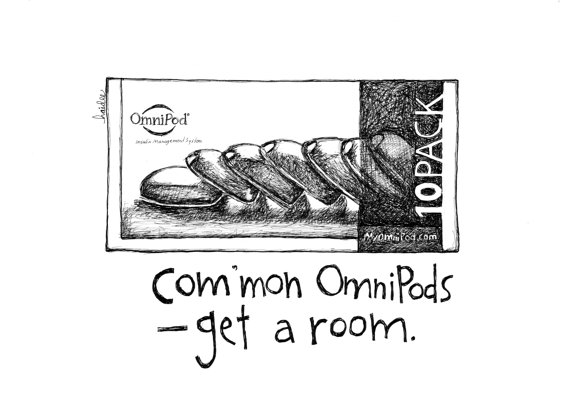
Omnipods

The other day I was browsing the wonderful cartoons of Haidee Merritt. Haidee contributed a number of her cartoons to my book, Diabetes Do’s & How To’s, and has often and generously sent me more for fun. We had a great time working together, she type 1 from the age of 2, me 18.

So, I was thinking why should I be the only one to have all the fun? Here’s a joyful look at some of Haidee’s published and unpublished cartoons. Enjoy.

2birds

Walk-a-thons

Of course, for more fab cartoons you can go to Haidee’s website and purchase her book, or get mine. Better yet, get both!

ADA 74th Scientific Conference

Unknown

The American Diabetes Association just held it’s 74th annual conferencein San Francisco.

16,000 medical professionals, patients, exhibitors and trade people attended. Of course I would have made 16, 001 but I was in Phoenix attending my peer-mentor annual conference, the A1C Champions.

So, while I wasn’t in San Fran, I’ve been following the research, science and encouraging shift highlighting patient voices posted on various web sites. 

Here’s are three if you want to catch up along with me:

Healio Endocrinology

Medscape

Diabetes Mine