What Yahya saw as a boy that pushed him to become a diabetologist

Above Yahya Ur Rehman, final year MBBS student at Liaquat University of Medical and Health Sciences in Pakistan

Yahya wrote to me to share his story and I want to share it with you, below. It’s unique in that this young man, at only twelve years old, not only saw his future, but saw how lacking diabetes treatment is in education and connection.

“In 2013, at age of 12, my life took an unexpected turn. I was diagnosed with type 1 diabetes. The news was overwhelming, but my frequent visits to the diabetologist soon became a part of my routine. It was during one of these visits that I witnessed something that would forever change the course of my life.

A young boy, no older than five, sat in the waiting room with his father. The father was a farmer, appearing bewildered as the doctor explained his son’s condition. The doctor prescribed insulin, but it was clear that the father had no understanding of what diabetes entailed or how to manage it. There was no mention of the importance of carrying sweet products to counteract hypoglycemia or the dangers of hyperglycemia. It struck me that counseling was just as crucial as the prescription itself.

Watching this interaction, I realized the significant gap in healthcare education for people from underprivileged backgrounds. At that moment, I decided that I wanted to make a difference. I resolved to pursue a career in the medical field, driven by a desire to bridge this gap and provide comprehensive care and education to patients.

Determined and focused, I poured my heart into my studies. Six years of relentless hard work paid off when I was accepted into the MBBS program at

Liaquat University of Medical and Health Sciences on merit in 2019. It was a proud moment, but I knew the journey ahead would not be easy.

One day, during my clinical rotations, I encountered a patient who reminded me of the young boy I had seen years ago. This patient, too, was from a rural area and had little understanding of his condition. I took the time to explain everything in detail, ensuring he understood how to manage his diabetes. The gratitude in his eyes was a profound moment of human connection that reaffirmed my purpose.

As I progressed through my medical education, I became increasingly involved in patient counseling during my clinical rotations. I found immense satisfaction in taking the time to educate patients about their conditions, management strategies, and the importance of lifestyle modifications. This hands-on experience deepened my understanding of the challenges faced by individuals with diabetes, especially those from underserved communities.

Throughout my journey, I learned invaluable lessons on the frontlines of healthcare. I discovered the importance of empathy, patience, and the power of education. I also witnessed the transformative potential of innovative treatments and breakthroughs in diabetes management. For instance, I learned about continuous glucose monitors and insulins, which have revolutionized diabetes care and improved the quality of life for many patients.

These experiences reinforced my aspiration to become a diabetologist. I wanted to dedicate my career to helping people manage their diabetes through both medical treatment and comprehensive counseling. I believed that empowering patients with knowledge about their condition was crucial for effective management and better outcomes.

Today, as a final-year MBBS student, I am more committed than ever to this goal. I actively participate in counseling sessions during my clinical rotations, focusing on educating patients about diabetes management, dietary habits, and the importance of regular exercise. I emphasize the significance of understanding the symptoms of hypo- and hyperglycemia and the steps to take in each scenario. Additionally, I encourage patients to maintain open communication with their healthcare providers and to never hesitate to ask questions or seek clarification.

My journey has not been without challenges. Balancing the demands of medical school with my commitment to patient counseling has required meticulous time management and unwavering dedication. However, the rewards have been immeasurable. Every person I help, every life I touch, reinforces my belief in the path I have chosen.

Looking back, my own diagnosis of type 1 diabetes was a life-changing encounter that set me on a path to help others navigate their own health challenges with knowledge and confidence. It has been a journey of personal growth, professional development, and profound human connections. I am grateful for the opportunity to make a difference in the lives of others and to contribute to the field of diabetes care.

As I prepare to complete my medical education and embark on my career as a diabetologist, I remain committed to my mission. I strive to provide not only medical treatment but also the necessary welfare and counseling to my patients. My goal is to ensure that no one leaves my office feeling as lost and confused as that farmer did years ago. I am dedicated to bridging the gap in healthcare education and empowering my patients to take control of their health.

In the years to come, I hope to continue learning and growing as a healthcare professional. I aim to stay abreast of the latest advancements in diabetes care and to integrate innovative treatments into my practice. Most importantly, I aspire to be a source of support, guidance, and inspiration for my patients, helping them lead healthier, more fulfilling lives.”

Change ‘the frame’ to make diabetes a little easier

Just returned from a day at Camp Nejeda in New Jersey presenting ways to better handle our diabetes ‘demons’. This one was captured by my old friend, and amazing advocate, Ginger Vieira, pictured above.

https://www.linkedin.com/feed/update/urn:li:activity:7202768879683534849/

Camp Nejeda runs two weekends a year for adults with type 1. I’ll be back in September with the husband as we talk together about spousal diabetes and all that comes with it. Meet us there if you can and bring your partner.

Forgive the rage bolus, so cunning, so calculating, so primed to take us down

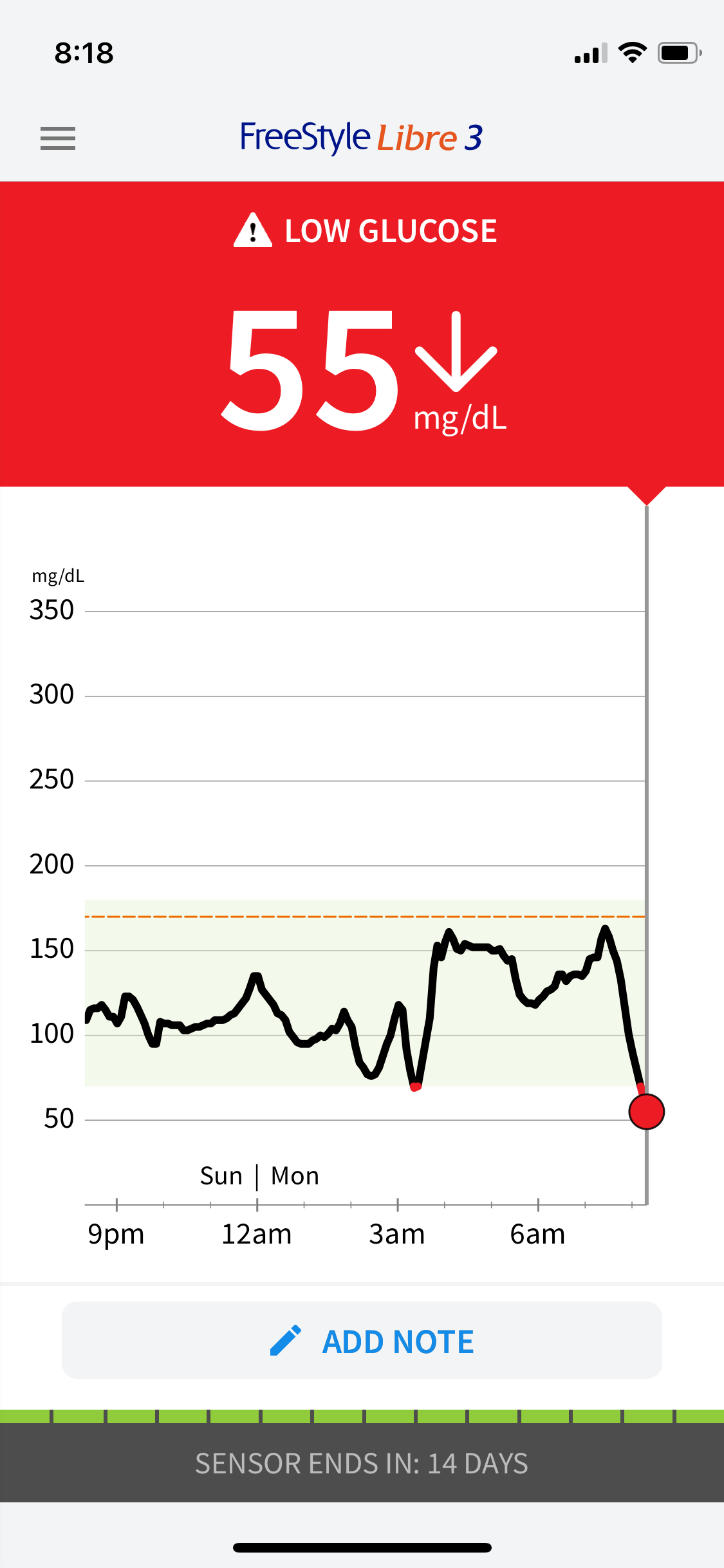
So what the heck is that above? At 4 am I appear to be 170 mg/dl. I was 173 mg/dl when I checked upon waking and 166 mg/dl when I checked on my meter. I checked because this is unusual for me and I just put this sensor on yesterday, and we know they can go wacky in the first 24 hours. Yet, that it was not.

Since I typically need 2 units when I wake up a little high, let’s say 130 mg/dl – one for the Dawn Effect and 1 for my coffee. – my fingers skipped my rationale calculating mind and pushed the plunger down on 3 units. After all, I was 170!

An hour later I paid for my impulsivity. 55 mg/dl (also confirmed on my meter) was the bottom only because I finally ate a teaspoon of honey and 1 jelly bean. FYI I hate to eat for no other reason than I have to, so I usually wait it out like a Tiger Mom watching how far and fast my numbers go up and down.

I think unfortunately the rage bolus is here to stay. It’s just the expression of human emotion. We want to rectify a troubling situation FAST. Even I, who generally follows Dr. Richard Bernstein’s “law of small numbers” (google it for the short explanation) gets sucked in when my emotions override my better thinking; but of course I can blame it on neurobiology saying my perhaps to say it’s really not my fault at all as it’s my amygdala gets hijacked and I just go along.

Then, the only thing you can do, the only route back to sanity is self-forgiveness. Luckily today I had the fortitude to bestow that gift upon myself. I wish you the same.

Diabetes Sisters brings outstanding peer & professional support to women with diabetes

Diabetes Sisters has a new look – and a forward looking agenda. They are working to be THE support organization for women and their health, and they’re well on their way.

The photo above documents their offerings. Among them are weekly virtual meet-ups. While a few years ago the groups were run locally face to face, the pandemic brought the groups online where they have stayed. The advantage is now you can attend any group, anywhere, and as many as you like.

I’ve been doing a lot of work with the leads of Diabetes Sisters, Donna Rice, Michele Polz, Shelby Kinnaird and Kristy Farnoly since last November when I wrote an article in their December newsletter that we can’t control blood sugar. I can vouch that these women’s concern is you. To bring you everything in their power to help you thrive.

I can also vouch that flourishing with diabetes lies very much at the foundation of Diabetes Sisters’ new platform. There are regular expert talks on issues that affect women’s health. Some are given by medical experts, others by patient experts. And I kicked off the Expert Series last month with a webinar on flourishing with diabetes.

May 29th I’ll be showcasing live guest Amy Jordan and her amazing triumphal story. Amy lives with type 1 diabetes, blindness, a damaged leg due to being hit by a New York City bus. Yet, she still leads a dance company, her lifelong passion, and has never stopped taking giant-sized bites out of life, with a sense of humor. You can watch Amy’s documentary, Amy’s Victory Dance, and I strongly suggest that you do. Then join us on the 29th for the conversation.

While the organization has put on a new face, much hasn’t changed. Founded by Brandy Barnes in 2008, and then run by her successor, Anna Norton, and including the women who have run the meet-up groups over the past years, everyone has held the same desire – to help women with diabetes not feel alone, not be alone and live their best life.

There’s a lot going on and there’s a warm community waiting for you with open arms.

Diabetes Sisters for outstanding professional & peer support for women with diabetes

Diabetes Sisters has a new look – and a forward looking agenda. They are working to be THE support organization for women and their health, and they’re well on their way.

The photo above documents their offerings. Among them are weekly virtual meet-ups. While a few years ago the groups were run locally face to face, the pandemic brought the groups online where they have stayed. The advantage is now you can attend any group, anywhere, and as many as you like.

I’ve been doing a lot of work with the leads of Diabetes Sisters, Donna Rice, Michele Polz, Shelby Kinnaird and Kristy Farnoly since last November when I wrote an article in their December newsletter that we can’t control blood sugar. I can vouch that these women’s concern is you. To bring you everything in their power to help you thrive.

I can also vouch that flourishing with diabetes lies very much at the foundation of Diabetes Sisters’ new platform. There are regular expert series on issues that affect women’s health. Some are given by medical experts, others by patient experts.

I delivered a webinar last month on flourishing with diabetes and May 29th I’ll be showcasing live guest Amy Jordan and her amazing triumphal story. Amy lives with type 1 diabetes, blindness, a damaged leg due to being hit by a New York City bus, and she leads a dance company, her lifelong passion, and has never stopped taking giant-sized bites out of life. You can watch her documentary, Amy’s Victory Dance, and I strongly suggest that you do. Then join us on the 29th for the conversation.

While the organization has put on a new face, much hasn’t changed. Founded by Brandy Barnes in 2008, and then run by her successor, Anna Norton, and including the women who have run the meet-up groups over the past years, everyone has held the same desire, to help women with diabetes not feel alone, not be alone and live their best life.

There’s a lot going on and there’s a warm community waiting with open arms. Come take a look, I’m sure you’ll find something of interest.

How to deal with Levemir being taken off the market

Admittedly I’ve never used Levemir, a basal insulin from Novo Nordisk. I used Lantus for a long time and now use Tresiba, which frankly I love. Flat profile, once a day, just works for me. That said, maybe it’s never been truer than when a medication goes away, YDMV — Your Diabetes May Vary. What works for one may not work so well for another.

I wanted to post this article from diaTribe today, “Switching Away From Levemir: What Are the Options?” for those who use Levemir. I can imagine your distress. It’s ridiculous, potentially harmful and uncaring for pharmaceutical companies to always let their bottom line weight more heavily than their morality.

That said, as the old Chinese fable of the farmer tells us, some who will switch from Levemir to something else will actually find a benefit in having to do so. No matter which camp you fall into, I wish you well.

Diabetes treatment is not set up for flourishing. But you can.

Join me for an utterly conversational, yet paradigm shifting talk below. I had the pleasure to kick off Diabetes Sisters‘ Lifestyle Webinar series with a half hour look at flourishing with diabetes.

You’ll learn how our treatment approach for people living with diabetes evolved. How it’s aimed at coping rather than flourishing. Why you can’t control your blood sugar. What you can do instead to better manage your numbers. And why you’re responsible for your effort, but not your outcome.

If you live with diabetes it’s time you took yourself off the hook. If you’re a health professional, you’ll see you need never put your patients on one.

“I just thought your presentation was absolutely wonderful, and I think everybody, everywhere, needs to watch it. Not just PWD, but family members and medical professionals. Your insights give a wonderful and positive perspective on something that’s a serious topic.” Anne Dalin, Type 2

To find out why controlling blood sugar is a myth, check out my recent articles in Diabetes Sisters’ newsletter and diaTribe.

Mini glucagon dosing coming

Drs Edelman and Pettus share important information about glucagon from its early days up to the much easier remedies that came out a few years ago. What’s exciting for me is at the end, hopeful news about glucagon mini dosing so you don’t have to eat everything in the fridge when you have a low.

10 nutrition myths debunked by experts

This article ran in today’s New York Times, “10 Nutrition Myths Experts Wish Would Die.” If you have access to the Times, you can see the full article. For those who don’t I thought I’d do a brief summary.

Myth No. 1: Fresh fruits and vegetables are always healthier than canned, frozen or dried varieties.

Non fresh can be just as nutritious, sometimes better if fresh isn’t so fresh. One caveat: they can contain added sugars, saturated fats and sodium so read the label.

Myth No. 2: All fat is bad.

This myth was published in the 1940s when experts found a correlation between high fat diets and high cholesterol. In the 1980s everyone reported a low fat diet could benefit everyone even though there was no solid evidence. Food manufacturers replaced fat with sugar, remember SnackWell’s? (I do!). Now the experts say while saturated and trans fats (red meat, cheese) can increase your risk for heart disease, monounsaturated fats (nuts, fish, flaxseed, avocados) can decrease it. Don’t assume “fat free” means healthy.

Myth No. 3: ‘Calories in, calories out’ is the most important factor for long-term weight gain.

Yes and no. Follow the above and you will lose weight for the short term, but not the long term. Stay away from refined carbs (cereal, starchy snacks, crackers, baked goods, soda) they digest quickly, raise your blood sugar and turn into fat in the body. Eat healthy overall, quality over quantity.

Myth No. 4: People with Type 2 diabetes shouldn’t eat fruit.

Everyone benefits from the nutrients in fruit — fiber, vitamins, antioxidants. Even people with diabetes. Always choose fruit over fruit juice.

Myth No. 5: Plant milk is healthier than dairy milk.

Not true. Cow’s milk has more protein. (Still, personally, while I do put light cream or half n’ half in my coffee, I drink almond milk for the lesser carbs.)

Myth No. 6: White potatoes are bad for you.

Yes, they can spike your blood sugar, but they are rick in vitamin C, potassium and fiber, especially consumed with the skin.

Myth No. 7: You should never feed peanut products to your children within their first few years of life.

Surprise! Experts say it’s best to introduce kids to peanut products early on – unless your baby has eczema. Also feed baby a diverse diet the first year to prevent food allergies.

Myth No. 8: The protein in plants is incomplete.

All plants contain all the amino acids necessary for building protein. But to a greater or lesser degree. So eat a variety of plant based foods every day. Most Americans get more protein than they realize or need.

Myth No. 9: Eating soy-based foods can increase the risk of breast cancer.

While isoflavones found in soy stimulate breast cancer in animal studies, it’s not been verified in humans. So for now, scientists are not linking the two. Instead, soy products may be protective toward breast cancer.

Myth No. 10: Fundamental nutrition advice keeps changing — a lot.

Dr. Marion Nestle, food guru and professor of nutrition, points out that in the 1950s people were advised to stay away from saturated fat, high sugar and salt products, and that hasn’t changed. Author Michael Pollan says in his book Food Rules (which I loved) “Eat food. Not too much. Mostly plants” and Nestle agrees.