Blood sugar has a mind of its own

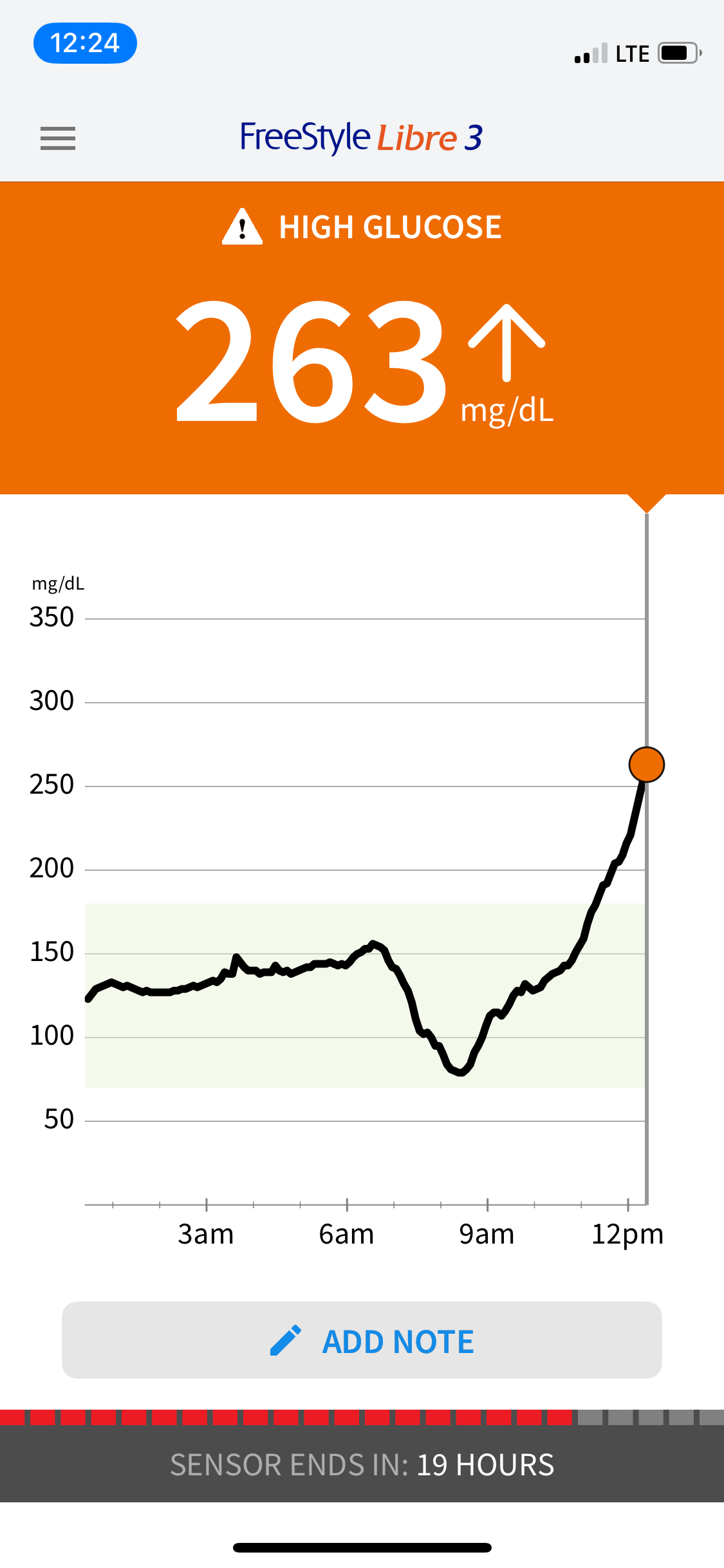
One of the things that has the most value for me managing my blood sugar is routine. Like the Virgo I am, I tend to eat the same type of foods, amount, carbs, often the same foods every day — and no I don’t feel deprived. I also tend to exercise similarly day to day. What you see above was me stepping off my routine track and while gleefully wanting to shout, “look ma, no hands!” I took a giant splat, or spike and spill, spike and spill…

The 150 mg/dl around 7 am was just the damn Dawn Effect, and it started before I even awoke. That sometimes happens, other times it waits for me to at least put a foot on the floor from my bed.

But the afternoon spike and spill was walking to a cafe I wanted to try that gets rave reviews for amazing griddle oatmeal pancakes. Now, I next to never eat pancakes. Yes, my low carb lifestyle is my second most effective agent to manage my blood sugar. But today was a gorgeous near 80F, sunny day, perfect for a long walk and an adventure. So I set off for these boasted pancakes, and to indulge in a treat.

When I arrived at the cafe my sensor reported 59 mg/dl, so I watched it and didn’t bolus until I’d finished my meal. I sat on a bench and noticed it was now at 164 mg/dl. Again, I had a 40 minute walk home, so I took one unit leaning toward small errors, small misfortunes. However, the trickery of how many carbs were in those pancakes? Who knows. What would be the effect of the 40 minute walk home? Who knows. How many units of insulin did I really need having waited to inject until after I ate? Who knows?

You know, and I know you know, there’s no rest for the weary.

So I’m happily ready to get back on my routine horse, until a beautiful day, and an impetuous mood, calls me out, very likely to once again get my free ride on this roller coaster.

What a day.

Gary Scheiner and I agree you can’t control blood sugar

Yesterday I was a guest on Gary’s podcast, ‘Think like a pancreas.’ If you don’t know, Gary is a former Diabetes Educator of The Year and founded, Integrated Diabetes Services, his clinic outside of Philadelphia that is type 1 focused. He and his type 1 staff work both on site and remote.

Our podcast talk centered around the myth that you can control your blood sugar and diabetes. I will post it when I get the recording. Meanwhile, I had to laugh when I woke up this morning and looked at my CGM (above). Really…at 6 am, while I was still asleep, my blood sugar starting rising to 150. How the heck was I supposed to control that? The subsequent rise at 9 am, when I got up and started moving, was the Dawn Effect. Another thing I can’t control.

We’ve got to break this myth that you can control blood sugar. It’s insidious and harmful. If you missed it, you can read what I wrote about the topic on diatribe, ‘Why Controlling Blood Sugar Shouldn’t Be the Goal.’

Pre surgical procedure my blood sugar was “abnormal”

I had hand surgery on Monday. At noon, after not eating since 8 pm the night before, after managing the dawn effect upon waking, after judging how much insulin I could take without going low because I couldn’t eat or drink pre-surgery yet I had to walk to the subway and from the subway to the hospital, at noon my blood sugar was 107 mg/dl.

For anyone who understands type 1 diabetes 107 is celebratory, yet for a medical institution that spits out clinical data, it is abnormal because it is about 99 mg/dl. That’s data without context. That’s data without human eyes, without stories, without relationship. That’s sad and disappointing and shades of the future for healthcare, already “care” slipping away.

Dr. Richard Bernstein lived 78 years with type 1 diabetes

Dr. Bernstein died April 15th at the age of 90. He got type 1 when he was 12, yes, that’s 78 years living with type 1. He’s a special person in my life. Maybe two decades ago I was asked to tape a segment for dLife, a diabetes TV show that ran from 2005 to 2013, at his office in Mamaroneck, NY. The segment was on gastroparesis. To my amazement I discovered I had it, well, he told me, “Almost everyone with type 1 has some amount of gastroparesis.” He thought mine was about 15%.

He’s also a special person to me because reading his book, The Diabetes Solution, caused me to vacuum refined carbs out of my diet. It changed my life with diabetes. It dropped my weight, and my insulin requirement halved. A low carb diet, which I’ve since never wavered from, also makes my blood sugar much easier to manage.

He was also a special person to me because he helped get glucose meters into the hands of people with diabetes. His wife, a nurse, used one in the hospital before any of the larger population had access. With this awareness, he got one for himself and subsequently for all of us. And he’s done so much to help people with type 1 understand their own condition.

I found this article in the UK news, “Diabetes pioneer Dr Richard Bernstein passes away at age of 90”, which is a nice overview of Dr. Bernstein’s life and his impact.

You will be missed.

World Adherence Day says you are a machine

I’m late to this apparently new day we have now every year, March 27th, called World Adherence Day. And I’m fuming. Started by the World Heart Foundation and supported by the International Diabetes Federation, I find it malicious that healthcare executives from these organizations support adherence – push over pull, hierarchy over collaboration, and medical language over lay language. This poster’s headline announces not just an oxymoron, but these two organizations’ ignorance.

How can ‘adherence’ be a partnership? When I looked up the definition of adherence this is what I got – “In healthcare, “adherence” refers to a patient’s willingness and ability to follow a prescribed treatment plan, including taking medications, attending appointments, and making lifestyle changes as recommended by their healthcare provider.” How can ‘following’ and ‘as recommended by’ be a partnership?

Adherence, for a “patient”, means following a treatment plan created by a clinician. It is absent of partnership, collaboration, choice, context, the complexity of what life throws at us, the complexity of our condition, and our own human foibles managing everyday life and our condition.

Similarly the IDF’s campaign states, “The campaign aims to highlight the importance of following prescribed healthcare plans to manage chronic conditions like diabetes and cardiovascular diseases.” Yes, the bold and underlining is my doing.

Not only is ignorance highlighted in this campaign, but arrogance. Long has the diabetes #languagematters movement shared the words, concepts and behavior offensive and detrimental to people with diabetes’ management. “The Use of Language in Diabetes Care and Education” published in Diabetes Care in December 2017 is explanatory and comprehensive. Have we learned nothing? Yes, we have learned nothing. Below an excerpt from the article:

When will we learn that machine, left-brain hemispheric thinking that values – push, grab, overpower, precision, perfection, narrow focus, heart-less – does not inspire people, emotive beings, to do their best? When will we understand that with all our medicine, treatment plans and glorious devices at our fingertips – hardware and software – it is “heartware,” – connection, compassion, support and safety – always that inspires people to do their best?

Today’s state of industrialized healthcare cannot help but follow its own heavily laden, structured and systemic paradigms and procedures. Such structures are part of the reason the world is in the state it is in today: a narrow focus on getting, grabbing, dehumanizing, power, dominance over.

But things will not change until people reclaim what it means to be human. In healthcare, until health professionals work with their patients with respect, dignity, collaboration and understanding that words like ‘adherence’ imply mechanistic cause and effect, and that anything less than desired is the patient’s fault. And the world will change only when we all treat each other similarly and understand the same.


Controlling blood sugar is not the goal

Reading a recent issue of diaTribe I came across this article I wrote for them recently, “Why Controlling Blood Sugar Shouldn’t Be the Goal.” It’s still one of the most important truisms in managing diabetes, yet you’ll hardly ever hear it. I want you to understand how “control” is impossible and sets us up for failure, while influencing our blood sugar, and navigating it, will have you in your target range longer and more often.

Sweet, nutritious snacks with small impact on blood sugar

I was sent the four snacks below by Ben’s Natural Health. They all look delicious and won’t spike your blood sugar, so I highly recommend giving them a try. Below them I share my favorite recent slow-rise sandwich.

  1. Grapes with Cheese

Because cheese has a lot of fat and protein, pairing it with any sugary food will slow the rise of your blood sugar. You can use grapes, peaches, cherries, pretty much whatever fruit you like. Remember, dried fruits like prunes and raisins are packed with more sugar than fresh fruit. If you’re using canned fruit, buy it packed in water, or if you can’t, rinse off the sweetened water it comes in.

2. Greek Yogurt with Cacao Nibs, Chia and Berries

“Greek yogurt is a fantastic base for a blood sugar-friendly treat,” says Oscar Scheiner from Ben’s Natural Health, “Adding cacao nibs for antioxidants, chia seeds for fiber, and berries for a natural sweetness creates a perfect combination for stabilizing blood sugar. ” A study published in Diabetes Care found that fiber-rich additions like chia seeds can reduce glucose spikes by up to 39%. Personally, I’d leave out the chocolate nibs and add fiber-rich nuts instead.

A variation of this recipe can be made with coconut and or almond milk instead of Greek yogurt and it’s called chia seed pudding. There are tons of recipes for chia seed pudding online so have a look around.

3. Apple Slices with Peanut Butter and Cinnamon

An oldie but goodie. Fiber and protein-rich peanut butter is filling and apples are the best way to keep doctors away, aren’t they? Just spread some peanut butter, or almond butter if you prefer, on a slice of apple and sprinkle with cinnamon. Altogether this will give you a really satisfying crunch, super smooth mouth sensation and gradual sugar rise.

4. Dark Chocolate with Almond Butter

Lucky for me dark chocolate has been shown to have more antioxidants than milk chocolate so enjoy it. Personally, 92% is my bliss point which I usually get by pairing a square of 85% with a square of 95 or 100%. The almond butter as you know now will slow down the sugar rise due to its protein and fat. The key here is quality chocolate. The flavor sensation is so rich, you don’t need more than a square or two.

Thank you for these ideas Ben’s Natural Health.

5. My new fave sandwich: Peanut butter and banana on multi-grain toast

If you’re my age you might remember this sandwich was enormously popular years ago when hippies ruled the earth. Somehow it seems to have slid out of fashion, but recently I made it for myself and I can’t stop. I rarely eat bread at home, but a friend, and fellow type 1, recommended Dave’s Killer Bread, so I bought the PowerSeed loaf. Several varieties also come in “thin.” I toast the bread and only use half a banana and slice it thinly. I lay it down on one toasted slice of bread and slather the other with peanut butter. It’s mildly sweet, and sensuous in your mouth, and while I do have to take 2.5 units to cover the seedy bread and banana, it’s a slow rise.

The T1D Self-Care Collective

About two years ago I met Mandy Jones. We had coffee at a local coffee shop in my Brooklyn neighborhood and talked for quite a while. She was searching for a way to bring unity, ease, and compassion to those of us who traverse each day through the rigor of living with diabetes, and help lessen feelings of aloneness.

Well, Mandy went on to get her degree in psychology and created her company called Sage Diabetes. I recently received this message about her initiative the T1D Self-Care Collective. As she says, it’s a place to have conversations, support others, gain support and build resilience.

If you’re interested, you can contact Mandy at mandy@sagediabetes.co for details. Maybe I’ll see you there.

Standing together: The men behind the women in diabetes

In this video below you’ll hear from three husbands who love and support their global-diabetes-advocate wife. One of those amazing advocates is Dawn Adams from Ireland. We met last year in Hamburg as part of the #dedoc entourage. Her lovely husband is Roger. Another advocate is Anita Sabidi from Indonesia. She and I run into each other at the International Diabetes Federation World Congress every two years or so. Her very supportive husband is Riotanto. Then there’s me and the husband, Boudewijn.

While there are a few twists and turns at the beginning of the video, stick with it, especially if you’re a partner to someone with type 1 diabetes. Or advance to 1:58 where the interview begins.

The interview was conducted by my friend, and Pen-Plus super advocate, Tino Dzikiti from Zimbabwe. Hats off to his going off-road to give us an up-close and personal look at those who stand by us: how they do it and what they think, as we three are lucky that this 24/7 condition has a man standing (or sitting) behind us.

The video: https://youtu.be/IRznFgkoCYQ?si=EKr6Y-Jfbsx2JqJ-