If you’re over 18 years old and use a CGM and insulin pump or smart pen, you may qualify for a study being conducted by Tidepool and DCB (Diabetes Center Berne). The aim is to discover how one’s menstrual cycle impacts glucose throughout the cycle.
The goal of the study is also to support the development of tools and products to help manage T1D during one’s menstrual cycle.
I’ve been saying this for quite a while, now I’m writing about it: You cannot control blood sugar or diabetes. Yes, you can manage it, influence it, navigate it, wrangle with it, bolus rage it, but you cannot “control” it. You cannot do x, y and z and get the precise number you want. There are a multitude of interacting factors why. If you’ve had diabetes long enough for the shock to wear off, I will go out on a limb and say you agree, as everyone does once I explain this. Surely you’d think after having type 1 for 51 years I’d know every trick to control it – geez, hasn’t happened yet.
It’s truly amazing that this falsehood has been told to us for decades, by our health professionals, the media, and now device companies. Is it wishful thinking? Our love of speaking in sound bites? Medical training for acute conditions that fails miserably for chronic conditions.
Whatever it is that causes us to repeat this myth, without scientific or anecdotal evidence, or much thought at all, causes people with diabetes to expect the impossible from themselves, and then feel bad, sad, frustrated, disappointed, angry, shamed, burned out you name it when they don’t ace it.
So steal away sometime today and have a read. The reward is immediate. And need I say, will be a gift that just keeps giving each and every day.
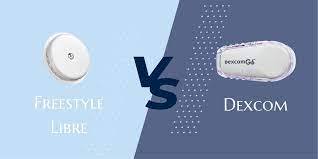
My friend Scott Strumello, probably the smartest diabetes advocate regarding tech, costs and insurance policies, sent me the heads up below regarding costs and coupons for Dexcom and Freestyle Libre CGMs. I’m passing it on to you with his permission.
From Scott: I have been (putting it nicely) perturbed by the fact that my own insurance company (Aetna’s PBM Caremark) is receiving legally-exempted rebate kickbacks contingent upon “formulary exclusion” for any CGM that is not DEXCOM brand, which basically means Abbott Freestyle Libre.
Dexcom, for its part, offers a manufacturer coupon save “enabling patients to ‘Save $200 per 30-day supply of sensors and an additional $200 on each 3-month transmitter’ to buy Dexcom sensors (and transmitters for the G6) which it distributes via GoodRx and on its website at https://www.dexcom.com/en-us/savings-center-cgm-without-insurance/ which is a valuable work-around for anyone with high-deductible insurance plans, are uninsured (or on Medicare, for that matter, you just cannot submit it as a Medicare claim to use the manufacturer coupon or reveal that you’re covered by Medicare, but technically, they are not legally entitled to know that anyway). But for anyone with commercial healthcare insurance, I was unaware of any such manufacturer coupon offered by Abbott for Libre.
Then, I discovered they do offer one (see https://www.freestyle.abbott/us-en/private-insurance.html for more) “If you are commercially insured and asked to pay over $75 for two sensors”. Patients must call Abbott’s Customer Care Team by telephone at 1-844-330-5535 (Available Monday to Friday from 8AM – 8PM ET) and ask for its eSavings voucher. Within 24 hours, Abbott will email the patient a voucher.
That seemed to be comparable to Dexcom’s coupon offer. For example, the retail price for a box of 2 Libre 3 sensors was $118.51 at Costco Pharmacy. On a per-sensor basis, that reduces the cost from $59.26 per sensor to just $37.50 each. But it also offers patients a choice which they might not have had available before.
A woman was wearing this shirt today in my gym class. She told me she bought it on Confidence Apparel. I wasn’t thinking particularly of diabetes when I read her T-shirt, but I was thinking we should honor the hard work we do each and every day, regardless of the outcomes we get. We live with a second job, 24/7. Few people see it, and we ourselves don’t readily admit to how much weight we carry, thinking we need to be strong and ever-resilient.
So take a few moments right now. Recognize all that you do to keep yourself as safe and healthy as you can. Recognize you are all the things listed on this T-shirt. Take it in and treat yourself with the kindness and love you extend to others.
Perhaps I’m particularly feeling this way today because my blood sugar was up and down all day long to extremes that left me exhausted. It isn’t an often occurrence, but it happens. It’s part of this condition we live with. And when it happens we deserve to move gently and allow ourselves to just fold into it. After all, tomorrow is another day.
“Why Doctors and Pharmacists Are in Revolt” appeared in yesterday’s New York Times written by Noam Scheiber. If you subscribe to the Times, read it. If not, I’ve pulled out a few highlights below, but I cannot do it justice because the piece is long and multi-layered.
The overall message, as you can imagine, is due to recent mergers of chain drugstores and clinics, the exodus of health professionals during and post covid, the focus of profit over care, managers who are business executives, not medical professionals, care is becoming ever more bled out of the system and the system is ever more standardized.
Health professionals are increasingly overworked and have less access to resources and staff. Those at the top are seen, and treated, as efficiency managers. Those under them, cogs in a wheel. As a result, patients get less time with their docs and pharmacists, less personal attention, health providers who are exhausted, and increasingly are recipients of policies that are profit, rather than care, based.
I know this is not a new story. If you follow our industrialized medical system and the plight of health professionals, as I do, you’ve been reading about this over the past several years. Somehow, however, this article really struck a nerve. Perhaps it’s the fact that health professionals now feel the need to unionize – no longer given the respect of their years of education and training, they are seen as ‘Human Resources.’ That title invented by management in business years ago. The irony of people being resources, while you’re trying to say that you respect people, is thick.
Dr. John Wust, an obstetrician-gynecologist featured in the article talks of how little input doctors are given regarding the practices designed for and around them by health corporations. Once he could have never dreamed of being in a union but now he feels it’s his only recourse.
Both CVS and Walgreens say they have made significant investments in their workers’ staffing needs. But as Scheiber writes, “A longer-term consolidation of health care companies has left workers feeling powerless in big bureaucracies. They say the trend has left them with little room to exercise their professional judgment.” Professionals feel micromanaged and everything has become about the metrics.
Pharmacists described being held to measures as to how quickly they answer the phone and how many scripts they fill for 90 over 30 and 60 day prescriptions as the 90 day fills mean more profit. One cited pharmacist gave up his position as district manager to become a frontline pharmacist again. He couldn’t inflict on others what he saw as unconscionable, including weekly calls when a budget for tech hours exceeded by 10, nothing much, but a warning call its required.
I will close with this quote, “Corporate tells you how to manage your patient,” said Dr. Frances Quee, president of the Doctors Council, which represents about 3,000 doctors, most of them at public hospitals. “You know that’s not how you’re supposed to manage your patient, but you can’t say anything because you’re scared you’re going to be fired.”
What world have we created? Why is money almost always more important than how we treat each other, the planet, the other species that live here?
I have no answers. I just wish more people were asking and asking more fervently. I think at some point this movement by health professionals will cause a change I hope so because it frankly scares me to see so blatantly, so openly and so glaringly the profitization of healthcare, the thing we will all be relying on more and more as we age.
I was a very happy user of the Dexcom G5 and G6 CGM. If you read anything here you likely know I’m not a fan of the G7 – too many lost signals and that atrocious overpatch. So several weeks ago I switched to Abbott’s Libre 3 and frankly it’s working pretty great so far. Yes, there’s an occasional lost signal, but far, far, far fewer, it’s just as accurate for me as Dexcom, so tiny that I forget I’m wearing it, and it uses the smallest amount of adhesive that’s also the strongest. It stays on throughout the entire 14 day wear.
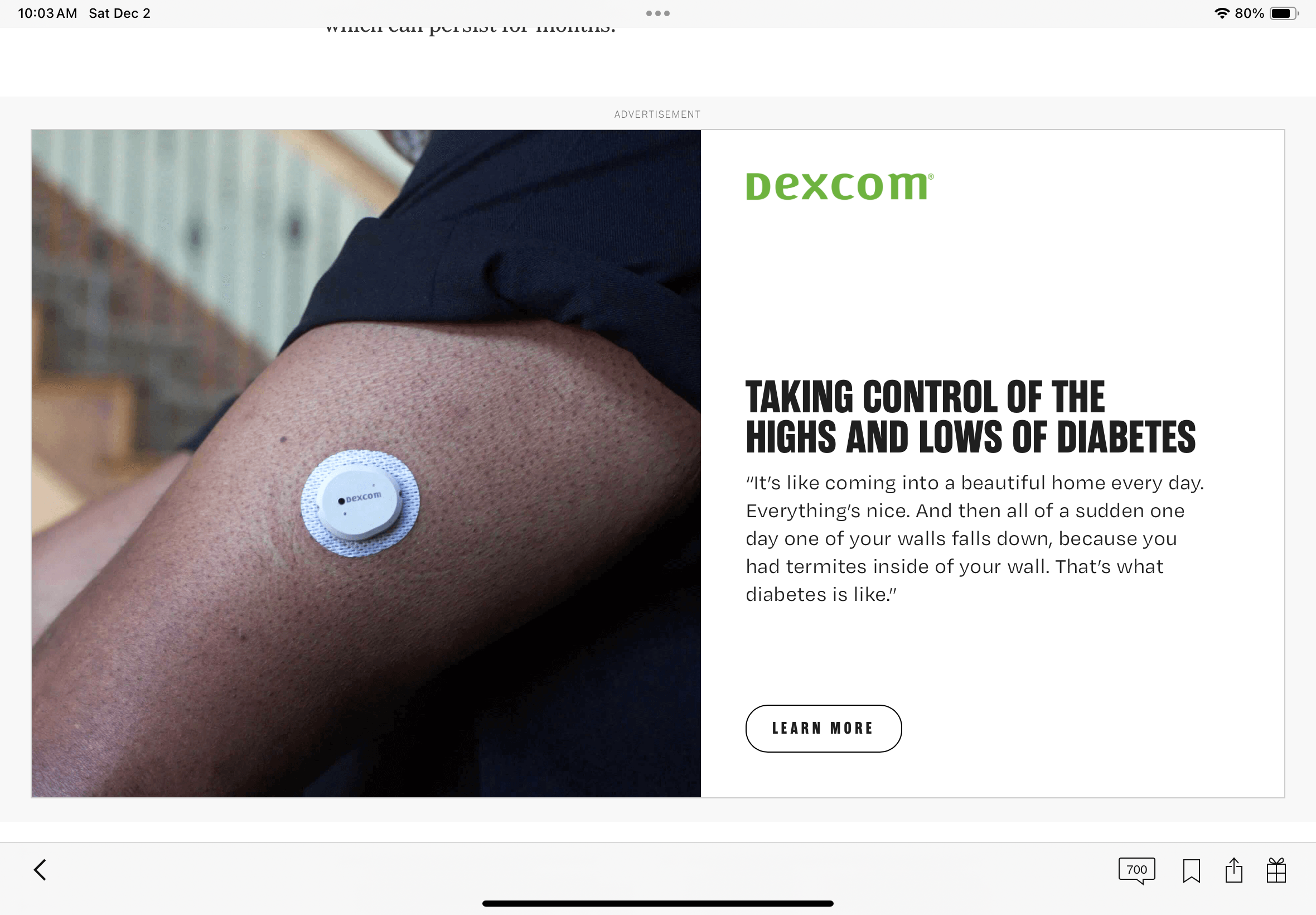
However, while I think the CGM is the best thing to have happened to diabetes after the discovery of insulin, it does not, in any way, shape or form, control it. Or allow you to control it as the ad above indicates. What it does do is expand your ability to influence and navigate, aka manage, your blood sugar: nothing “controls” blood sugar or diabetes because it cannot be controlled.
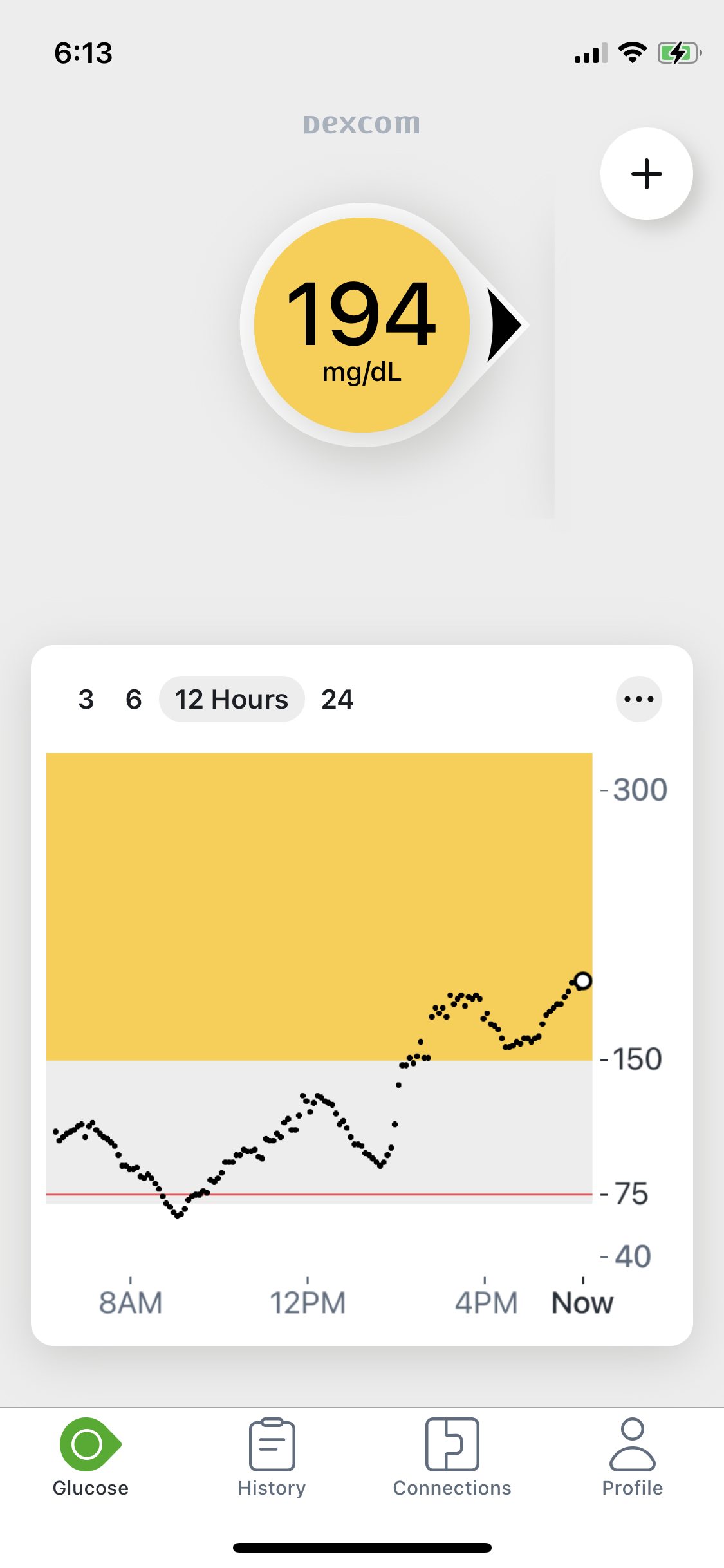
Thinking we can control blood sugar and our diabetes takes the view that the human body – you – are a machine. As in you can do this and that will happen, precisely. As if I could get a blood sugar of 168 mg/dl down to 100 mg/dl exactly and in a certain time period. As if I could prevent toppling over 140 mg/dl by eating low carb and exercising, which I do, yet I’ve seen my fair share of highs and will continue to.
As a human, with multiple metabolic functions interacting and influencing blood sugar, and as I, and you, daily interact with our often unpredictable world, control is just not possible. So why do we keep telling people to take control as Dexcom assures us you can do with their CGM? I’ve recently written about this in further detail and will post the article here when published.
Meanwhile I’m glad to know “control” has been singled out for phasing out in the #languagematters movement. It’s time we get earnest about it and not continue to set people up for failure giving them the impossible goal of control.



 Diabetes Stories